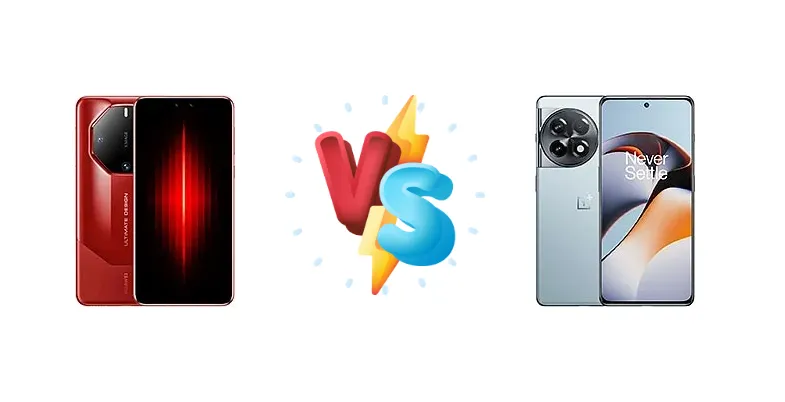
The Huawei Mate 60 RS Ultimate represents a return to form for Huawei's flagship ambitions, powered by its domestically produced Kirin 9000S chipset. This contrasts sharply with the OnePlus 11R, a value-focused flagship utilizing the established Qualcomm Snapdragon 8+ Gen 1. This comparison dissects these two devices, focusing on where their architectural differences translate into real-world user experience.
🏆 Quick Verdict
For the average user prioritizing raw performance and value, the OnePlus 11R emerges as the stronger choice. Its Snapdragon 8+ Gen 1, built on a more efficient 4nm process, delivers comparable, and often superior, performance with less thermal throttling, all at a significantly lower price point. However, the Mate 60 RS Ultimate’s unique design and advanced charging capabilities appeal to a niche audience.
| Network |
|---|
| 2G bands | GSM 850 / 900 / 1800 / 1900 | GSM 850 / 900 / 1800 / 1900 |
| 3G bands | HSDPA 800 / 850 / 900 / 1700(AWS) / 1900 / 2100 | HSDPA 850 / 900 / 1700(AWS) / 2100 |
| 4G bands | LTE | 1, 3, 4, 5, 8, 28, 34, 38, 39, 40, 41 |
| 5G bands | SA/NSA | 1, 3, 5, 8, 28, 40, 41, 77, 78 SA/NSA |
| Speed | HSPA, LTE, 5G | HSPA, LTE (3CA), 5G |
| Technology | GSM / CDMA / HSPA / CDMA2000 / LTE / 5G | GSM / CDMA / HSPA / LTE / 5G |
| | - | CDMA 800 |
| Launch |
|---|
| Announced | 2023, September 25 | 2023, February 07 |
| Status | Available. Released 2023, September 28 | Available. Released 2023, February 21 |
| Body |
|---|
| Build | - | Glass front, glass back (Gorilla Glass 5), plastic frame |
| Dimensions | 163.7 x 79 x 8.1 mm (6.44 x 3.11 x 0.32 in) | 163.4 x 74.3 x 8.7 mm (6.43 x 2.93 x 0.34 in) |
| SIM | Nano-SIM + Nano-SIM | Nano-SIM + Nano-SIM |
| Weight | 242 g or 246 g (8.54 oz) | 204 g (7.20 oz) |
| Display |
|---|
| Protection | Huawei Kunlun Glass 2 | - |
| Resolution | 1260 x 2720 pixels, 19.5:9 ratio (~440 ppi density) | 1240 x 2772 pixels, 20:9 ratio (~451 ppi density) |
| Size | 6.82 inches, 114.4 cm2 (~88.5% screen-to-body ratio) | 6.74 inches, 109.2 cm2 (~90.0% screen-to-body ratio) |
| Type | LTPO OLED, 1B colors, 120Hz | Fluid AMOLED, 1B colors, 120Hz, HDR10+, 1450 nits (peak) |
| Platform |
|---|
| CPU | Octa-core (1x2.62 GHz Taishan Big & 3x2.15 GHz Taishan Mid & 4x1.53GHz Cortex-A510) | Octa-core (1x3.0 GHz Cortex-X2 & 3x2.5 GHz Cortex-A710 & 4x1.80 GHz Cortex-A510) |
| Chipset | Kirin 9000S (7 nm) | Qualcomm SM8475 Snapdragon 8+ Gen 1 (4 nm) |
| GPU | Maleoon 910 MP4 | Adreno 730 |
| OS | HarmonyOS 4.0 (China) | Android 13, upgradable to Android 15, OxygenOS 15 |
| Memory |
|---|
| Card slot | Nano Memory (uses shared SIM slot) | No |
| Internal | 512GB 16GB RAM, 1TB 16GB RAM | 128GB 8GB RAM, 256GB 16GB RAM, 512GB 18GB RAM |
| | - | UFS 3.1 |
| Main Camera |
|---|
| Features | Laser AF, color spectrum sensor, LED flash, panorama, HDR | Color spectrum sensor, LED flash, HDR, panorama |
| Single | - | 16 MP, f/2.4, 24mm (wide), 1/3.09", 1.0µm |
| Triple | 48 MP, f/1.4-f/4.0, 24mm (wide), PDAF, OIS
48 MP, f/3.0, 90mm (periscope telephoto), PDAF, OIS, 3.5x optical zoom
40 MP, f/2.2, 13mm, 120˚ (ultrawide), PDAF | 50 MP, f/1.8, 24mm (wide), 1/1.56", 1.0µm, multi-directional PDAF, OIS
8 MP, f/2.2, 120˚ (ultrawide), 1/4.0", 1.12µm
2 MP (macro) |
| Video | 4K@30/60fps, 1080p@30/60/120/240/480fps, 720p@960fps, 720p@3840fps, HDR Vivid, gyro-EIS | 4K@30/60fps, 1080p@30/60/240fps, gyro-EIS |
| Selfie camera |
|---|
| Features | HDR, panorama | HDR |
| Single | 13 MP, f/2.4, 18mm (ultrawide)
TOF 3D, (depth/biometrics sensor) | 16 MP, f/2.4, 24mm (wide), 1/3.09", 1.0µm |
| Video | 4K@30/60fps, 1080p@30/60/240fps, HDR Vivid | 1080p@30fps |
| Sound |
|---|
| 3.5mm jack | - | No |
| 35mm jack | No | No |
| Loudspeaker | Yes, with stereo speakers | Yes, with stereo speakers |
| | - | 24-bit/192kHz audio |
| Comms |
|---|
| Bluetooth | 5.2, A2DP, LE | 5.3, A2DP, LE, aptX HD |
| Infrared port | Yes | Yes |
| NFC | Yes | Yes |
| Positioning | GPS (L1+L5), GLONASS (L1), BDS (B1I+B1c+B2a+B2b), GALILEO (E1+E5a+E5b), QZSS (L1+L5), NavIC (L5) | GPS (L1+L5), GLONASS (G1), BDS (B1I+B1c+B2a), GALILEO (E1+E5a), QZSS (L1+L5) |
| Radio | No | No |
| USB | USB Type-C 3.1, OTG, DisplayPort 1.2 | USB Type-C 2.0 |
| WLAN | Wi-Fi 802.11 a/b/g/n/ac/6, dual-band, Wi-Fi Direct | Wi-Fi 802.11 a/b/g/n/ac/6, dual-band |
| Features |
|---|
| Sensors | Face ID, fingerprint (under display, optical), accelerometer, gyro, proximity, barometer, compass | Fingerprint (under display, optical), accelerometer, gyro, proximity, compass |
| Battery |
|---|
| Charging | 88W wired, 100% in 30 min
50W wireless
20W reverse wireless | 100W wired |
| Type | Li-Po 5000 mAh | Li-Po 5000 mAh |
| Misc |
|---|
| Colors | Black, Red | Galactic Silver, Sonic Black, Solar Red |
| Models | ALN-AL10 | CPH2487 |
| Price | About 1550 EUR | About 600 EUR |
| SAR | - | 1.16 W/kg (head) 0.61 W/kg (body) |
Huawei Mate 60 RS Ultimate
- Unique and luxurious design
- Fast 88W wired and 50W wireless charging
- Reverse wireless charging capability
- Domestically produced Kirin 9000S chipset
- 7nm chipset may suffer from thermal throttling
- Limited information on camera specifications
- Potentially higher price point
OnePlus 11R
- Efficient Snapdragon 8+ Gen 1 (4nm)
- 100W SuperVOOC charging for rapid replenishment
- Excellent value for money
- Strong gaming performance
- Less distinctive design
- No wireless charging
- 2MP macro camera is largely unnecessary
Display Comparison
While specific display specs are absent for the Mate 60 RS Ultimate, its positioning suggests a high-quality panel. The OnePlus 11R features a 6.72-inch AMOLED display. The key differentiator lies in the chipsets’ impact on display driving capabilities. The Snapdragon 8+ Gen 1’s Adreno 730 GPU can efficiently handle high refresh rates and complex visuals, potentially leading to smoother animations and gaming experiences. The Kirin 9000S’s graphics performance is less well-documented, making direct comparisons difficult, but its 7nm process may result in slightly higher power consumption for similar visual output.
Camera Comparison
Detailed camera specifications for the Mate 60 RS Ultimate are limited. However, Huawei’s history suggests a strong emphasis on computational photography. The OnePlus 11R features a 50MP main sensor with OIS, a 8MP ultrawide, and a 2MP macro lens. While the 2MP macro lens is largely a marketing feature, the 50MP main sensor, coupled with Qualcomm’s image signal processor (ISP), delivers excellent image quality in various lighting conditions. The Kirin 9000S’s ISP capabilities are unknown, but Huawei’s software processing could potentially compensate for any hardware limitations. The absence of detailed camera specs for the Mate 60 RS Ultimate makes a definitive comparison challenging.
Performance
The core of this comparison is the chipset battle. The OnePlus 11R’s Snapdragon 8+ Gen 1 (4nm) boasts a Cortex-X2 prime core clocked at 3.0 GHz, offering strong single-core performance. The Mate 60 RS Ultimate’s Kirin 9000S (7nm) utilizes a tri-cluster configuration with Taishan cores, a design Huawei developed. While the Taishan architecture aims for high performance, the 7nm fabrication process inherently limits its efficiency compared to the 4nm Snapdragon. This translates to the Snapdragon 8+ Gen 1 likely maintaining sustained performance for longer periods, minimizing throttling during extended gaming or video editing sessions. The 11R’s LPDDR5X RAM further enhances memory bandwidth, contributing to a snappier overall experience.
Battery Life
The OnePlus 11R’s 5000mAh battery, combined with the Snapdragon 8+ Gen 1’s efficiency, provides solid all-day battery life. Its 100W SuperVOOC charging is a standout feature, achieving a 1-100% charge in approximately 25 minutes. The Mate 60 RS Ultimate offers 88W wired charging (reaching 100% in 30 minutes), 50W wireless charging, and 20W reverse wireless charging. While the Mate 60 RS Ultimate’s wireless and reverse wireless charging capabilities are unique advantages, the OnePlus 11R’s faster wired charging and potentially better power efficiency give it an edge in overall usability.
Buying Guide
Buy the Huawei Mate 60 RS Ultimate if you prioritize a distinctive, luxury design, cutting-edge (though domestically sourced) technology, and the convenience of both fast wired and wireless charging, including reverse wireless. Buy the OnePlus 11R if you prefer a more pragmatic approach, focusing on maximizing performance-per-dollar, especially for gaming and demanding applications, and appreciate a streamlined software experience.
Frequently Asked Questions
❓ Does the Kirin 9000S in the Mate 60 RS Ultimate overheat during prolonged gaming sessions?
Given the 7nm fabrication process and the lack of extensive thermal testing data, the Kirin 9000S is more susceptible to thermal throttling compared to the 4nm Snapdragon 8+ Gen 1 in the OnePlus 11R. Expect potential performance drops during extended gaming or demanding tasks.
❓ How does the 100W charging on the OnePlus 11R compare to the 88W charging on the Mate 60 RS Ultimate in real-world usage?
While both offer incredibly fast charging, the OnePlus 11R’s 100W SuperVOOC consistently delivers a 1-100% charge in approximately 25 minutes, slightly faster than the Mate 60 RS Ultimate’s 30-minute timeframe. This difference, while not massive, can be noticeable for users who frequently need to quickly top up their battery.
❓ Is the reverse wireless charging feature on the Mate 60 RS Ultimate useful for charging accessories like earbuds?
Yes, the 20W reverse wireless charging is a convenient feature for topping up accessories like wireless earbuds or smartwatches. While not as fast as dedicated chargers, it provides a practical solution when a power outlet isn't readily available.