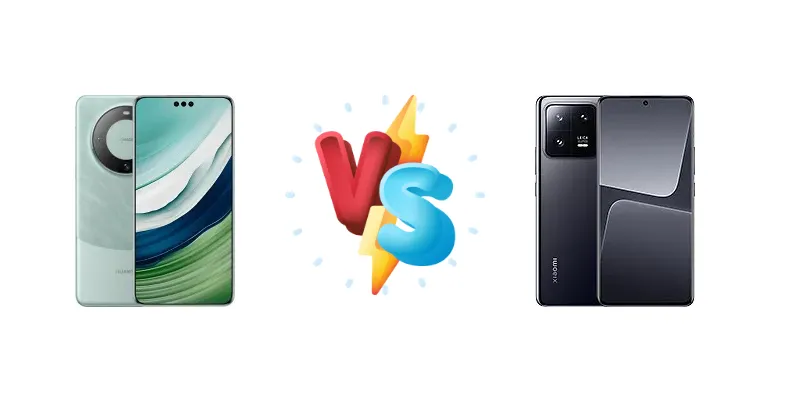
The Huawei Mate 60 Pro arrives amidst geopolitical complexities, boasting a domestically produced Kirin 9000S chipset, while the Xiaomi 13 Pro represents the pinnacle of Qualcomm’s Snapdragon 8 Gen 2 power. This comparison dissects these two flagship contenders, focusing on real-world performance, camera capabilities, and battery endurance to determine which reigns supreme.
🏆 Quick Verdict
For the average user prioritizing raw performance and consistently fast charging, the Xiaomi 13 Pro emerges as the winner. Its Snapdragon 8 Gen 2 offers a more mature and efficient platform, coupled with a significantly faster 19-minute full charge. However, the Mate 60 Pro’s unique situation and potential for future software developments make it a compelling alternative.
| Network |
|---|
| 2G bands | GSM 850 / 900 / 1800 / 1900 | GSM 850 / 900 / 1800 / 1900 |
| 3G bands | HSDPA 800 / 850 / 900 / 1700(AWS) / 1900 / 2100 | HSDPA 800 / 850 / 900 / 1700(AWS) / 1900 / 2100 |
| 4G bands | LTE | 1, 2, 3, 4, 5, 7, 8, 12, 13, 17, 18, 19, 20, 25, 26, 28, 32, 38, 39, 40, 41, 42, 48, 66 - International |
| 5G bands | SA/NSA | 1, 3, 5, 7, 8, 20, 28, 38, 40, 41, 66, 71, 75, 77, 78 SA/NSA - International |
| Speed | HSPA, LTE, 5G | HSPA, LTE, 5G |
| Technology | GSM / CDMA / HSPA / CDMA2000 / LTE / 5G | GSM / CDMA / HSPA / CDMA2000 / LTE / 5G |
| | - | 1, 3, 5, 8, 28, 38, 40, 41, 77, 78, 79 SA/NSA - China |
| Launch |
|---|
| Announced | 2023, August 29 | 2022, December 11 |
| Status | Available. Released 2023, August 29 | Available. Released 2022, December 14 |
| Body |
|---|
| Build | Glass front, aluminum frame, glass back | Glass front (Gorilla Glass Victus), ceramic back or silicone polymer back, aluminum frame |
| Dimensions | 163.7 x 79 x 8.1 mm (6.44 x 3.11 x 0.32 in) | 162.9 x 74.6 x 8.4 mm or 8.7 mm |
| SIM | Nano-SIM + Nano-SIM | · Nano-SIM + eSIM· Nano-SIM + Nano-SIM |
| Weight | 225 g (7.94 oz) | 210 g or 229 g (7.41 oz) |
| | - | IP68 dust/water resistant (up to 1.5m for 30 min) |
| Display |
|---|
| Protection | Huawei Kunlun Glass 2 | Corning Gorilla Glass Victus |
| Resolution | 1260 x 2720 pixels, 19.5:9 ratio (~440 ppi density) | 1440 x 3200 pixels, 20:9 ratio (~522 ppi density) |
| Size | 6.82 inches, 114.4 cm2 (~88.5% screen-to-body ratio) | 6.73 inches, 108.9 cm2 (~89.6% screen-to-body ratio) |
| Type | LTPO OLED, 1B colors, 120Hz | LTPO AMOLED, 1B colors, 120Hz, Dolby Vision, HDR10+, 1200 nits (HBM), 1900 nits (peak) |
| Platform |
|---|
| CPU | Octa-core (1x2.62 GHz Taishan Big & 3x2.15 GHz Taishan Mid & 4x1.53GHz Cortex-A510) | Octa-core (1x3.2 GHz Cortex-X3 & 2x2.8 GHz Cortex-A715 & 2x2.8 GHz Cortex-A710 & 3x2.0 GHz Cortex-A510) |
| Chipset | Kirin 9000S (7 nm) | Qualcomm SM8550-AB Snapdragon 8 Gen 2 (4 nm) |
| GPU | Maleoon 910 MP4 | Adreno 740 |
| OS | HarmonyOS 4.0 (China) | Android 13, upgradable to Android 14, HyperOS |
| Memory |
|---|
| Card slot | Nano Memory (uses shared SIM slot) | No |
| Internal | 256GB 12GB RAM, 512GB 12GB RAM, 1TB 12GB RAM | 128GB 8GB RAM, 256GB 8GB RAM, 256GB 12GB RAM, 512GB 12GB RAM |
| | - | UFS 3.1 - 128GB
UFS 4.0 - 256/512GB |
| Main Camera |
|---|
| Features | Laser AF, color spectrum sensor, LED flash, panorama, HDR | Laser AF, color spectrum sensor, Leica lens, Dual-LED dual-tone flash, HDR, panorama |
| Triple | 50 MP, f/1.4-f/4.0, 24mm (wide), PDAF, OIS
48 MP, f/3.5, 90mm (periscope telephoto), PDAF, OIS, 3.5x optical zoom
12 MP, f/2.2, 13mm, 120˚ (ultrawide), PDAF | 50.3 MP, f/1.9, 23mm (wide), 1.0"-type, 1.6µm, dual pixel PDAF, OIS
50 MP, f/2.0, 75mm (telephoto), PDAF (10cm - ∞), 3.2x optical zoom
50 MP, f/2.2, 14mm, 115˚ (ultrawide), AF |
| Video | 4K, 1080p, HDR, gyro-EIS, OIS | 8K@24fps (HDR), 4K@24/30/60fps (HDR10+, 10-bit Dolby Vision HDR, 10-bit LOG), 1080p@30/120/240/960fps, 1080p@1920fps, gyro-EIS |
| Selfie camera |
|---|
| Features | HDR, panorama | HDR, panorama |
| Single | 13 MP, f/2.4, 18mm (ultrawide)
TOF 3D, (depth/biometrics sensor) | 32 MP, f/2.0, 22mm (wide), 1/3.14", 0.7µm |
| Video | 4K, 1080p, HDR, gyro-EIS | 1080p@30fps |
| Sound |
|---|
| 3.5mm jack | - | No |
| 35mm jack | No | No |
| Loudspeaker | Yes, with stereo speakers | Yes, with stereo speakers |
| | - | 24-bit/192kHz audio |
| Comms |
|---|
| Bluetooth | 5.2, A2DP, LE | 5.3, A2DP, aptX HD, aptX Adaptive |
| Infrared port | Yes | Yes |
| NFC | Yes | Yes |
| Positioning | GPS (L1+L5), GLONASS (L1), BDS (B1I+B1c+B2a+B2b), GALILEO (E1+E5a+E5b), QZSS (L1+L5), NavIC (L5) | GPS (L1+L5), GLONASS (G1), BDS (B1I+B1c+B2a), GALILEO (E1+E5a), QZSS (L1+L5), NavIC (L5) |
| Radio | No | No |
| USB | USB Type-C 3.1, OTG, DisplayPort 1.2 | USB Type-C 2.0, OTG |
| WLAN | Wi-Fi 802.11 a/b/g/n/ac/6, dual-band, Wi-Fi Direct | Wi-Fi 802.11 a/b/g/n/ac/6e, dual-band, Wi-Fi Direct |
| Features |
|---|
| Sensors | Face ID, fingerprint (under display, optical), accelerometer, gyro, proximity, barometer, compass | Fingerprint (under display, optical), accelerometer, proximity, gyro, compass, barometer |
| Battery |
|---|
| Charging | 88W wired, 100% in 30 min
50W wireless
20W reverse wireless | 120W wired, PD3.0, QC4, 100% in 19 min
50W wireless, 100% in 36 min
10W reverse wireless |
| Type | Li-Po 5000 mAh | Li-Po 4820 mAh |
| Misc |
|---|
| Colors | Black, White, Green, Purple | Ceramic White, Ceramic Black, Ceramic Flora Green, Mountain Blue |
| Models | ALN-AL00, ALN-AL80 | 2210132G, 2210132C |
| Price | About 890 EUR | About 750 EUR |
| Tests |
|---|
| Battery life | - |
Endurance rating 115h
|
| Camera | - |
Photo / Video |
| Display | - |
Contrast ratio: Infinite (nominal) |
| Loudspeaker | - |
-25.6 LUFS (Very good)
|
| Performance | - |
AnTuTu: 1281666 (v9)
GeekBench: 5087 (v5.1), 5323 (v6)
GFXBench: 64fps (ES 3.1 onscreen) |
Huawei Mate 60 Pro
- Domestically produced Kirin 9000S chipset
- Potential for unique software features
- Satellite communication capabilities
- Limited global software support
- Less efficient chipset compared to Snapdragon
- Slower wired charging
Xiaomi 13 Pro
- Superior performance with Snapdragon 8 Gen 2
- Extremely fast 120W wired charging
- Globally supported software and updates
- Relies on Qualcomm chipset
- May lack unique features of the Mate 60 Pro
- Potentially less compelling for users seeking technological independence
Display Comparison
The Xiaomi 13 Pro boasts a measured peak brightness of 1253 nits, suggesting a more vibrant outdoor viewing experience compared to the Mate 60 Pro (brightness data unavailable). Both feature infinite (nominal) contrast ratios, typical of OLED panels. While the Mate 60 Pro’s display specifics are limited, Xiaomi’s likely utilizes LTPO technology for adaptive refresh rates, potentially contributing to better battery efficiency. The Xiaomi 13 Pro’s display is likely to offer a more refined and consistently bright experience.
Camera Comparison
Both phones are equipped for excellent photo and video capture, but details beyond this are limited. The Xiaomi 13 Pro’s camera system likely benefits from Qualcomm’s ISP enhancements within the Snapdragon 8 Gen 2. Without sensor size specifics for the Mate 60 Pro, it’s difficult to make a direct comparison. However, Xiaomi’s flagship typically prioritizes natural color reproduction and dynamic range, while Huawei often leans towards more saturated and stylized images. The absence of detailed camera specs for the Mate 60 Pro makes a definitive assessment challenging, but Xiaomi’s established camera prowess gives it an edge.
Performance
The core difference lies in the chipsets: Huawei’s 7nm Kirin 9000S versus Xiaomi’s 4nm Snapdragon 8 Gen 2. The 4nm process node inherently provides better power efficiency and thermal headroom, meaning the Snapdragon 8 Gen 2 is less prone to throttling under sustained loads. The Snapdragon 8 Gen 2’s CPU configuration – a Cortex-X3 prime core alongside Cortex-A715 and A710 performance cores – is architecturally superior to the Kirin 9000S’s Taishan cores and Cortex-A510 efficiency cores. This translates to faster application loading, smoother multitasking, and superior gaming performance for the Xiaomi 13 Pro. While the Kirin 9000S is a remarkable achievement given the constraints, it’s unlikely to match the Snapdragon’s overall performance.
Battery Life
The Xiaomi 13 Pro’s endurance rating of 115 hours and active use score of 10:55h demonstrates strong battery life. Crucially, its 120W wired charging, achieving 100% in just 19 minutes, is significantly faster than the Mate 60 Pro’s 88W charging (30 minutes). The Mate 60 Pro offers 50W wireless and 20W reverse wireless, while the Xiaomi 13 Pro provides 50W wireless (36 minutes) and 10W reverse wireless. While the Mate 60 Pro’s wireless charging is competitive, the Xiaomi 13 Pro’s wired charging speed is a major advantage for users who prioritize quick top-ups.
Buying Guide
Buy the Huawei Mate 60 Pro if you need a phone that represents technological independence and are comfortable with a potentially evolving software ecosystem. Its Kirin 9000S offers a unique experience, and the satellite communication features are a differentiator. Buy the Xiaomi 13 Pro if you prefer a polished, globally-supported experience with guaranteed performance, exceptional fast charging, and a proven camera system. It’s the safer, more predictable choice for power users.
Frequently Asked Questions
❓ Does the Kirin 9000S chipset in the Mate 60 Pro suffer from significant thermal throttling during extended gaming sessions?
Given the 7nm process node and the complexity of the Taishan architecture, the Kirin 9000S is more likely to experience thermal throttling under sustained heavy loads compared to the Snapdragon 8 Gen 2’s 4nm process. While Huawei has likely implemented thermal management solutions, the Xiaomi 13 Pro will likely maintain higher sustained performance during prolonged gaming.
❓ How does the satellite communication feature on the Mate 60 Pro function, and is it widely available outside of China?
The Mate 60 Pro’s satellite communication feature allows for basic messaging and emergency calls in areas with no cellular coverage. However, its availability is currently limited to China and requires a subscription to a compatible service. Its usefulness for international travelers is currently restricted.
❓ Is the 10W reverse wireless charging on the Xiaomi 13 Pro useful for charging accessories like earbuds or smartwatches?
While 10W reverse wireless charging is slower than dedicated chargers, it's sufficient for topping up smaller accessories like earbuds or smartwatches. It's a convenient feature for travelers or situations where a traditional charger isn't readily available, but don't expect rapid charging speeds.
❓ What kind of software updates can Huawei Mate 60 Pro users expect, given the geopolitical situation?
Software updates for the Mate 60 Pro are uncertain due to ongoing restrictions. While Huawei is developing its HarmonyOS, access to Google Mobile Services remains unavailable. Updates will likely focus on optimizing the existing software and adding new features within the HarmonyOS ecosystem, but may lag behind the frequency and breadth of updates offered by Xiaomi.