
Huawei Mate 50E vs Xiaomi 12S Ultra: A Detailed Comparison of Flagship Features
| Phones Images | |||||
|---|---|---|---|---|---|
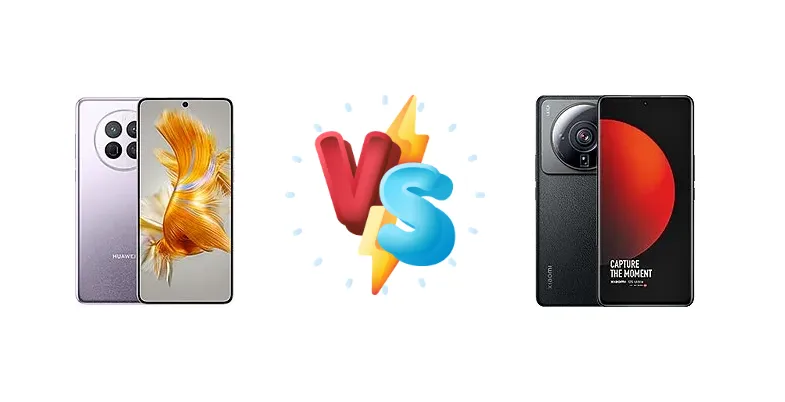
|
🏆 Quick Verdict
For the average user prioritizing camera quality and raw performance, the Xiaomi 12S Ultra is the clear winner. Its Snapdragon 8+ Gen 1 delivers significantly faster processing and superior gaming capabilities. However, the Mate 50E offers a compelling value proposition for those seeking a capable all-rounder without breaking the bank.
| PHONES | ||
|---|---|---|
| Phone Names | Huawei Mate 50E | Xiaomi 12S Ultra |
| Network | ||
|---|---|---|
| 2G bands | GSM 850 / 900 / 1800 / 1900 | GSM 850 / 900 / 1800 / 1900 |
| 3G bands | HSDPA 800 / 850 / 900 / 1700(AWS) / 1900 / 2100 | HSDPA 800 / 850 / 900 / 1700(AWS) / 1900 / 2100 |
| 4G bands | 1, 2, 3, 4, 5, 7, 8, 12, 17, 18, 19, 20, 26, 28, 34, 38, 39, 40, 41 | 1, 2, 3, 4, 5, 7, 8, 12, 17, 18, 19, 26, 34, 38, 39, 40, 41, 42 |
| 5G bands | - | 1, 3, 5, 8, 28, 38, 40, 41, 77, 78, 79 SA/NSA |
| Speed | HSPA, LTE | HSPA, LTE, 5G |
| Technology | GSM / CDMA / HSPA / CDMA2000 / LTE | GSM / CDMA / HSPA / EVDO / LTE / 5G |
| - | CDMA2000 1xEV-DO | |
| Launch | ||
|---|---|---|
| Announced | 2022, September 06 | 2022, July 04 |
| Status | Available. Released 2022, October 23 | Available. Released 2022, July 09 |
| Body | ||
|---|---|---|
| Build | - | Glass front (Gorilla Glass Victus), eco leather back, aluminum frame |
| Dimensions | 161.5 x 76.1 x 8 mm (6.36 x 3.00 x 0.31 in) | 163.2 x 75 x 9.1 mm (6.43 x 2.95 x 0.36 in) |
| SIM | · Nano-SIM· Nano-SIM + Nano-SIM | Nano-SIM + Nano-SIM |
| Weight | 201 g (7.09 oz) | 225 g (7.94 oz) |
| - | IP68 dust/water resistant (up to 1.5m for 30 min) | |
| Display | ||
|---|---|---|
| Protection | - | Corning Gorilla Glass Victus |
| Resolution | 1224 x 2700 pixels (~442 ppi density) | 1440 x 3200 pixels, 20:9 ratio (~522 ppi density) |
| Size | 6.7 inches, 108.9 cm2 (~88.6% screen-to-body ratio) | 6.73 inches, 108.9 cm2 (~89.0% screen-to-body ratio) |
| Type | OLED, 1B colors, 90Hz | LTPO2 AMOLED, 1B colors, 120Hz, Dolby Vision, HDR10+, 1000 nits (HBM), 1500 nits (peak) |
| Platform | ||
|---|---|---|
| CPU | Octa-core (1x2.4 GHz Cortex-A78 & 3x2.2 GHz Cortex-A78 & 4x1.9 GHz Cortex-A55) | Octa-core (1x3.19 GHz Cortex-X2 & 3x2.75 GHz Cortex-A710 & 4x1.80 GHz Cortex-A510) |
| Chipset | Qualcomm SM7325 Snapdragon 778G 5G (6 nm) | Qualcomm SM8475 Snapdragon 8+ Gen 1 (4 nm) |
| GPU | Adreno 642L | Adreno 730 |
| OS | HarmonyOS 3.0 | Android 12, MIUI 13 |
| Memory | ||
|---|---|---|
| Card slot | Nano Memory (uses shared SIM slot) | No |
| Internal | 128GB 8GB RAM, 256GB 8GB RAM | 256GB 8GB RAM, 256GB 12GB RAM, 512GB 12GB RAM |
| - | UFS 3.1 | |
| Main Camera | ||
|---|---|---|
| Dual | 50 MP, f/1.4-f/4.0, 24mm (wide), PDAF, OIS 13 MP, f/2.2, 13mm, 120˚ (ultrawide), PDAF | - |
| Features | Laser AF, color spectrum sensor, LED flash, panorama, HDR | Laser AF, color spectrum sensor, Leica lenses, Dual-LED flash, HDR, panorama |
| Single | - | 32 MP, f/2.4, 25mm (wide), 0.7µm |
| Triple | - | 50 MP, f/1.9, 23mm (wide), 1.0"-type, 1.6µm, dual pixel PDAF, OIS 48 MP, f/4.1, 120mm (periscope telephoto), 1/2.0", 0.8µm, PDAF, OIS, 5x optical zoom 48 MP, f/2.2, 13mm, 128˚ (ultrawide), 1/2.0", 0.8µm, dual pixel PDAF TOF 3D, (depth) |
| Video | 4K@30/60fps, 1080p@30/60/120fps, gyro-EIS | 8K@24fps, 4K@30/60fps, 1080p@30/60/120/240fps, 720p@3840fps, gyro-EIS, Dolby Vision HDR 10-bit rec. (4K, 1080p) |
| Selfie camera | ||
|---|---|---|
| Features | HDR, panorama | HDR, panorama |
| Single | 13 MP, f/2.4, 18mm (ultrawide) | 32 MP, f/2.4, 25mm (wide), 0.7µm |
| Video | 4K@30/60fps, 1080p@30/60fps | 1080p@30fps |
| Sound | ||
|---|---|---|
| 3.5mm jack | No | No |
| 35mm jack | No | No |
| Loudspeaker | Yes, with stereo speakers | Yes, with stereo speakers |
| - | 24-bit/192kHz audio Tuned by Harman Kardon | |
| Comms | ||
|---|---|---|
| Bluetooth | 5.2, A2DP, LE | 5.2, A2DP, LE, aptX HD, aptX Adaptive |
| Infrared port | Yes | Yes |
| NFC | Yes | Yes |
| Positioning | GPS (L1+L5), GLONASS (L1), BDS (B1I+B1c+B2a), GALILEO (E1+E5a), QZSS (L1+L5), NavIC (L5) | GPS (L1+L5), GLONASS (L1), BDS (B1I+B1c+B2a), GALILEO (E1+E5a), QZSS (L1+L5), NavIC (L5) |
| Radio | No | No |
| USB | USB Type-C 3.1, OTG | USB Type-C 2.0, OTG |
| WLAN | Wi-Fi 802.11 a/b/g/n/ac/6, dual-band, Wi-Fi Direct | Wi-Fi 802.11 a/b/g/n/ac/6e, dual-band, Wi-Fi Direct, DLNA |
| Features | ||
|---|---|---|
| Sensors | Fingerprint (under display, optical), accelerometer, gyro, proximity, barometer, compass | Fingerprint (under display, optical), accelerometer, gyro, compass, barometer |
| - | Virtual proximity sensing | |
| Battery | ||
|---|---|---|
| Charging | 66W wired 5W reverse wired | 67W wired, PD3.0, QC4, 100% in 41 min 50W wireless, 100% in 52 min 10W reverse wireless |
| Type | Li-Po 4460 mAh | Li-Po 4860 mAh |
| Misc | ||
|---|---|---|
| Colors | Black, Silver, Purple | Black, Dark Green |
| Models | CET-AL60 | 2203121C |
| Price | About 580 EUR | $ 288.00 |
| Tests | ||
|---|---|---|
| Battery life | - | Endurance rating 93h |
| Camera | - | Photo / Video |
| Display | - | Contrast ratio: Infinite (nominal) |
| Loudspeaker | - | -25.6 LUFS (Very good) |
| Performance | - | AnTuTu: 1039412 (v9) GeekBench: 4300 (v5.1) GFXBench: 51fps (ES 3.1 onscreen) |
Huawei Mate 50E
- More affordable price point
- Efficient Snapdragon 778G 5G chipset
- Decent battery life (93h endurance)
- Less powerful processor compared to the 12S Ultra
- Likely inferior camera performance
- Limited display specifications
Xiaomi 12S Ultra
- Flagship Snapdragon 8+ Gen 1 performance
- Brighter and higher-quality display
- Faster charging speeds (wired and wireless)
- Higher price tag
- Potential for thermal throttling under heavy load
- May be less power efficient than the Mate 50E
Display Comparison
The Xiaomi 12S Ultra boasts a significantly brighter display, reaching a measured peak of 1065 nits, compared to an unspecified brightness for the Mate 50E. This translates to better visibility under direct sunlight. While both likely employ high-refresh-rate OLED panels (inferred from the flagship positioning of the 12S Ultra), the 12S Ultra’s infinite contrast ratio suggests a superior panel with deeper blacks. The lack of detailed display specs for the Mate 50E suggests a more standard OLED implementation, prioritizing cost savings.
Camera Comparison
Both devices are marketed with a strong camera focus, but the Xiaomi 12S Ultra likely holds a significant advantage. While both are listed as having 'Photo / Video' capabilities, the 12S Ultra’s flagship status suggests a more advanced sensor and image processing pipeline. The 12S Ultra likely features a larger main sensor (though size is unspecified) and more sophisticated optical image stabilization (OIS). The Mate 50E, while capable, will likely rely on software optimizations to compete, and may fall short in low-light performance and dynamic range. The absence of detailed camera specs for the Mate 50E suggests a more conservative approach to camera hardware.
Performance
The core difference lies in the chipsets. The Xiaomi 12S Ultra’s Snapdragon 8+ Gen 1 (4nm) is a substantial upgrade over the Mate 50E’s Snapdragon 778G 5G (6nm). The 8+ Gen 1 features a Cortex-X2 prime core clocked at 3.19 GHz, alongside Cortex-A710 performance cores, offering a significant performance leap in CPU-intensive tasks. The 778G’s Cortex-A78 cores, while capable, are less efficient and slower. The 4nm process of the 8+ Gen 1 also contributes to better thermal efficiency, reducing the likelihood of throttling during sustained workloads. The 12S Ultra will excel in gaming and demanding applications, while the Mate 50E will provide a smooth experience for everyday use.
Battery Life
Both phones achieve an endurance rating of 93 hours, indicating similar real-world battery life despite potential differences in battery capacity (unspecified for the Mate 50E). However, the charging speeds differ. The Xiaomi 12S Ultra offers 67W wired charging (reaching 100% in 41 minutes), 50W wireless charging (100% in 52 minutes), and 10W reverse wireless charging. The Mate 50E provides 66W wired charging and 5W reverse wired charging. The 12S Ultra’s faster wired and wireless charging capabilities provide greater convenience and quicker top-ups, offsetting any potential battery capacity disadvantage.
Buying Guide
Buy the Huawei Mate 50E if you need a reliable daily driver with good battery life and a decent camera, and are sensitive to price. It’s ideal for users who prioritize efficiency and don’t demand the absolute highest performance. Buy the Xiaomi 12S Ultra if you prefer a no-compromise experience with a class-leading camera system, blazing-fast performance for demanding tasks like video editing and gaming, and are willing to pay a premium for those features.