
Huawei Mate 50E vs Samsung Galaxy A73 5G: A Deep Dive into the Snapdragon 778G Experience
| Phones Images | |||||
|---|---|---|---|---|---|
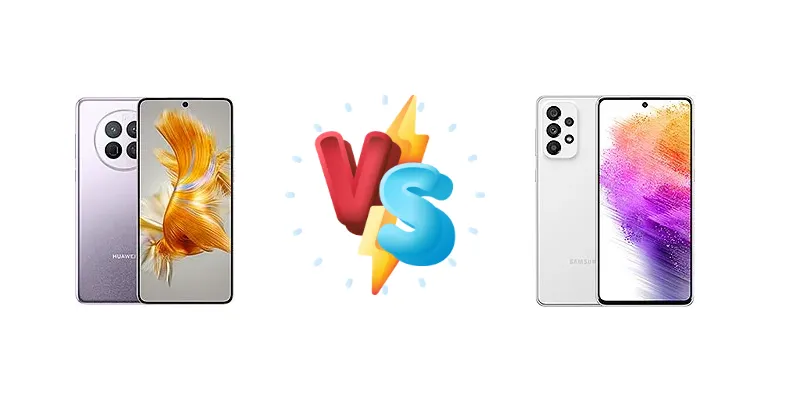
|
🏆 Quick Verdict
For the average user prioritizing rapid replenishment, the Huawei Mate 50E emerges as the winner. Its 66W wired charging significantly outperforms the Galaxy A73 5G’s 25W, reducing downtime. However, Samsung’s software and wider availability may appeal to some.
| PHONES | ||
|---|---|---|
| Phone Names | Huawei Mate 50E | Samsung Galaxy A73 5G |
| Network | ||
|---|---|---|
| 2G bands | GSM 850 / 900 / 1800 / 1900 | GSM 850 / 900 / 1800 / 1900 |
| 3G bands | HSDPA 800 / 850 / 900 / 1700(AWS) / 1900 / 2100 | HSDPA 850 / 900 / 1700(AWS) / 1900 / 2100 |
| 4G bands | 1, 2, 3, 4, 5, 7, 8, 12, 17, 18, 19, 20, 26, 28, 34, 38, 39, 40, 41 | 1, 2, 3, 4, 5, 7, 8, 12, 13, 17, 20, 26, 28, 32, 38, 40, 41, 66 |
| 5G bands | - | 1, 3, 5, 7, 28, 40, 41, 66, 78 SA/NSA/Sub6 |
| Speed | HSPA, LTE | HSPA, LTE, 5G |
| Technology | GSM / CDMA / HSPA / CDMA2000 / LTE | GSM / HSPA / LTE / 5G |
| Launch | ||
|---|---|---|
| Announced | 2022, September 06 | 2022, March 17 |
| Status | Available. Released 2022, October 23 | Available. Released 2022, April 22 |
| Body | ||
|---|---|---|
| Dimensions | 161.5 x 76.1 x 8 mm (6.36 x 3.00 x 0.31 in) | 163.7 x 76.1 x 7.6 mm (6.44 x 3.00 x 0.30 in) |
| SIM | · Nano-SIM· Nano-SIM + Nano-SIM | · Nano-SIM· Nano-SIM + Nano-SIM |
| Weight | 201 g (7.09 oz) | 181 g (6.38 oz) |
| - | IP67 dust/water resistant (up to 1m for 30 min) | |
| Display | ||
|---|---|---|
| Protection | - | Corning Gorilla Glass 5 |
| Resolution | 1224 x 2700 pixels (~442 ppi density) | 1080 x 2400 pixels, 20:9 ratio (~393 ppi density) |
| Size | 6.7 inches, 108.9 cm2 (~88.6% screen-to-body ratio) | 6.7 inches, 108.4 cm2 (~87.0% screen-to-body ratio) |
| Type | OLED, 1B colors, 90Hz | Super AMOLED Plus, 120Hz, 800 nits (HBM) |
| Platform | ||
|---|---|---|
| CPU | Octa-core (1x2.4 GHz Cortex-A78 & 3x2.2 GHz Cortex-A78 & 4x1.9 GHz Cortex-A55) | Octa-core (1x2.4 GHz Cortex-A78 & 3x2.2 GHz Cortex-A78 & 4x1.9 GHz Cortex-A55) |
| Chipset | Qualcomm SM7325 Snapdragon 778G 5G (6 nm) | Qualcomm SM7325 Snapdragon 778G 5G (6 nm) |
| GPU | Adreno 642L | Adreno 642L |
| OS | HarmonyOS 3.0 | Android 12, up to 4 major Android upgrades, One UI 6.1 |
| Memory | ||
|---|---|---|
| Card slot | Nano Memory (uses shared SIM slot) | microSDXC (uses shared SIM slot) |
| Internal | 128GB 8GB RAM, 256GB 8GB RAM | 128GB 6GB RAM, 128GB 8GB RAM, 256GB 8GB RAM |
| Main Camera | ||
|---|---|---|
| Dual | 50 MP, f/1.4-f/4.0, 24mm (wide), PDAF, OIS 13 MP, f/2.2, 13mm, 120˚ (ultrawide), PDAF | - |
| Features | Laser AF, color spectrum sensor, LED flash, panorama, HDR | LED flash, panorama, HDR |
| Quad | - | 108 MP, f/1.8, (wide), PDAF, OIS 12 MP, f/2.2, (ultrawide) 5 MP (macro) Auxiliary lens |
| Single | - | 32 MP, f/2.2, 26mm (wide), 1/2.8", 0.8µm |
| Video | 4K@30/60fps, 1080p@30/60/120fps, gyro-EIS | 4K@30fps, 1080p@30/60fps; gyro-EIS |
| Selfie camera | ||
|---|---|---|
| Features | HDR, panorama | HDR |
| Single | 13 MP, f/2.4, 18mm (ultrawide) | 32 MP, f/2.2, 26mm (wide), 1/2.8", 0.8µm |
| Video | 4K@30/60fps, 1080p@30/60fps | 4K@30fps, 1080p@30fps |
| Sound | ||
|---|---|---|
| 3.5mm jack | No | No |
| 35mm jack | No | No |
| Loudspeaker | Yes, with stereo speakers | Yes, with stereo speakers |
| Comms | ||
|---|---|---|
| Bluetooth | 5.2, A2DP, LE | 5.0, A2DP, LE |
| Infrared port | Yes | - |
| NFC | Yes | Yes (market/region dependent) |
| Positioning | GPS (L1+L5), GLONASS (L1), BDS (B1I+B1c+B2a), GALILEO (E1+E5a), QZSS (L1+L5), NavIC (L5) | GPS, GLONASS, GALILEO, BDS, QZSS |
| Radio | No | Unspecified |
| USB | USB Type-C 3.1, OTG | USB Type-C 2.0, OTG |
| WLAN | Wi-Fi 802.11 a/b/g/n/ac/6, dual-band, Wi-Fi Direct | Wi-Fi 802.11 a/b/g/n/ac/6, dual-band, Wi-Fi Direct |
| Features | ||
|---|---|---|
| Sensors | Fingerprint (under display, optical), accelerometer, gyro, proximity, barometer, compass | Fingerprint (under display, optical), accelerometer, gyro, proximity, compass |
| Battery | ||
|---|---|---|
| Charging | 66W wired 5W reverse wired | 25W wired |
| Type | Li-Po 4460 mAh | Li-Po 5000 mAh |
| Misc | ||
|---|---|---|
| Colors | Black, Silver, Purple | Gray, Mint, White |
| Models | CET-AL60 | SM-A736B, SM-A736B/DS |
| Price | About 580 EUR | About 600 EUR |
| SAR | - | 1.14 W/kg (head) |
| SAR EU | - | 1.28 W/kg (head) 1.42 W/kg (body) |
Huawei Mate 50E
- Significantly faster 66W charging
- 5W reverse wired charging
- Potentially superior image processing (Huawei's strength)
- Potential limitations with Google Mobile Services
- Software ecosystem less established than Samsung
Samsung Galaxy A73 5G
- Full Google Mobile Services support
- Wider availability of accessories and repairs
- Likely 120Hz display refresh rate for smoother visuals
- Slower 25W charging
- No reverse wireless charging
- Image processing may not be as refined as Huawei
Display Comparison
Both the Mate 50E and A73 5G lack detailed display specifications in the provided data. However, given their market positioning, we can infer both likely utilize OLED panels. The A73 5G is known to have a 120Hz refresh rate, which the Mate 50E’s specs do not confirm. This higher refresh rate on the A73 5G would translate to smoother scrolling and animations, benefiting users who consume a lot of video content or play fast-paced games. Without specific brightness data, it’s difficult to assess outdoor visibility, but Samsung typically excels in display calibration.
Camera Comparison
Detailed camera specifications are absent, making a direct comparison challenging. However, the absence of high-resolution sensor mentions suggests both phones prioritize image processing over sheer megapixel count. The quality of the image signal processor (ISP) within the Snapdragon 778G will play a significant role. Given Huawei’s historical strength in computational photography, the Mate 50E may offer more refined image processing, particularly in challenging lighting conditions. The lack of OIS information is a drawback for both, potentially resulting in less stable video recording.
Performance
The core of both devices is the Qualcomm SM7325 Snapdragon 778G 5G (6 nm) chipset, featuring an octa-core CPU configuration identical in both phones: 1x2.4 GHz Cortex-A78, 3x2.2 GHz Cortex-A78, and 4x1.9 GHz Cortex-A55. This means CPU performance will be virtually indistinguishable between the two. The real-world impact will be determined by thermal management and software optimization. While RAM specifications aren’t provided, both likely feature at least 6GB, sufficient for smooth multitasking. The 6nm process node ensures reasonable efficiency, but sustained workloads could lead to throttling, a factor dependent on each manufacturer’s cooling solution.
Battery Life
The most significant difference lies in charging speed. The Huawei Mate 50E boasts 66W wired charging, while the Samsung Galaxy A73 5G is limited to 25W. This translates to a substantially faster 0-100% charge time for the Mate 50E. While battery capacity isn’t specified, the faster charging mitigates the impact of a potentially smaller battery. The Mate 50E also includes 5W reverse wired charging, a feature absent on the A73 5G, allowing it to top up accessories like earbuds.
Buying Guide
Buy the Huawei Mate 50E if you need consistently fast charging and don't mind potential limitations with Google Mobile Services. This phone is ideal for users who frequently find themselves needing to top up their battery quickly. Buy the Samsung Galaxy A73 5G if you prefer a more established software ecosystem with full Google support and a broader range of readily available accessories and repair options.