
Huawei Mate 50E vs Huawei P40 Pro: A Clash of Titans
| Phones Images | |||||
|---|---|---|---|---|---|
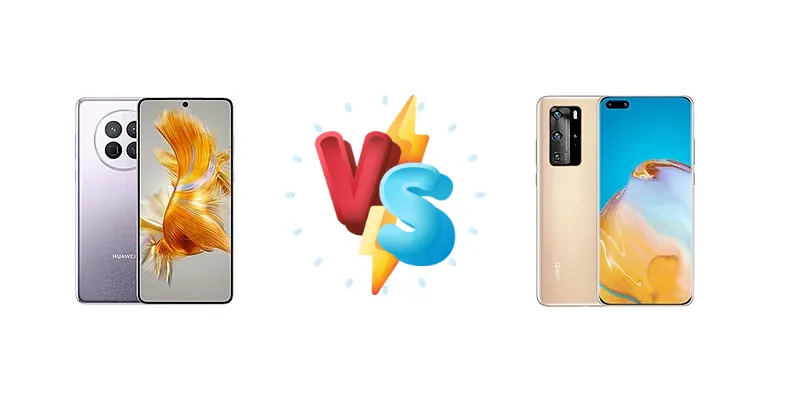
|
🏆 Quick Verdict
The P40 Pro boasts superior camera capabilities, a higher-end chipset, and wireless charging. However, the Mate 50E offers faster wired charging and a more modern, efficient processor. For photography enthusiasts, the P40 Pro wins; for those prioritizing efficiency and a slightly newer platform, the Mate 50E is a strong contender.
| PHONES | ||
|---|---|---|
| Phone Names | Huawei Mate 50E | Huawei P40 Pro |
| Network | ||
|---|---|---|
| 2G bands | GSM 850 / 900 / 1800 / 1900 | GSM 850 / 900 / 1800 / 1900 |
| 3G bands | HSDPA 800 / 850 / 900 / 1700(AWS) / 1900 / 2100 | HSDPA 800 / 850 / 900 / 1700(AWS) / 1900 / 2100 |
| 4G bands | 1, 2, 3, 4, 5, 7, 8, 12, 17, 18, 19, 20, 26, 28, 34, 38, 39, 40, 41 | 1, 2, 3, 4, 5, 6, 7, 8, 9, 12, 17, 18, 19, 20, 26, 28, 32, 34, 38, 39, 40, 41 - ELS-NX9 |
| 5G bands | - | 1, 3, 28, 38, 41, 77, 78, 79 SA/NSA - ELS-NX9 |
| Speed | HSPA, LTE | HSPA, LTE, 5G |
| Technology | GSM / CDMA / HSPA / CDMA2000 / LTE | GSM / HSPA / LTE / 5G |
| Launch | ||
|---|---|---|
| Announced | 2022, September 06 | 2020, March 26 |
| Status | Available. Released 2022, October 23 | Available. Released 2020, April 07 |
| Body | ||
|---|---|---|
| Build | - | Glass front, glass back, aluminum frame |
| Dimensions | 161.5 x 76.1 x 8 mm (6.36 x 3.00 x 0.31 in) | 158.2 x 72.6 x 9 mm (6.23 x 2.86 x 0.35 in) |
| SIM | · Nano-SIM· Nano-SIM + Nano-SIM | · Nano-SIM + eSIM· Nano-SIM + Nano-SIM |
| Weight | 201 g (7.09 oz) | 209 g (7.37 oz) |
| Display | ||
|---|---|---|
| Resolution | 1224 x 2700 pixels (~442 ppi density) | 1200 x 2640 pixels (~441 ppi density) |
| Size | 6.7 inches, 108.9 cm2 (~88.6% screen-to-body ratio) | 6.58 inches, 105.2 cm2 (~91.6% screen-to-body ratio) |
| Type | OLED, 1B colors, 90Hz | OLED, 90Hz, HDR10 |
| Platform | ||
|---|---|---|
| CPU | Octa-core (1x2.4 GHz Cortex-A78 & 3x2.2 GHz Cortex-A78 & 4x1.9 GHz Cortex-A55) | Octa-core (2x2.86 GHz Cortex-A76 & 2x2.36 GHz Cortex-A76 & 4x1.95 GHz Cortex-A55) |
| Chipset | Qualcomm SM7325 Snapdragon 778G 5G (6 nm) | Kirin 990 5G (7 nm+) |
| GPU | Adreno 642L | Mali-G76 MP16 |
| OS | HarmonyOS 3.0 | Android 10, EMUI 12, no Google Play Services |
| Memory | ||
|---|---|---|
| Card slot | Nano Memory (uses shared SIM slot) | Nano Memory (uses shared SIM slot) |
| Internal | 128GB 8GB RAM, 256GB 8GB RAM | 128GB 8GB RAM, 256GB 8GB RAM, 512GB 8GB RAM |
| Main Camera | ||
|---|---|---|
| Dual | 50 MP, f/1.4-f/4.0, 24mm (wide), PDAF, OIS 13 MP, f/2.2, 13mm, 120˚ (ultrawide), PDAF | - |
| Features | Laser AF, color spectrum sensor, LED flash, panorama, HDR | Leica optics, color spectrum sensor, LED flash, panorama, HDR |
| Triple | - | 50 MP, f/1.9, 23mm (wide), 1/1.28", 1.22µm, dual pixel PDAF, OIS 12 MP, f/3.4, 125mm (periscope telephoto), PDAF, OIS, 5x optical zoom 40 MP, f/1.8, 18mm (ultrawide), 1/1.54", PDAF TOF 3D, (depth) |
| Video | 4K@30/60fps, 1080p@30/60/120fps, gyro-EIS | 4K@30/60fps, 1080p@30/60fps, 720@7680fps, 1080p@960fps, HDR; gyro-EIS |
| Selfie camera | ||
|---|---|---|
| Features | HDR, panorama | HDR |
| Single | 13 MP, f/2.4, 18mm (ultrawide) | 32 MP, f/2.2, 26mm (wide), 1/2.8", 0.8µm, AF IR TOF 3D, (depth/biometrics sensor) |
| Video | 4K@30/60fps, 1080p@30/60fps | 4K@30/60fps, 1080p@30/60fps |
| Sound | ||
|---|---|---|
| 3.5mm jack | No | No |
| 35mm jack | No | No |
| Loudspeaker | Yes, with stereo speakers | Yes |
| Comms | ||
|---|---|---|
| Bluetooth | 5.2, A2DP, LE | 5.1, A2DP, LE |
| Infrared port | Yes | Yes |
| NFC | Yes | Yes |
| Positioning | GPS (L1+L5), GLONASS (L1), BDS (B1I+B1c+B2a), GALILEO (E1+E5a), QZSS (L1+L5), NavIC (L5) | GPS (L1+L5), GLONASS (L1), BDS (B1I+B1c+B2a), GALILEO (E1+E5a), QZSS (L1+L5), NavIC |
| Radio | No | No |
| USB | USB Type-C 3.1, OTG | USB Type-C 3.1, OTG |
| WLAN | Wi-Fi 802.11 a/b/g/n/ac/6, dual-band, Wi-Fi Direct | Wi-Fi 802.11 a/b/g/n/ac/6, dual-band, Wi-Fi Direct |
| Features | ||
|---|---|---|
| Sensors | Fingerprint (under display, optical), accelerometer, gyro, proximity, barometer, compass | Infrared Face ID, fingerprint (under display, optical), accelerometer, gyro, proximity, compass |
| Battery | ||
|---|---|---|
| Charging | 66W wired 5W reverse wired | 40W wired 27W wireless 27W reverse wireless |
| Type | Li-Po 4460 mAh | Li-Po 4200 mAh |
| Misc | ||
|---|---|---|
| Colors | Black, Silver, Purple | Silver Frost, Blush Gold, Deep Sea Blue, Ice White, Black |
| Models | CET-AL60 | ELS-NX9, ELS-N04, ELS-AN00, ELS-TN00 |
| Price | About 580 EUR | € 360.00 / £ 335.00 |
| Pricing | ||
|---|---|---|
| 256GB 8GB RAM | - | $ 714.88 |
| RENEWED | - | $ 680.00 |
| Tests | ||
|---|---|---|
| Battery life | - | Endurance rating 94h |
| Camera | - | Photo / Video |
| Display | - | Contrast ratio: Infinite (nominal) |
| Loudspeaker | - | -27.5 LUFS (Good) |
| Performance | - | AnTuTu: 496356 (v8) GeekBench: 12848 (v4.4), 3197 (v5.1) GFXBench: 31fps (ES 3.1 onscreen) |
Huawei Mate 50E
- Faster 66W wired charging
- More modern Snapdragon 778G chipset
- Potentially lower price
- Efficient performance
- Less impressive camera system
- No wireless charging
- Older design compared to some newer models
Huawei P40 Pro
- Exceptional camera system
- Premium display with infinite contrast ratio
- Wireless and reverse wireless charging
- Strong Kirin 990 5G chipset
- Older chipset
- Slower 40W wired charging
- Potentially higher price (depending on availability)
- Less efficient than the Mate 50E
Display Comparison
The P40 Pro's display is renowned for its exceptional contrast ratio (nominally infinite), offering vibrant colors and deep blacks. While the Mate 50E's display is likely good, it lacks the same level of prestige and potentially the same color accuracy. Both feature OLED panels, but the P40 Pro's implementation is generally considered superior.
Camera Comparison
The P40 Pro's camera system is a standout feature, consistently praised for its image quality, zoom capabilities, and overall versatility. The Mate 50E's camera is competent, but it doesn't reach the same heights as the P40 Pro. The P40 Pro's larger sensor and more advanced processing algorithms give it a clear advantage.
Performance
The Kirin 990 5G in the P40 Pro is a powerful chipset, though it's now a few years old. The Snapdragon 778G 5G in the Mate 50E is more modern and efficient, offering excellent performance for everyday tasks and gaming. While the Kirin 990 has a slight edge in raw power, the 778G's efficiency is a significant advantage.
Battery Life
Both phones offer impressive battery life, with the P40 Pro achieving an endurance rating of 94 hours. The Mate 50E, with its more efficient chipset, likely provides comparable battery performance. The P40 Pro also has wireless and reverse wireless charging, features absent in the Mate 50E.
Buying Guide
The Huawei Mate 50E is ideal for users seeking a balanced smartphone with good performance and fast charging at a potentially lower price point. The Huawei P40 Pro is best suited for photography lovers who value a premium camera system and don't mind a slightly older chipset, especially if they can find it at a discounted price.