
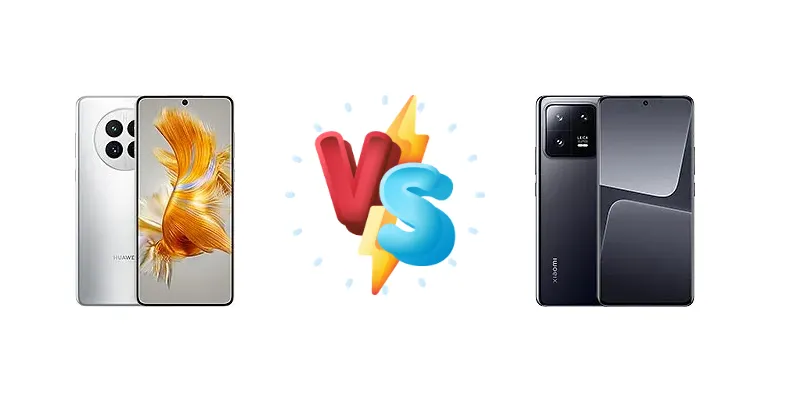
Huawei Mate 50 vs Xiaomi 13 Pro: The Ultimate Flagship Battle
| Phones Images | |||||
|---|---|---|---|---|---|
|
🏆 Quick Verdict
The Xiaomi 13 Pro takes the crown with its significantly faster charging, superior Snapdragon 8 Gen 2 chipset, and brighter display. While the Mate 50 offers a unique design and strong camera, the 13 Pro's overall performance and features make it the more compelling choice for most users.
| PHONES | ||
|---|---|---|
| Phone Names | Huawei Mate 50 | Xiaomi 13 Pro |
| Network | ||
|---|---|---|
| 2G bands | GSM 850 / 900 / 1800 / 1900 | GSM 850 / 900 / 1800 / 1900 |
| 3G bands | HSDPA 800 / 850 / 900 / 1700(AWS) / 1900 / 2100 | HSDPA 800 / 850 / 900 / 1700(AWS) / 1900 / 2100 |
| 4G bands | 1, 2, 3, 4, 5, 7, 8, 12, 13, 17, 18, 19, 20, 26, 28, 32, 34, 38, 39, 40, 41, 66 - International | 1, 2, 3, 4, 5, 7, 8, 12, 13, 17, 18, 19, 20, 25, 26, 28, 32, 38, 39, 40, 41, 42, 48, 66 - International |
| 5G bands | - | 1, 3, 5, 7, 8, 20, 28, 38, 40, 41, 66, 71, 75, 77, 78 SA/NSA - International |
| Speed | HSPA, LTE | HSPA, LTE, 5G |
| Technology | GSM / CDMA / HSPA / CDMA2000 / LTE | GSM / CDMA / HSPA / CDMA2000 / LTE / 5G |
| 1, 2, 3, 4, 5, 7, 8, 12, 17, 18, 19, 20, 26, 28, 34, 38, 39, 40, 41 - China | 1, 3, 5, 8, 28, 38, 40, 41, 77, 78, 79 SA/NSA - China | |
| Launch | ||
|---|---|---|
| Announced | 2022, September 06 | 2022, December 11 |
| Status | Available. Released 2022, September 28 | Available. Released 2022, December 14 |
| Body | ||
|---|---|---|
| Build | - | Glass front (Gorilla Glass Victus), ceramic back or silicone polymer back, aluminum frame |
| Dimensions | 161.5 x 76.1 x 8 mm (6.36 x 3.00 x 0.31 in) | 162.9 x 74.6 x 8.4 mm or 8.7 mm |
| SIM | · Nano-SIM· Nano-SIM + Nano-SIM | · Nano-SIM + eSIM· Nano-SIM + Nano-SIM |
| Weight | 202 g / 206 g (7.13 oz) | 210 g or 229 g (7.41 oz) |
| IP68 dust/water resistant (up to 2m for 30 min) | IP68 dust/water resistant (up to 1.5m for 30 min) | |
| Display | ||
|---|---|---|
| Protection | Huawei Kunlun Glass | Corning Gorilla Glass Victus |
| Resolution | 1224 x 2700 pixels (~442 ppi density) | 1440 x 3200 pixels, 20:9 ratio (~522 ppi density) |
| Size | 6.7 inches, 108.9 cm2 (~88.6% screen-to-body ratio) | 6.73 inches, 108.9 cm2 (~89.6% screen-to-body ratio) |
| Type | OLED, 1B colors, 90Hz | LTPO AMOLED, 1B colors, 120Hz, Dolby Vision, HDR10+, 1200 nits (HBM), 1900 nits (peak) |
| Platform | ||
|---|---|---|
| CPU | Octa-core (1x3.19 GHz Cortex-X2 & 3x2.75 GHz Cortex-A710 & 4x2.0 GHz Cortex-A510) | Octa-core (1x3.2 GHz Cortex-X3 & 2x2.8 GHz Cortex-A715 & 2x2.8 GHz Cortex-A710 & 3x2.0 GHz Cortex-A510) |
| Chipset | Qualcomm SM8475 Snapdragon 8+ Gen 1 4G (4 nm) | Qualcomm SM8550-AB Snapdragon 8 Gen 2 (4 nm) |
| GPU | Adreno 730 | Adreno 740 |
| OS | EMUI 13 (International), HarmonyOS 3.0 (China) | Android 13, upgradable to Android 14, HyperOS |
| Memory | ||
|---|---|---|
| Card slot | Nano Memory (uses shared SIM slot) | No |
| Internal | 128GB 8GB RAM, 256GB 8GB RAM, 512GB 8GB RAM | 128GB 8GB RAM, 256GB 8GB RAM, 256GB 12GB RAM, 512GB 12GB RAM |
| UFS 3.1 | UFS 3.1 - 128GB UFS 4.0 - 256/512GB | |
| Main Camera | ||
|---|---|---|
| Features | Laser AF, color spectrum sensor, LED flash, panorama, HDR | Laser AF, color spectrum sensor, Leica lens, Dual-LED dual-tone flash, HDR, panorama |
| Single | 13 MP, f/2.4, 18mm (ultrawide) | - |
| Triple | 50 MP, f/1.4-f/4.0, 24mm (wide), PDAF 12 MP, f/3.4, 125mm (periscope telephoto), PDAF, OIS, 5x optical zoom 13 MP, f/2.2, 13mm, 120˚ (ultrawide), PDAF | 50.3 MP, f/1.9, 23mm (wide), 1.0"-type, 1.6µm, dual pixel PDAF, OIS 50 MP, f/2.0, 75mm (telephoto), PDAF (10cm - ∞), 3.2x optical zoom 50 MP, f/2.2, 14mm, 115˚ (ultrawide), AF |
| Video | 4K@30/60fps, 1080p@30/60/120/240fps, 1080p@960fps, gyro-EIS | 8K@24fps (HDR), 4K@24/30/60fps (HDR10+, 10-bit Dolby Vision HDR, 10-bit LOG), 1080p@30/120/240/960fps, 1080p@1920fps, gyro-EIS |
| Selfie camera | ||
|---|---|---|
| Features | HDR, panorama | HDR, panorama |
| Single | 13 MP, f/2.4, 18mm (ultrawide) | 32 MP, f/2.0, 22mm (wide), 1/3.14", 0.7µm |
| Video | 4K@30/60fps, 1080p@30/60/240fps | 1080p@30fps |
| Sound | ||
|---|---|---|
| 3.5mm jack | No | No |
| 35mm jack | No | No |
| Loudspeaker | Yes, with stereo speakers | Yes, with stereo speakers |
| 32-bit/384kHz audio | 24-bit/192kHz audio | |
| Comms | ||
|---|---|---|
| Bluetooth | 5.2, A2DP, LE | 5.3, A2DP, aptX HD, aptX Adaptive |
| Infrared port | Yes | Yes |
| NFC | Yes | Yes |
| Positioning | GPS (L1+L5), GLONASS (L1), BDS (B1I+B1c+B2a), GALILEO (E1+E5a), QZSS (L1+L5), NavIC (L5) | GPS (L1+L5), GLONASS (G1), BDS (B1I+B1c+B2a), GALILEO (E1+E5a), QZSS (L1+L5), NavIC (L5) |
| Radio | No | No |
| USB | USB Type-C 3.1, OTG, Display Port 1.2 | USB Type-C 2.0, OTG |
| WLAN | Wi-Fi 802.11 a/b/g/n/ac/6, dual-band, Wi-Fi Direct | Wi-Fi 802.11 a/b/g/n/ac/6e, dual-band, Wi-Fi Direct |
| Features | ||
|---|---|---|
| Sensors | Fingerprint (under display, optical), accelerometer, gyro, proximity, barometer, compass | Fingerprint (under display, optical), accelerometer, proximity, gyro, compass, barometer |
| BDS Satellite Message (sending only) | - | |
| Battery | ||
|---|---|---|
| Charging | 66W wired 50W wireless 5W reverse wireless | 120W wired, PD3.0, QC4, 100% in 19 min 50W wireless, 100% in 36 min 10W reverse wireless |
| Type | Li-Po 4460 mAh | Li-Po 4820 mAh |
| Misc | ||
|---|---|---|
| Colors | Black, Silver, Purple, Orange | Ceramic White, Ceramic Black, Ceramic Flora Green, Mountain Blue |
| Models | CET-AL00, CET-LX9 | 2210132G, 2210132C |
| Price | About 720 EUR | About 750 EUR |
| Tests | ||
|---|---|---|
| Battery life | - | Endurance rating 115h |
| Camera | - | Photo / Video |
| Display | - | Contrast ratio: Infinite (nominal) |
| Loudspeaker | - | -25.6 LUFS (Very good) |
| Performance | - | AnTuTu: 1281666 (v9) GeekBench: 5087 (v5.1), 5323 (v6) GFXBench: 64fps (ES 3.1 onscreen) |
Huawei Mate 50
- Unique and premium design
- Excellent camera system (XMAGE)
- Solid build quality
- Reverse wireless charging
- 4G connectivity only
- Slower charging speeds
- Limited software ecosystem (due to restrictions)
Xiaomi 13 Pro
- Blazing-fast charging (120W wired, 50W wireless)
- Powerful Snapdragon 8 Gen 2 chipset
- Bright and vibrant display
- Versatile camera system
- Design might be less distinctive
- MIUI software can be polarizing
- Potential for bloatware
Display Comparison
The Xiaomi 13 Pro's display shines with a measured peak brightness of 1253 nits and an infinite contrast ratio, offering a significantly more vibrant and immersive viewing experience compared to the Mate 50. While the Mate 50's display is good, it lacks the sheer brilliance and contrast of the 13 Pro.
Camera Comparison
Both phones offer excellent camera systems. The Mate 50 is known for its XMAGE image processing, delivering a distinct aesthetic. The Xiaomi 13 Pro boasts a versatile camera setup with impressive low-light capabilities and video recording prowess. While subjective, the 13 Pro generally offers more consistent and detailed results across various scenarios.
Performance
The Xiaomi 13 Pro's Snapdragon 8 Gen 2 provides a noticeable performance edge over the Mate 50's Snapdragon 8+ Gen 1. Expect smoother multitasking, faster app loading times, and better gaming performance on the 13 Pro. The Gen 2's efficiency also contributes to better battery management.
Battery Life
The Xiaomi 13 Pro dominates in battery charging speed with its 120W wired charging (19 minutes to 100%) and 50W wireless charging (36 minutes to 100%). The Mate 50's 66W wired and 50W wireless charging are respectable but fall short. Both offer similar endurance ratings (115h), suggesting comparable battery life under typical usage.
Buying Guide
The Huawei Mate 50 is ideal for users prioritizing a distinctive design, a reliable camera system (especially for XMAGE enthusiasts), and are comfortable with 4G connectivity. The Xiaomi 13 Pro is perfect for power users who demand top-tier performance, blazing-fast charging, a vibrant display, and the latest Snapdragon technology.