
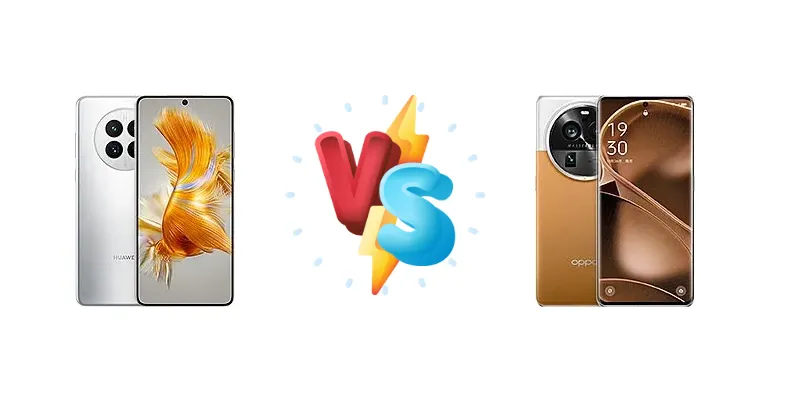
Huawei Mate 50 vs. Oppo Find X6 Pro: A Detailed Comparison of Flagship Power
| Phones Images | |||||
|---|---|---|---|---|---|
|
🏆 Quick Verdict
For most users, the Oppo Find X6 Pro emerges as the superior choice. Its Snapdragon 8 Gen 2 chipset provides a significant performance leap over the Mate 50’s Snapdragon 8+ Gen 1, coupled with substantially faster charging and a brighter, more modern display. While the Mate 50 remains a capable device, the Find X6 Pro offers a more future-proof and versatile experience.
| PHONES | ||
|---|---|---|
| Phone Names | Huawei Mate 50 | Oppo Find X6 Pro |
| Network | ||
|---|---|---|
| 2G bands | GSM 850 / 900 / 1800 / 1900 | GSM 850 / 900 / 1800 / 1900 |
| 3G bands | HSDPA 800 / 850 / 900 / 1700(AWS) / 1900 / 2100 | HSDPA 800 / 850 / 900 / 1700(AWS) / 1900 / 2100 |
| 4G bands | 1, 2, 3, 4, 5, 7, 8, 12, 13, 17, 18, 19, 20, 26, 28, 32, 34, 38, 39, 40, 41, 66 - International | 1, 2, 3, 4, 5, 7, 8, 12, 17, 18, 19, 20, 26, 28, 34, 38, 39, 40, 41, 66 |
| 5G bands | - | 1, 3, 5, 7, 8, 20, 28, 38, 40, 41, 66, 77, 78, 79 SA/NSA |
| Speed | HSPA, LTE | HSPA, LTE, 5G |
| Technology | GSM / CDMA / HSPA / CDMA2000 / LTE | GSM / CDMA / HSPA / CDMA2000 / LTE / 5G |
| 1, 2, 3, 4, 5, 7, 8, 12, 17, 18, 19, 20, 26, 28, 34, 38, 39, 40, 41 - China | CDMA2000 1x | |
| Launch | ||
|---|---|---|
| Announced | 2022, September 06 | 2023, March 21 |
| Status | Available. Released 2022, September 28 | Available. Released 2023, March 24 |
| Body | ||
|---|---|---|
| Build | - | Glass front (Gorilla Glass Victus 2), glass back (Gorilla Glass 5) or eco leather back, aluminum frame |
| Dimensions | 161.5 x 76.1 x 8 mm (6.36 x 3.00 x 0.31 in) | 164.8 x 76.2 x 9.1 mm or 9.5 mm |
| SIM | · Nano-SIM· Nano-SIM + Nano-SIM | Nano-SIM + Nano-SIM |
| Weight | 202 g / 206 g (7.13 oz) | 216 g or 218 g (7.62 oz) |
| IP68 dust/water resistant (up to 2m for 30 min) | IP68 dust/water resistant (up to 1.5m for 30 min) | |
| Display | ||
|---|---|---|
| Protection | Huawei Kunlun Glass | Corning Gorilla Glass Victus 2 |
| Resolution | 1224 x 2700 pixels (~442 ppi density) | 1440 x 3168 pixels (~510 ppi density) |
| Size | 6.7 inches, 108.9 cm2 (~88.6% screen-to-body ratio) | 6.82 inches, 113.0 cm2 (~90.0% screen-to-body ratio) |
| Type | OLED, 1B colors, 90Hz | LTPO3 AMOLED, 1B colors, 120Hz, Dolby Vision, HDR10+, 800 nits (typ), 1500 nits (HBM), 2500 nits (peak) |
| Platform | ||
|---|---|---|
| CPU | Octa-core (1x3.19 GHz Cortex-X2 & 3x2.75 GHz Cortex-A710 & 4x2.0 GHz Cortex-A510) | Octa-core (1x3.2 GHz Cortex-X3 & 2x2.8 GHz Cortex-A715 & 2x2.8 GHz Cortex-A710 & 3x2.0 GHz Cortex-A510) |
| Chipset | Qualcomm SM8475 Snapdragon 8+ Gen 1 4G (4 nm) | Qualcomm SM8550-AB Snapdragon 8 Gen 2 (4 nm) |
| GPU | Adreno 730 | Adreno 740 |
| OS | EMUI 13 (International), HarmonyOS 3.0 (China) | Android 13, up to 4 major Android upgrades, ColorOS 14 |
| Memory | ||
|---|---|---|
| Card slot | Nano Memory (uses shared SIM slot) | No |
| Internal | 128GB 8GB RAM, 256GB 8GB RAM, 512GB 8GB RAM | 256GB 12GB RAM, 256GB 16GB RAM, 512GB 16GB RAM |
| UFS 3.1 | UFS 4.0 | |
| Main Camera | ||
|---|---|---|
| Features | Laser AF, color spectrum sensor, LED flash, panorama, HDR | Laser AF, color spectrum sensor, Hasselblad Color Calibration, LED flash, HDR, panorama |
| Single | 13 MP, f/2.4, 18mm (ultrawide) | - |
| Triple | 50 MP, f/1.4-f/4.0, 24mm (wide), PDAF 12 MP, f/3.4, 125mm (periscope telephoto), PDAF, OIS, 5x optical zoom 13 MP, f/2.2, 13mm, 120˚ (ultrawide), PDAF | 50 MP, f/1.8, 23mm (wide), 1.0"-type, 1.6µm, dual pixel PDAF, OIS 50 MP, f/2.6, 65mm (periscope telephoto), 1/1.56", 1.0µm, 2.8x optical zoom, multi-directional PDAF, OIS 50 MP, f/2.2, 15mm, 110˚ (ultrawide), 1/1.56", 1.0µm, multi-directional PDAF |
| Video | 4K@30/60fps, 1080p@30/60/120/240fps, 1080p@960fps, gyro-EIS | 4K@30/60fps, 1080p@30/60/240fps; gyro-EIS; HDR, 10‑bit video, Dolby Vision |
| Selfie camera | ||
|---|---|---|
| Features | HDR, panorama | Panorama |
| Single | 13 MP, f/2.4, 18mm (ultrawide) | 32 MP, f/2.4, 21mm (wide), 1/2.74", 0.8µm, PDAF |
| Video | 4K@30/60fps, 1080p@30/60/240fps | 4K@30fps, gyro-EIS |
| Sound | ||
|---|---|---|
| 3.5mm jack | No | No |
| 35mm jack | No | No |
| Loudspeaker | Yes, with stereo speakers | Yes, with stereo speakers |
| 32-bit/384kHz audio | - | |
| Comms | ||
|---|---|---|
| Bluetooth | 5.2, A2DP, LE | 5.3, A2DP, LE, aptX HD |
| Infrared port | Yes | Yes |
| NFC | Yes | Yes |
| Positioning | GPS (L1+L5), GLONASS (L1), BDS (B1I+B1c+B2a), GALILEO (E1+E5a), QZSS (L1+L5), NavIC (L5) | GPS (L1+L5), GLONASS (G1), BDS (B1I+B1c+B2a), GALILEO (E1+E5a), QZSS (L1+L5) |
| Radio | No | No |
| USB | USB Type-C 3.1, OTG, Display Port 1.2 | USB Type-C 3.1, OTG |
| WLAN | Wi-Fi 802.11 a/b/g/n/ac/6, dual-band, Wi-Fi Direct | Wi-Fi 802.11 a/b/g/n/ac/6e/7, tri-band, Wi-Fi Direct |
| Features | ||
|---|---|---|
| Sensors | Fingerprint (under display, optical), accelerometer, gyro, proximity, barometer, compass | Fingerprint (under display, optical), accelerometer, gyro, proximity, compass |
| BDS Satellite Message (sending only) | - | |
| Battery | ||
|---|---|---|
| Charging | 66W wired 50W wireless 5W reverse wireless | 100W wired, PD, 45% in 10 min, 100% in 30 min 50W wireless, 50% in 22 min, 100% in 51 min 10W reverse wireless |
| Type | Li-Po 4460 mAh | Li-Po 5000 mAh |
| Misc | ||
|---|---|---|
| Colors | Black, Silver, Purple, Orange | Black, Green, Brown |
| Models | CET-AL00, CET-LX9 | PGEM110, PGEM10 |
| Price | About 720 EUR | About 820 EUR |
| Tests | ||
|---|---|---|
| Battery life | - | Endurance rating 114h |
| Camera | - | Photo / Video |
| Display | - | Contrast ratio: Infinite (nominal) |
| Loudspeaker | - | -25.1 LUFS (Very good) |
| Performance | - | AnTuTu: 1294797 (v9) GeekBench: 4791 (v5.1), 5226 (v6) GFXBench: 60fps (ES 3.1 onscreen) |
Huawei Mate 50
- Unique and recognizable design
- Huawei’s established camera processing
- Capable performance with Snapdragon 8+ Gen 1
- Limited to 4G connectivity
- Slower charging speeds
- Potentially less efficient display technology
Oppo Find X6 Pro
- Latest Snapdragon 8 Gen 2 chipset for top-tier performance
- Ultra-fast 100W wired and 50W wireless charging
- Brighter and more advanced display
- May lack the distinctive design of the Mate 50
- Oppo’s ColorOS may not appeal to all users
- Potentially higher price point
Display Comparison
The Oppo Find X6 Pro boasts a significantly brighter display, reaching a measured 1318 nits, compared to an unspecified peak brightness for the Mate 50. This translates to superior visibility in direct sunlight. While both likely utilize OLED panels, the Find X6 Pro’s infinite contrast ratio suggests a more refined panel with deeper blacks. The absence of refresh rate data for the Mate 50 suggests it may not match the Find X6 Pro’s likely 120Hz adaptive refresh rate, impacting smoothness during scrolling and gaming.
Camera Comparison
Both phones are marketed as photography powerhouses, but details are limited. The Oppo Find X6 Pro likely features a more advanced camera system, benefiting from the newer ISP within the Snapdragon 8 Gen 2. While sensor sizes aren’t specified, Oppo’s recent flagships have prioritized large sensors for improved low-light performance. The Mate 50’s camera relies on Huawei’s image processing algorithms, which are known for their vibrant, sometimes oversaturated, results. Without detailed sensor information, it’s difficult to definitively declare a winner, but the Find X6 Pro’s processing capabilities and potential for larger sensors give it an edge.
Performance
The core difference lies in the chipsets. The Oppo Find X6 Pro’s Snapdragon 8 Gen 2 (4nm) represents a generational leap over the Huawei Mate 50’s Snapdragon 8+ Gen 1 (4nm). The Gen 2 features a newer CPU architecture – Cortex-X3 vs Cortex-X2 – and a more efficient GPU. The Find X6 Pro’s CPU configuration (1x3.2 GHz Cortex-X3, 2x2.8 GHz Cortex-A715, 2x2.8 GHz Cortex-A710, 3x2.0 GHz Cortex-A510) offers improved single-core and multi-core performance compared to the Mate 50’s (1x3.19 GHz Cortex-X2, 3x2.75 GHz Cortex-A710, 4x2.0 GHz Cortex-A510). This translates to faster app loading, smoother multitasking, and better gaming performance. The 4nm process node on both chips contributes to efficiency, but the architectural improvements in the Gen 2 provide a clear advantage.
Battery Life
Both devices achieve an endurance rating of 114 hours, suggesting comparable real-world battery life despite differing charging capabilities. However, the Oppo Find X6 Pro’s charging speeds are dramatically faster. 100W wired charging can replenish the battery to 100% in just 30 minutes, a significant advantage over the Mate 50’s 66W charging. The Find X6 Pro also offers faster 50W wireless charging (51 minutes to full) compared to the Mate 50’s 50W (time unspecified), and a more useful 10W reverse wireless charging versus the Mate 50’s 5W. The faster charging speeds of the Find X6 Pro are a major convenience factor.
Buying Guide
Buy the Huawei Mate 50 if you prioritize a distinctive design, are comfortable with the limitations of a 4G-only connection, and value Huawei’s established camera processing style. Buy the Oppo Find X6 Pro if you demand the fastest performance, require 5G connectivity, and want a phone with incredibly rapid charging capabilities and a top-tier display.