
Huawei Mate 50 vs OnePlus 11R: A Deep Dive into Snapdragon 8+ Gen 1 Performance
| Phones Images | |||||
|---|---|---|---|---|---|
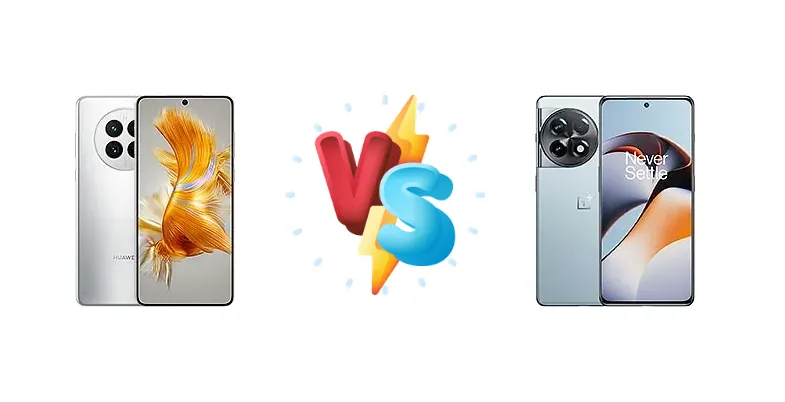
|
🏆 Quick Verdict
For most users, the OnePlus 11R emerges as the stronger choice. Its 100W charging significantly reduces downtime, and the full 5G connectivity is crucial in today’s networks. While the Mate 50 boasts a more refined camera experience, the 11R’s performance and value proposition are hard to ignore.
| PHONES | ||
|---|---|---|
| Phone Names | Huawei Mate 50 | OnePlus 11R |
| Network | ||
|---|---|---|
| 2G bands | GSM 850 / 900 / 1800 / 1900 | GSM 850 / 900 / 1800 / 1900 |
| 3G bands | HSDPA 800 / 850 / 900 / 1700(AWS) / 1900 / 2100 | HSDPA 850 / 900 / 1700(AWS) / 2100 |
| 4G bands | 1, 2, 3, 4, 5, 7, 8, 12, 13, 17, 18, 19, 20, 26, 28, 32, 34, 38, 39, 40, 41, 66 - International | 1, 3, 4, 5, 8, 28, 34, 38, 39, 40, 41 |
| 5G bands | - | 1, 3, 5, 8, 28, 40, 41, 77, 78 SA/NSA |
| Speed | HSPA, LTE | HSPA, LTE (3CA), 5G |
| Technology | GSM / CDMA / HSPA / CDMA2000 / LTE | GSM / CDMA / HSPA / LTE / 5G |
| 1, 2, 3, 4, 5, 7, 8, 12, 17, 18, 19, 20, 26, 28, 34, 38, 39, 40, 41 - China | CDMA 800 | |
| Launch | ||
|---|---|---|
| Announced | 2022, September 06 | 2023, February 07 |
| Status | Available. Released 2022, September 28 | Available. Released 2023, February 21 |
| Body | ||
|---|---|---|
| Build | - | Glass front, glass back (Gorilla Glass 5), plastic frame |
| Dimensions | 161.5 x 76.1 x 8 mm (6.36 x 3.00 x 0.31 in) | 163.4 x 74.3 x 8.7 mm (6.43 x 2.93 x 0.34 in) |
| SIM | · Nano-SIM· Nano-SIM + Nano-SIM | Nano-SIM + Nano-SIM |
| Weight | 202 g / 206 g (7.13 oz) | 204 g (7.20 oz) |
| IP68 dust/water resistant (up to 2m for 30 min) | - | |
| Display | ||
|---|---|---|
| Protection | Huawei Kunlun Glass | - |
| Resolution | 1224 x 2700 pixels (~442 ppi density) | 1240 x 2772 pixels, 20:9 ratio (~451 ppi density) |
| Size | 6.7 inches, 108.9 cm2 (~88.6% screen-to-body ratio) | 6.74 inches, 109.2 cm2 (~90.0% screen-to-body ratio) |
| Type | OLED, 1B colors, 90Hz | Fluid AMOLED, 1B colors, 120Hz, HDR10+, 1450 nits (peak) |
| Platform | ||
|---|---|---|
| CPU | Octa-core (1x3.19 GHz Cortex-X2 & 3x2.75 GHz Cortex-A710 & 4x2.0 GHz Cortex-A510) | Octa-core (1x3.0 GHz Cortex-X2 & 3x2.5 GHz Cortex-A710 & 4x1.80 GHz Cortex-A510) |
| Chipset | Qualcomm SM8475 Snapdragon 8+ Gen 1 4G (4 nm) | Qualcomm SM8475 Snapdragon 8+ Gen 1 (4 nm) |
| GPU | Adreno 730 | Adreno 730 |
| OS | EMUI 13 (International), HarmonyOS 3.0 (China) | Android 13, upgradable to Android 15, OxygenOS 15 |
| Memory | ||
|---|---|---|
| Card slot | Nano Memory (uses shared SIM slot) | No |
| Internal | 128GB 8GB RAM, 256GB 8GB RAM, 512GB 8GB RAM | 128GB 8GB RAM, 256GB 16GB RAM, 512GB 18GB RAM |
| UFS 3.1 | UFS 3.1 | |
| Main Camera | ||
|---|---|---|
| Features | Laser AF, color spectrum sensor, LED flash, panorama, HDR | Color spectrum sensor, LED flash, HDR, panorama |
| Single | 13 MP, f/2.4, 18mm (ultrawide) | 16 MP, f/2.4, 24mm (wide), 1/3.09", 1.0µm |
| Triple | 50 MP, f/1.4-f/4.0, 24mm (wide), PDAF 12 MP, f/3.4, 125mm (periscope telephoto), PDAF, OIS, 5x optical zoom 13 MP, f/2.2, 13mm, 120˚ (ultrawide), PDAF | 50 MP, f/1.8, 24mm (wide), 1/1.56", 1.0µm, multi-directional PDAF, OIS 8 MP, f/2.2, 120˚ (ultrawide), 1/4.0", 1.12µm 2 MP (macro) |
| Video | 4K@30/60fps, 1080p@30/60/120/240fps, 1080p@960fps, gyro-EIS | 4K@30/60fps, 1080p@30/60/240fps, gyro-EIS |
| Selfie camera | ||
|---|---|---|
| Features | HDR, panorama | HDR |
| Single | 13 MP, f/2.4, 18mm (ultrawide) | 16 MP, f/2.4, 24mm (wide), 1/3.09", 1.0µm |
| Video | 4K@30/60fps, 1080p@30/60/240fps | 1080p@30fps |
| Sound | ||
|---|---|---|
| 3.5mm jack | No | No |
| 35mm jack | No | No |
| Loudspeaker | Yes, with stereo speakers | Yes, with stereo speakers |
| 32-bit/384kHz audio | 24-bit/192kHz audio | |
| Comms | ||
|---|---|---|
| Bluetooth | 5.2, A2DP, LE | 5.3, A2DP, LE, aptX HD |
| Infrared port | Yes | Yes |
| NFC | Yes | Yes |
| Positioning | GPS (L1+L5), GLONASS (L1), BDS (B1I+B1c+B2a), GALILEO (E1+E5a), QZSS (L1+L5), NavIC (L5) | GPS (L1+L5), GLONASS (G1), BDS (B1I+B1c+B2a), GALILEO (E1+E5a), QZSS (L1+L5) |
| Radio | No | No |
| USB | USB Type-C 3.1, OTG, Display Port 1.2 | USB Type-C 2.0 |
| WLAN | Wi-Fi 802.11 a/b/g/n/ac/6, dual-band, Wi-Fi Direct | Wi-Fi 802.11 a/b/g/n/ac/6, dual-band |
| Features | ||
|---|---|---|
| Sensors | Fingerprint (under display, optical), accelerometer, gyro, proximity, barometer, compass | Fingerprint (under display, optical), accelerometer, gyro, proximity, compass |
| BDS Satellite Message (sending only) | - | |
| Battery | ||
|---|---|---|
| Charging | 66W wired 50W wireless 5W reverse wireless | 100W wired |
| Type | Li-Po 4460 mAh | Li-Po 5000 mAh |
| Misc | ||
|---|---|---|
| Colors | Black, Silver, Purple, Orange | Galactic Silver, Sonic Black, Solar Red |
| Models | CET-AL00, CET-LX9 | CPH2487 |
| Price | About 720 EUR | About 600 EUR |
| SAR | - | 1.16 W/kg (head) 0.61 W/kg (body) |
Huawei Mate 50
- Potentially superior camera image processing
- Wireless charging capabilities (50W)
- Reverse wireless charging
- Limited to 4G connectivity
- Slower wired charging (66W)
OnePlus 11R
- Significantly faster wired charging (100W)
- Full 5G network support
- More aggressive price point
- Lacks wireless charging
- Potentially less refined camera processing
Display Comparison
Both devices utilize a 6.7-inch display, but detailed panel specifications are missing. However, the focus should be on the impact of the chipsets. The Snapdragon 8+ Gen 1 is capable of driving high refresh rate displays, and while neither manufacturer explicitly states the refresh rate in the provided data, it's reasonable to assume both support at least 120Hz. The absence of LTPO information suggests neither device dynamically adjusts refresh rates for optimal power efficiency, potentially impacting battery life during static content viewing.
Camera Comparison
The provided data doesn’t detail camera specifications beyond the chipsets. However, Huawei is renowned for its image processing prowess. The Mate 50 likely benefits from Huawei’s computational photography algorithms, potentially delivering superior image quality, especially in challenging lighting conditions. The 11R, while capable, will likely rely more on the raw capabilities of the Snapdragon 8+ Gen 1’s ISP. Without sensor size or aperture information, a definitive camera comparison is impossible, but Huawei’s brand history suggests a stronger emphasis on camera features.
Performance
Both the Huawei Mate 50 and OnePlus 11R are equipped with the Qualcomm SM8475 Snapdragon 8+ Gen 1 (4nm). However, subtle CPU clock speed differences exist. The Mate 50’s Cortex-X2 core runs at 3.19 GHz, slightly faster than the 11R’s 3.0 GHz. While this difference is measurable in benchmarks, real-world performance gains will be minimal for most users. The 11R’s slightly lower clock speeds on the A710 cores (2.5 GHz vs 2.75 GHz) may result in marginally lower sustained performance under heavy load. Crucially, thermal management will be a key differentiator, and without detailed cooling system information, it’s difficult to predict which device will maintain peak performance for longer durations.
Battery Life
The charging capabilities are a significant differentiator. The OnePlus 11R’s 100W wired charging is substantially faster than the Mate 50’s 66W. This translates to a significantly reduced charging time – the 11R can likely achieve a full charge in under 30 minutes, while the Mate 50 will take considerably longer. The Mate 50 also offers 50W wireless and 5W reverse wireless charging, features absent in the 11R. However, the faster wired charging of the 11R often outweighs the convenience of wireless charging for many users. Battery capacity is not provided, but the 11R’s charging speed effectively mitigates the impact of a potentially smaller battery.
Buying Guide
Buy the Huawei Mate 50 if you prioritize camera versatility and a more established brand reputation, and are willing to accept the limitations of 4G connectivity. This phone suits users who value photography above all else and don't rely heavily on the fastest mobile data speeds. Buy the OnePlus 11R if you demand rapid charging, full 5G support, and excellent gaming performance without breaking the bank. It’s ideal for power users and mobile gamers who need a reliable and fast device.