
Huawei Mate 50 RS Porsche Design vs. Mate 40 RS Porsche Design: Which Reigns Supreme?
| Phones Images | |||||
|---|---|---|---|---|---|
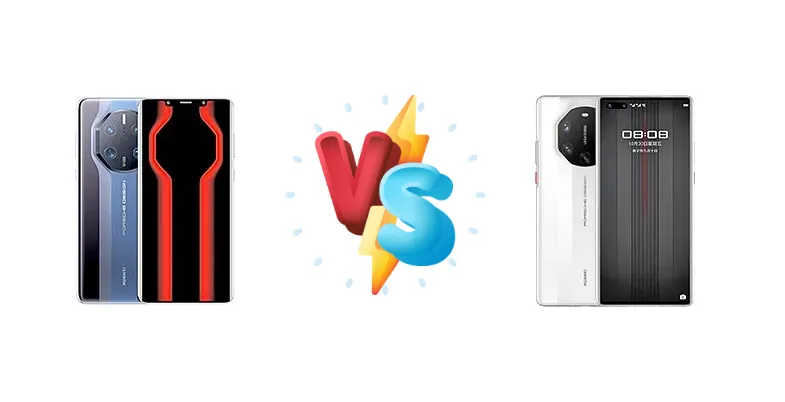
|
🏆 Quick Verdict
The Mate 50 RS Porsche Design offers a performance boost thanks to the Snapdragon 8+ Gen 1 and improved camera capabilities. However, the Kirin 9000 in the Mate 40 RS remains a powerful contender, especially considering its often-lower price. The Mate 50 RS is the overall winner for those prioritizing the latest tech.
| PHONES | ||
|---|---|---|
| Phone Names | Huawei Mate 50 RS Porsche Design | Huawei Mate 40 RS Porsche Design |
| Network | ||
|---|---|---|
| 2G bands | GSM 850 / 900 / 1800 / 1900 | GSM 850 / 900 / 1800 / 1900 |
| 3G bands | HSDPA 800 / 850 / 900 / 1700(AWS) / 1900 / 2100 | HSDPA 800 / 850 / 900 / 1700(AWS) / 1900 / 2100 |
| 4G bands | 1, 2, 3, 4, 5, 7, 8, 12, 17, 18, 19, 20, 26, 28, 34, 38, 39, 40, 41 | 1, 2, 3, 4, 5, 6, 7, 8, 9, 12, 17, 18, 19, 20, 26, 34, 38, 39, 40, 41 |
| 5G bands | - | 1, 3, 28, 38, 40, 41, 77, 78, 79, 80, 84 SA/NSA/Sub6 |
| Speed | HSPA, LTE | HSPA, LTE, 5G |
| Technology | GSM / CDMA / HSPA / CDMA2000 / LTE | GSM / HSPA / LTE / 5G |
| CDMA2000 1x | - | |
| Launch | ||
|---|---|---|
| Announced | 2022, September 06 | 2020, October 22 |
| Status | Available. Released 2022, September 21 | Available. Released 2020, November 04 |
| Body | ||
|---|---|---|
| Build | Glass front, ceramic back, aluminum frame | Glass front, ceramic back, aluminum frame |
| Dimensions | 162.1 x 75.5 x 9.9 mm (6.38 x 2.97 x 0.39 in) | 162.9 x 75.5 x 10.1 mm (6.41 x 2.97 x 0.40 in) |
| SIM | · Nano-SIM· Nano-SIM + Nano-SIM | · Nano-SIM· Nano-SIM + Nano-SIM |
| Weight | 232 g (8.18 oz) | 234 g (8.25 oz) |
| IP68 dust/water resistant (up to 6m for 30 min) | IP68 dust/water resistant | |
| Display | ||
|---|---|---|
| Protection | Huawei Kunlun Glass | - |
| Resolution | 1212 x 2616 pixels, 19.5:9 ratio (~428 ppi density) | 1344 x 2772 pixels, 18.5:9 ratio (~456 ppi density) |
| Size | 6.74 inches, 111.8 cm2 (~91.3% screen-to-body ratio) | 6.76 inches, 115.7 cm2 (~94.1% screen-to-body ratio) |
| Type | OLED, 1B colors, 120Hz | OLED, HDR10, 90Hz |
| Platform | ||
|---|---|---|
| CPU | Octa-core (1x3.19 GHz Cortex-X2 & 3x2.75 GHz Cortex-A710 & 4x2.0 GHz Cortex-A510) | Octa-core (1x3.13 GHz Cortex-A77 & 3x2.54 GHz Cortex-A77 & 4x2.05 GHz Cortex-A55) |
| Chipset | Qualcomm SM8475 Snapdragon 8+ Gen 1 4G (4 nm) | Kirin 9000 5G (5 nm) |
| GPU | Adreno 730 | Mali-G78 MP24 |
| OS | HarmonyOS 3.0 | Android 10, EMUI 11, no Google Play Services |
| Memory | ||
|---|---|---|
| Card slot | Nano Memory (uses shared SIM slot) | Nano Memory (uses shared SIM slot) |
| Internal | 512GB 12GB RAM | 256GB 8GB RAM, 256GB 12GB RAM, 512GB 12GB RAM |
| UFS 3.1 | SFS 1.0 | |
| Main Camera | ||
|---|---|---|
| Features | Laser AF, color spectrum sensor, LED flash, panorama, HDR | Laser AF, color spectrum sensor, Leica optics, LED flash, panorama, HDR |
| Quad | - | 50 MP, f/1.9, 23mm (wide), 1/1.28", 1.22µm, multi-directional PDAF, OIS 12 MP, f/2.4, (telephoto), PDAF, OIS, 3x optical zoom 8 MP, f/4.4, 240mm (periscope telephoto), PDAF, OIS, 10x optical zoom 20 MP, f/1.8, 18mm (ultrawide), PDAF TOF 3D, (depth) |
| Single | 13 MP, f/2.4, 18mm (ultrawide) TOF 3D, (depth/biometrics sensor) | - |
| Triple | 50 MP, f/1.4-f/4.0, 24mm (wide), PDAF, OIS 48 MP, f/3.0, 90mm (periscope telephoto macro), PDAF, OIS, 3.5x optical zoom 13 MP, f/2.2, 13mm, 120˚ (ultrawide), PDAF | - |
| Video | 4K@30/60fps, 1080p@30/60/120/240/480fps, 720p@960fps, 720p@3840fps, HDR, gyro-EIS | 4K@30/60fps, 1080p@30/60/120/240/480fps, 720p@960fps, 720p@3840fps, HDR, gyro-EIS |
| Selfie camera | ||
|---|---|---|
| Features | HDR, panorama | HDR, panorama |
| Single | 13 MP, f/2.4, 18mm (ultrawide) TOF 3D, (depth/biometrics sensor) | 13 MP, f/2.4, 18mm (ultrawide) TOF 3D, (depth/biometrics sensor) |
| Video | 4K@30/60fps, 1080p@30/60/240fps | 4K@30/60fps, 1080p@30/60/240fps |
| Sound | ||
|---|---|---|
| 3.5mm jack | No | No |
| 35mm jack | No | No |
| Loudspeaker | Yes, with stereo speakers | Yes, with stereo speakers |
| 32-bit/384kHz audio | 32-bit/384kHz audio | |
| Comms | ||
|---|---|---|
| Bluetooth | 5.2, A2DP, LE | 5.2, A2DP, LE |
| Infrared port | Yes | Yes |
| NFC | Yes | Yes |
| Positioning | GPS (L1+L5), GLONASS (L1), BDS (B1I+B1c+B2a), GALILEO (E1+E5a), QZSS (L1+L5), NavIC (L5) | GPS (L1+L5), GLONASS (L1), BDS (B1I+B1c+B2a+B2b), GALILEO (E1+E5a+E5b), QZSS (L1+L5), NavIC |
| Radio | No | No |
| USB | USB Type-C 3.1, OTG, Display Port 1.2 | USB Type-C 3.1, OTG |
| WLAN | Wi-Fi 802.11 a/b/g/n/ac/6, dual-band, Wi-Fi Direct | Wi-Fi 802.11 a/b/g/n/ac/6, dual-band, Wi-Fi Direct |
| Features | ||
|---|---|---|
| Sensors | Face ID, fingerprint (under display, optical), accelerometer, gyro, proximity, barometer, compass | Face ID, fingerprint (under display, optical), accelerometer, gyro, proximity, barometer, compass, infrared thermometer |
| BDS Satellite Message (sending only) | - | |
| Battery | ||
|---|---|---|
| Charging | 66W wired 50W wireless 5W reverse wireless | 66W wired 50W wireless 5W reverse wireless |
| Type | Li-Po 4700 mAh | Li-Po 4400 mAh |
| Misc | ||
|---|---|---|
| Colors | Ink Blue, Purple | Ceramic White, Ceramic Black, Collector Edition |
| Models | DCO-AL00 | NOP-AN00 |
| Price | About 1880 EUR | About 1400 EUR |
Huawei Mate 50 RS Porsche Design
- Significantly faster Snapdragon 8+ Gen 1 chipset
- Improved camera system with XMAGE technology
- More modern design and materials
- Slightly better display technology
- Higher price point
- 4G connectivity only
- Limited software support compared to other brands
Huawei Mate 40 RS Porsche Design
- Powerful Kirin 9000 chipset
- Excellent camera performance
- Luxurious Porsche Design aesthetics
- Potentially lower price (depending on availability)
- Older chipset, less efficient than Snapdragon 8+ Gen 1
- Slightly older display technology
- 4G connectivity only
- Limited software support compared to other brands
Display Comparison
Both phones feature OLED displays with vibrant colors and excellent contrast. The Mate 50 RS likely has slightly improved brightness and color accuracy due to newer panel technology, but the difference is subtle. Both offer a smooth 90Hz refresh rate for fluid scrolling and animations.
Camera Comparison
The Mate 50 RS boasts a more advanced camera system, likely with improved image processing and low-light performance. While the Mate 40 RS had an excellent camera, the Mate 50 RS's XMAGE imaging technology brings noticeable improvements in detail, color reproduction, and dynamic range. Both offer Leica-branded lenses for exceptional image quality.
Performance
The Snapdragon 8+ Gen 1 in the Mate 50 RS is significantly faster and more efficient than the Kirin 9000 in the Mate 40 RS. Expect smoother multitasking, faster app loading times, and better gaming performance on the Mate 50 RS. The Kirin 9000 is still a capable chip, but it shows its age compared to the newer Snapdragon.
Battery Life
Battery life is comparable between the two devices, with both offering all-day battery life under moderate usage. Charging speeds are identical at 66W wired and 50W wireless, ensuring relatively quick top-ups.
Buying Guide
The Huawei Mate 50 RS Porsche Design is for those who demand the absolute best in performance, camera technology, and exclusive design. It's a statement piece for tech enthusiasts with a generous budget. The Mate 40 RS Porsche Design is a great choice for users seeking a premium experience with flagship-level performance and a stunning design, but at a potentially more accessible price point.