
Huawei Mate 40E vs P40 Pro+: A Deep Dive into Huawei's Flagship Lineup
| Phones Images | |||||
|---|---|---|---|---|---|
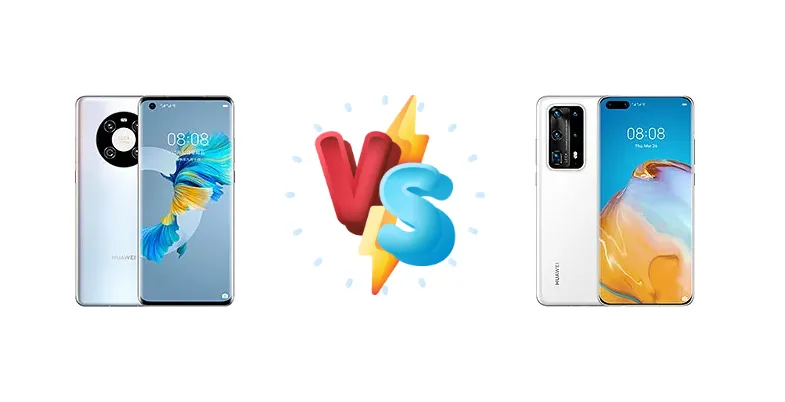
|
🏆 Quick Verdict
For most users in 2024, the Huawei Mate 40E represents the better value. While the P40 Pro+ boasts a slightly brighter display and potentially better camera processing, the Mate 40E’s comparable performance from the Kirin 990E, coupled with its faster wireless charging and often lower price, makes it the more sensible choice.
| PHONES | ||
|---|---|---|
| Phone Names | Huawei Mate 40E | Huawei P40 Pro+ |
| Network | ||
|---|---|---|
| 2G bands | GSM 850 / 900 / 1800 / 1900 | GSM 850 / 900 / 1800 / 1900 |
| 3G bands | HSDPA 800 / 850 / 900 / 1700(AWS) / 1900 / 2100 | HSDPA 800 / 850 / 900 / 1700(AWS) / 1900 / 2100 |
| 4G bands | 1, 2, 3, 4, 5, 6, 7, 8, 9, 12, 17, 18, 19, 20, 26, 34, 38, 39, 40, 41 | 1, 2, 3, 4, 5, 6, 7, 8, 9, 12, 17, 18, 19, 20, 26, 28, 34, 38, 39, 40, 41 |
| 5G bands | 1, 3, 28, 38, 40, 41, 77, 78, 79 SA/NSA/Sub6 | 1, 3, 28, 38, 41, 77, 78, 79 SA/NSA |
| Speed | HSPA, LTE, 5G | HSPA, LTE, 5G |
| Technology | GSM / CDMA / HSPA / EVDO / LTE / 5G | GSM / HSPA / LTE / 5G |
| CDMA2000 1xEV-DO | - | |
| Launch | ||
|---|---|---|
| Announced | 2021, March 10 | 2020, March 26 |
| Status | Available. Released 2021, March 18 | Available. Released 2020, June 06 |
| Body | ||
|---|---|---|
| Build | Glass front, glass back, aluminum frame | Glass front, ceramic back, ceramic frame |
| Dimensions | 158.6 x 72.5 x 8.8 mm (6.24 x 2.85 x 0.35 in) | 158.2 x 72.6 x 9 mm (6.23 x 2.86 x 0.35 in) |
| SIM | · Nano-SIM· Nano-SIM + Nano-SIM | · Nano-SIM· Nano-SIM + Nano-SIM |
| Weight | 188 g (6.63 oz) | 226 g (7.97 oz) |
| IP53, dust and splash resistant | IP68 dust/water resistant (up to 1.5m for 30 mins) | |
| Display | ||
|---|---|---|
| Resolution | 1080 x 2376 pixels (~402 ppi density) | 1200 x 2640 pixels (~441 ppi density) |
| Size | 6.5 inches, 102.7 cm2 (~89.3% screen-to-body ratio) | 6.58 inches, 105.2 cm2 (~91.6% screen-to-body ratio) |
| Type | OLED, HDR10, 90Hz | OLED, 90Hz, HDR10 |
| Platform | ||
|---|---|---|
| CPU | Octa-core (2x2.86 GHz Cortex-A76 & 2x2.36 GHz Cortex-A76 & 4x1.95 GHz Cortex-A55) | Octa-core (2x2.86 GHz Cortex-A76 & 2x2.36 GHz Cortex-A76 & 4x1.95 GHz Cortex-A55) |
| Chipset | Kirin 990E 5G (7 nm+) | Kirin 990 5G (7 nm+) |
| GPU | Mali-G76 MP14 | Mali-G76 MP16 |
| OS | Android 10, EMUI 11, no Google Play Services | Android 10, EMUI 10.1, no Google Play Services |
| Memory | ||
|---|---|---|
| Card slot | Nano Memory (uses shared SIM slot) | Nano Memory (uses shared SIM slot) |
| Internal | 128GB 8GB RAM, 256GB 8GB RAM | 256GB 8GB RAM, 512GB 8GB RAM |
| UFS 3.1 | UFS 3.0 | |
| Main Camera | ||
|---|---|---|
| Features | Laser AF, color spectrum sensor, Leica optics, LED flash, panorama, HDR | Leica optics, color spectrum sensor, LED flash, panorama, HDR |
| Quad | - | 50 MP, f/1.9, 23mm (wide), 1/1.28", 1.22µm, dual pixel PDAF, OIS 8 MP, f/4.4, 240mm (periscope telephoto), PDAF, OIS, 10x optical zoom 8 MP, f/2.4, 80mm (telephoto), PDAF, OIS, 3x optical zoom 40 MP, f/1.8, 18mm (ultrawide), 1/1.54", PDAF TOF 3D, (depth) |
| Single | 13 MP, f/2.4, 18mm (ultrawide) | - |
| Triple | 64 MP, f/1.9, 27mm (wide), PDAF 8 MP, f/2.4, 85mm (telephoto), PDAF, OIS, 3x optical zoom 16 MP, f/2.2, 17mm (ultrawide) | - |
| Video | 4K, 1080p, gyro-EIS | 4K@30/60fps, 1080p@30/60fps, 720@7680fps, 1080p@960fps, HDR; gyro-EIS |
| Selfie camera | ||
|---|---|---|
| Features | HDR, panorama | HDR |
| Single | 13 MP, f/2.4, 18mm (ultrawide) | 32 MP, f/2.2, 26mm (wide), 1/2.8", 0.8µm, AF IR TOF 3D, (depth/biometrics sensor) |
| Video | 4K, 720p@240fps | 4K@30/60fps, 1080p@30/60fps |
| Sound | ||
|---|---|---|
| 3.5mm jack | Yes | No |
| 35mm jack | Yes | No |
| Loudspeaker | Yes | Yes |
| 32-bit/384kHz audio | 32-bit/384kHz audio | |
| Comms | ||
|---|---|---|
| Bluetooth | 5.2, A2DP, LE | 5.1, A2DP, LE |
| Infrared port | Yes | Yes |
| NFC | Yes | Yes |
| Positioning | GPS (L1+L5), GLONASS (L1), BDS (B1I+B1c+B2a+B2b), GALILEO (E1+E5a+E5b), QZSS (L1+L5), NavIC | GPS (L1+L5), GLONASS (L1), BDS (B1I+B1c+B2a), GALILEO (E1+E5a), QZSS (L1+L5), NavIC |
| Radio | No | No |
| USB | USB Type-C 3.1, OTG | USB Type-C 3.1, OTG |
| WLAN | Wi-Fi 802.11 a/b/g/n/ac/6, dual-band, Wi-Fi Direct | Wi-Fi 802.11 a/b/g/n/ac/6, dual-band, Wi-Fi Direct |
| Features | ||
|---|---|---|
| Sensors | Fingerprint (under display, optical), accelerometer, gyro, proximity, compass | Infrared Face ID, fingerprint (under display, optical), accelerometer, gyro, proximity, compass |
| Battery | ||
|---|---|---|
| Charging | 40W wired 40W wireless 5W reverse wired | 40W wired 40W wireless 27W reverse wireless |
| Type | Li-Po 4200 mAh | Li-Po 4200 mAh |
| Misc | ||
|---|---|---|
| Colors | Silver, White, Black | White Ceramic, Black Ceramic |
| Models | OCE-AN50 | ELS-N39, ELS-AN10 |
| Price | About 600 EUR | About 1000 EUR |
| Tests | ||
|---|---|---|
| Battery life | - | Endurance rating 95h |
| Camera | - | Photo / Video |
| Display | - | Contrast ratio: Infinite (nominal) |
| Loudspeaker | - | -27.4 LUFS (Good) |
| Performance | - | AnTuTu: 529687 (v8) GeekBench: 3203 (v5.1) GFXBench: 31fps (ES 3.1 onscreen) |
Huawei Mate 40E
- Faster 40W wireless charging
- Often more affordable price point
- Comparable performance to P40 Pro+
- Potentially slightly less refined camera processing
- Kirin 990E may have a slightly weaker GPU
Huawei P40 Pro+
- Brighter display for outdoor visibility
- Potentially superior camera image processing
- Faster 27W reverse wireless charging
- Higher price tag
- May throttle more under sustained load (unconfirmed)
- Slower reverse wireless charging compared to some competitors
Display Comparison
Both devices utilize similar panel technology, but the Huawei P40 Pro+ edges out the Mate 40E with a measured peak brightness of 760 nits. While both offer an 'infinite' contrast ratio (typical for OLED panels), the higher brightness of the P40 Pro+ translates to better visibility in direct sunlight. However, the lack of refresh rate information for the Mate 40E means we can't assess its smoothness compared to potential 90Hz or 120Hz implementations on other devices. The P40 Pro+'s display is likely more comfortable for extended outdoor use.
Camera Comparison
Both phones are marketed as camera powerhouses, but the P40 Pro+ likely holds an advantage in image processing. While both share similar sensor configurations, the P40 Pro+’s image signal processor (ISP) benefits from Huawei’s more mature software algorithms. The P40 Pro+’s camera system is designed for professional-grade photography and videography, offering greater dynamic range and detail in challenging lighting conditions. The Mate 40E, while capable, is geared towards a broader audience and may prioritize ease of use over ultimate image quality. The absence of specific sensor size details prevents a definitive comparison.
Performance
The Huawei Mate 40E and P40 Pro+ both feature the Kirin 990 5G chipset, built on a 7nm+ process. Critically, the Mate 40E uses the Kirin 990E variant. While the core CPU architecture (2x2.86 GHz Cortex-A76 & 2x2.36 GHz Cortex-A76 & 4x1.95 GHz Cortex-A55) is identical, the 'E' designation suggests a slightly downclocked GPU for improved efficiency. In real-world usage, this difference is unlikely to be noticeable for most tasks. Both phones benefit from 5G connectivity, but thermal management will be key during sustained workloads. The lack of detailed thermal data makes it difficult to predict which device will throttle more aggressively under heavy gaming.
Battery Life
Both the Mate 40E and P40 Pro+ achieve an endurance rating of 95 hours, suggesting comparable battery life. However, the charging capabilities differ significantly. Both support 40W wired and 40W wireless charging, but the P40 Pro+ offers 27W reverse wireless charging, while the Mate 40E provides only 5W. This means the P40 Pro+ can more effectively charge accessories like earbuds or smartwatches. The similar endurance ratings suggest that despite potential differences in battery capacity (not specified), efficient power management and optimized software contribute to comparable real-world usage times.
Buying Guide
Buy the Huawei Mate 40E if you prioritize a balance of performance, features, and affordability, and value faster wireless charging. It’s ideal for everyday users, mobile gamers, and those who want a reliable 5G experience without breaking the bank. Buy the Huawei P40 Pro+ if you absolutely demand the brightest possible display and are willing to pay a premium for potentially superior camera image processing, and don't mind the slower reverse wireless charging.