
Huawei Mate 40E vs Google Pixel 6 Pro: A Detailed Comparison of Flagship Power
| Phones Images | |||||
|---|---|---|---|---|---|
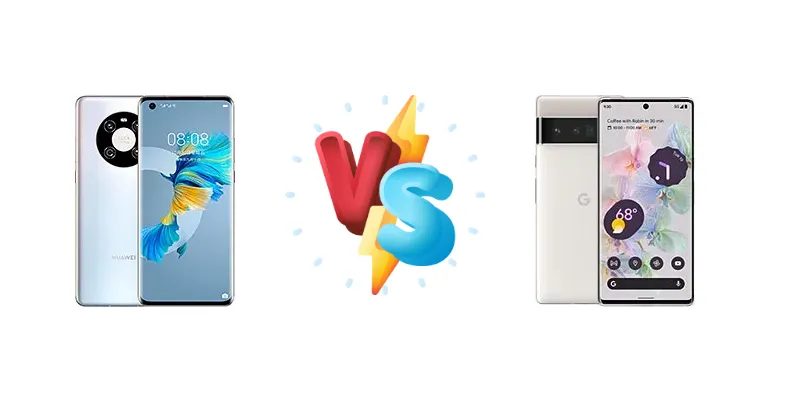
|
🏆 Quick Verdict
For most users, the Google Pixel 6 Pro is the superior choice. Its Google Tensor chip, while not a raw performance leader, offers a uniquely optimized experience, and its superior display brightness and software support outweigh the Mate 40E’s faster charging speeds. However, the Mate 40E remains a compelling option for those prioritizing a more compact form factor and who can live without Google services.
| PHONES | ||
|---|---|---|
| Phone Names | Huawei Mate 40E | Google Pixel 6 Pro |
| Network | ||
|---|---|---|
| 2G bands | GSM 850 / 900 / 1800 / 1900 | GSM 850 / 900 / 1800 / 1900 |
| 3G bands | HSDPA 800 / 850 / 900 / 1700(AWS) / 1900 / 2100 | HSDPA 800 / 850 / 900 / 1700(AWS) / 1900 / 2100 |
| 4G bands | 1, 2, 3, 4, 5, 6, 7, 8, 9, 12, 17, 18, 19, 20, 26, 34, 38, 39, 40, 41 | 1, 2, 3, 4, 5, 7, 8, 12, 13, 14, 17, 18, 19, 20, 25, 26, 28, 29, 30, 32, 38, 39, 40, 41, 42, 46, 48, 66, 71 - GLUOG, G8VOU |
| 5G bands | 1, 3, 28, 38, 40, 41, 77, 78, 79 SA/NSA/Sub6 | 1, 2, 3, 5, 7, 8, 12, 14, 20, 25, 28, 30, 38, 40, 41, 48, 66, 71, 77, 78, 257, 258, 260, 261 SA/NSA/Sub6/mmWave - G8VOU |
| Speed | HSPA, LTE, 5G | HSPA, LTE, 5G |
| Technology | GSM / CDMA / HSPA / EVDO / LTE / 5G | GSM / CDMA / HSPA / EVDO / LTE / 5G |
| CDMA2000 1xEV-DO | 1, 2, 3, 5, 7, 8, 12, 14, 20, 25, 28, 30, 38, 40, 41, 48, 66, 71, 77, 78 SA/NSA/Sub6 - GLUOG | |
| Launch | ||
|---|---|---|
| Announced | 2021, March 10 | 2021, October 19 |
| Status | Available. Released 2021, March 18 | Available. Released 2021, October 28 |
| Body | ||
|---|---|---|
| Build | Glass front, glass back, aluminum frame | Glass front (Gorilla Glass Victus), glass back (Gorilla Glass Victus), aluminum frame |
| Dimensions | 158.6 x 72.5 x 8.8 mm (6.24 x 2.85 x 0.35 in) | 163.9 x 75.9 x 8.9 mm (6.45 x 2.99 x 0.35 in) |
| SIM | · Nano-SIM· Nano-SIM + Nano-SIM | Nano-SIM + eSIM |
| Weight | 188 g (6.63 oz) | 210 g (7.41 oz) |
| IP53, dust and splash resistant | IP68 dust/water resistant (up to 1.5m for 30 min) | |
| Display | ||
|---|---|---|
| Protection | - | Corning Gorilla Glass Victus |
| Resolution | 1080 x 2376 pixels (~402 ppi density) | 1440 x 3120 pixels, 19.5:9 ratio (~512 ppi density) |
| Size | 6.5 inches, 102.7 cm2 (~89.3% screen-to-body ratio) | 6.7 inches, 110.6 cm2 (~88.9% screen-to-body ratio) |
| Type | OLED, HDR10, 90Hz | LTPO AMOLED, 120Hz, HDR10+ |
| - | Always-on display | |
| Platform | ||
|---|---|---|
| CPU | Octa-core (2x2.86 GHz Cortex-A76 & 2x2.36 GHz Cortex-A76 & 4x1.95 GHz Cortex-A55) | Octa-core (2x2.80 GHz Cortex-X1 & 2x2.25 GHz Cortex-A76 & 4x1.80 GHz Cortex-A55) |
| Chipset | Kirin 990E 5G (7 nm+) | Google Tensor (5 nm) |
| GPU | Mali-G76 MP14 | Mali-G78 MP20 |
| OS | Android 10, EMUI 11, no Google Play Services | Android 12, upgradable to Android 15, up to 5 major Android upgrades |
| Memory | ||
|---|---|---|
| Card slot | Nano Memory (uses shared SIM slot) | No |
| Internal | 128GB 8GB RAM, 256GB 8GB RAM | 128GB 12GB RAM, 256GB 12GB RAM, 512GB 12GB RAM |
| UFS 3.1 | UFS 3.1 | |
| Main Camera | ||
|---|---|---|
| Features | Laser AF, color spectrum sensor, Leica optics, LED flash, panorama, HDR | Laser AF, Dual-LED flash, Pixel Shift, Auto-HDR, panorama |
| Single | 13 MP, f/2.4, 18mm (ultrawide) | 11.1 MP, f/2.2, 20mm (ultrawide), 1.22µm |
| Triple | 64 MP, f/1.9, 27mm (wide), PDAF 8 MP, f/2.4, 85mm (telephoto), PDAF, OIS, 3x optical zoom 16 MP, f/2.2, 17mm (ultrawide) | 50 MP, f/1.9, 25mm (wide), 1/1.31", 1.2µm, dual pixel PDAF, OIS 48 MP, f/3.5, 104mm (periscope telephoto), 1/2.0", 0.8µm, PDAF, OIS, 4x optical zoom 12 MP, f/2.2, 17mm, 114˚ (ultrawide), 1.25µm |
| Video | 4K, 1080p, gyro-EIS | 4K@30/60fps, 1080p@30/60/120/240fps; gyro-EIS, OIS |
| Selfie camera | ||
|---|---|---|
| Features | HDR, panorama | HDR, panorama |
| Single | 13 MP, f/2.4, 18mm (ultrawide) | 11.1 MP, f/2.2, 20mm (ultrawide), 1.22µm |
| Video | 4K, 720p@240fps | 4K@30fps, 1080p@30/60fps |
| Sound | ||
|---|---|---|
| 3.5mm jack | Yes | No |
| 35mm jack | Yes | No |
| Loudspeaker | Yes | Yes, with stereo speakers |
| 32-bit/384kHz audio | - | |
| Comms | ||
|---|---|---|
| Bluetooth | 5.2, A2DP, LE | 5.2, A2DP, LE, aptX HD |
| Infrared port | Yes | - |
| NFC | Yes | Yes |
| Positioning | GPS (L1+L5), GLONASS (L1), BDS (B1I+B1c+B2a+B2b), GALILEO (E1+E5a+E5b), QZSS (L1+L5), NavIC | GPS (L1+L5), GLONASS (G1), BDS (B1I+B1c+B2a), GALILEO (E1+E5a), QZSS (L1+L5) |
| Radio | No | No |
| USB | USB Type-C 3.1, OTG | USB Type-C 3.1 |
| WLAN | Wi-Fi 802.11 a/b/g/n/ac/6, dual-band, Wi-Fi Direct | Wi-Fi 802.11 a/b/g/n/ac/6e, dual-band, Wi-Fi Direct |
| Features | ||
|---|---|---|
| Sensors | Fingerprint (under display, optical), accelerometer, gyro, proximity, compass | Fingerprint (under display, optical), accelerometer, gyro, proximity, compass, barometer |
| - | Ultra Wideband (UWB) support | |
| Battery | ||
|---|---|---|
| Charging | 40W wired 40W wireless 5W reverse wired | 23W wired, PD3.0, 50% in 30 min 23W wireless Reverse wireless |
| Type | Li-Po 4200 mAh | Li-Ion 5003 mAh |
| Misc | ||
|---|---|---|
| Colors | Silver, White, Black | Cloudy White, Sorta Sunny, Stormy Black |
| Models | OCE-AN50 | GLUOG, G8VOU, GF5KQ |
| Price | About 600 EUR | € 199.99 / $ 204.99 / £ 275.00 / ₹ 29,699 |
| Tests | ||
|---|---|---|
| Battery life | - | Endurance rating 84h |
| Display | - | Contrast ratio: Infinite (nominal) |
| Performance | - | AnTuTu: 585485 (v8), 719815 (v9) GeekBench: 2831 (v5.1) GFXBench: 39 fps (ES 3.1 onscreen) |
Huawei Mate 40E
- Faster 40W wired and wireless charging
- More compact form factor
- Potentially lower price point (due to age)
- Older chipset (Kirin 990E)
- Limited software support
- Lack of Google Mobile Services
Google Pixel 6 Pro
- Google Tensor chip with AI focus
- Superior display brightness and quality
- Long-term software support and updates
- Slower 23W charging
- Larger and heavier design
- Potential for thermal throttling under heavy load
Display Comparison
The Pixel 6 Pro boasts a significantly brighter display, reaching a measured 846 nits, compared to an unspecified peak brightness for the Mate 40E. This difference is crucial for outdoor visibility. While both offer an 'infinite' contrast ratio (typical for OLED panels), the Pixel 6 Pro’s larger screen size and higher resolution contribute to a more immersive viewing experience. The Pixel 6 Pro’s display technology likely incorporates variable refresh rate (LTPO) for improved efficiency, a feature not confirmed on the Mate 40E.
Camera Comparison
The Pixel 6 Pro’s camera system is a major strength, leveraging Google’s renowned computational photography. While specific sensor details are missing for the Mate 40E, the Pixel 6 Pro’s larger main sensor and advanced image processing algorithms deliver superior image quality, particularly in low-light conditions. The Pixel 6 Pro’s image processing excels in dynamic range and detail preservation. The Mate 40E likely relies more heavily on hardware capabilities, while the Pixel 6 Pro emphasizes software optimization.
Performance
The Google Tensor chip (5nm) represents a shift in Google’s strategy, prioritizing AI and machine learning tasks. While the Kirin 990E 5G (7nm+) offers a strong CPU configuration with its octa-core setup, the Tensor’s Cortex-X1 prime core provides a performance edge in specific workloads. The Kirin 990E’s architecture, while capable, is older and less efficient. The Pixel 6 Pro benefits from potentially faster LPDDR5 RAM, while the Mate 40E’s RAM specification is unknown. Thermal management is a key consideration; the Tensor’s 5nm process should offer better efficiency, potentially mitigating throttling during sustained tasks.
Battery Life
Both devices achieve an endurance rating of 84 hours, suggesting comparable real-world battery life despite differing battery capacities (not specified for the Mate 40E). However, the charging speeds differ significantly. The Mate 40E supports 40W wired and wireless charging, while the Pixel 6 Pro is limited to 23W wired and wireless. The Mate 40E’s faster charging allows for quicker top-ups, reaching a full charge more rapidly. The Pixel 6 Pro’s 50% charge in 30 minutes is respectable, but slower than the Mate 40E’s potential.
Buying Guide
Buy the Huawei Mate 40E if you need a more compact flagship device, prioritize fast 40W wired *and* wireless charging, and are comfortable operating within the Huawei ecosystem without full Google Mobile Services. Buy the Google Pixel 6 Pro if you prefer a larger, brighter display, a more versatile camera system powered by Google’s computational photography, and a guaranteed long-term software support experience with timely updates.