
Huawei Mate 40E 4G vs Xiaomi Mi 11i: A Detailed Comparison of Flagship Performance
| Phones Images | |||||
|---|---|---|---|---|---|
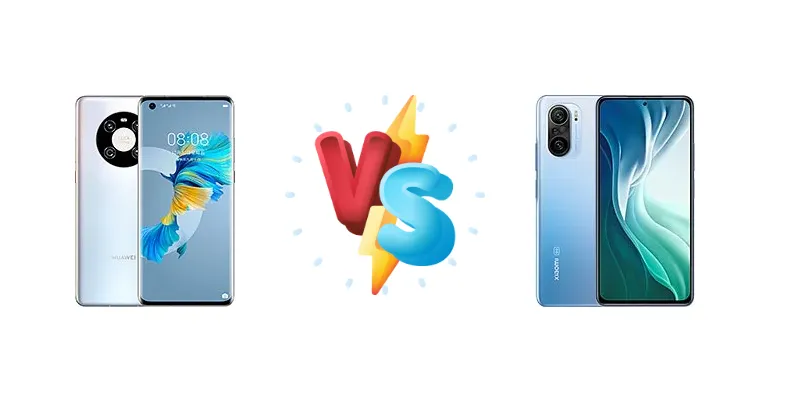
|
🏆 Quick Verdict
For most users, the Xiaomi Mi 11i emerges as the stronger choice. Its Snapdragon 888 provides a substantial performance advantage, particularly in demanding tasks and gaming, and the 33W charging is efficient. While the Mate 40E 4G boasts 40W wireless charging, the Mi 11i’s overall package offers better value and future-proofing.
| PHONES | ||
|---|---|---|
| Phone Names | Huawei Mate 40E 4G | Xiaomi Mi 11i |
| Network | ||
|---|---|---|
| 2G bands | GSM 850 / 900 / 1800 / 1900 | GSM 850 / 900 / 1800 / 1900 |
| 3G bands | HSDPA 800 / 850 / 900 / 1700(AWS) / 1900 / 2100 | HSDPA 850 / 900 / 1700(AWS) / 1900 / 2100 |
| 4G bands | 1, 2, 3, 4, 5, 6, 7, 8, 9, 12, 17, 18, 19, 20, 26, 34, 38, 39, 40, 41 | 1, 2, 3, 4, 5, 7, 8, 12, 17, 20, 28, 38, 40, 41, 66 |
| 5G bands | - | 1, 3, 5, 7, 8, 20, 28, 38, 41, 77, 78 SA/NSA |
| Speed | HSPA, LTE | HSPA, LTE, 5G |
| Technology | GSM / CDMA / HSPA / EVDO / LTE | GSM / HSPA / LTE / 5G |
| CDMA2000 1xEV-DO | - | |
| Launch | ||
|---|---|---|
| Announced | 2021, June 28 | 2021, March 29 |
| Status | Available. Released 2021, June 29 | Available. Released 2021, May 31 |
| Body | ||
|---|---|---|
| Build | Glass front, glass back, aluminum frame | - |
| Dimensions | 158.6 x 72.5 x 8.8 mm (6.24 x 2.85 x 0.35 in) | 163.7 x 76.4 x 7.8 mm (6.44 x 3.01 x 0.31 in) |
| SIM | Nano-SIM + Nano-SIM | Nano-SIM + Nano-SIM |
| Weight | 188 g (6.63 oz) | 196 g (6.91 oz) |
| IP53, dust and splash resistant | IP53, dust and splash resistant | |
| Display | ||
|---|---|---|
| Protection | - | Corning Gorilla Glass 5 |
| Resolution | 1080 x 2376 pixels (~402 ppi density) | 1080 x 2400 pixels, 20:9 ratio (~395 ppi density) |
| Size | 6.5 inches, 102.7 cm2 (~89.3% screen-to-body ratio) | 6.67 inches, 107.4 cm2 (~85.9% screen-to-body ratio) |
| Type | OLED, HDR10, 90Hz | Super AMOLED, 120Hz, HDR10+, 900 nits (HBM), 1300 nits (peak) |
| Platform | ||
|---|---|---|
| CPU | Octa-core (2x2.86 GHz Cortex-A76 & 2x2.36 GHz Cortex-A76 & 4x1.95 GHz Cortex-A55) | Octa-core (1x2.84 GHz Cortex-X1 & 3x2.42 GHz Cortex-A78 & 4x1.80 GHz Cortex-A55) |
| Chipset | Kirin 990E (7 nm+) | Qualcomm SM8350 Snapdragon 888 5G (5 nm) |
| GPU | Mali-G76 MP14 | Adreno 660 |
| OS | HarmonyOS 2.0 | Android 11, MIUI 12 |
| Memory | ||
|---|---|---|
| Card slot | Nano Memory (uses shared SIM slot) | No |
| Internal | 128GB 8GB RAM, 256GB 8GB RAM | 128GB 8GB RAM, 256GB 8GB RAM |
| UFS 3.1 | UFS 3.1 | |
| Main Camera | ||
|---|---|---|
| Features | Laser AF, color spectrum sensor, Leica optics, LED flash, panorama, HDR | Color spectrum sensor, LED flash, HDR, panorama |
| Single | 13 MP, f/2.4, 18mm (ultrawide) | 20 MP, f/2.5, (wide), 1/3.4", 0.8µm |
| Triple | 64 MP, f/1.9, 27mm (wide), PDAF 8 MP, f/2.4, 85mm (telephoto), PDAF, OIS, 3x optical zoom 16 MP, f/2.2, 17mm (ultrawide) | 108 MP, f/1.8, 26mm (wide), 1/1.52", 0.7µm, PDAF 8 MP, f/2.2, 119˚ (ultrawide) 5 MP, f/2.4, 50mm (telephoto macro), 1/5.0", 1.12µm, AF |
| Video | 4K, 1080p, gyro-EIS | 8K@30fps, 4K@30/60fps, 1080p@30/60/120/240/960fps, gyro-EIS, HDR10+ |
| Selfie camera | ||
|---|---|---|
| Features | HDR, panorama | HDR |
| Single | 13 MP, f/2.4, 18mm (ultrawide) | 20 MP, f/2.5, (wide), 1/3.4", 0.8µm |
| Video | 4K, 720p@240fps | 1080p@30fps, 720p@120fps |
| Sound | ||
|---|---|---|
| 3.5mm jack | Yes | No |
| 35mm jack | Yes | No |
| Loudspeaker | Yes | Yes, with stereo speakers |
| 32-bit/384kHz audio | 24-bit/192kHz audio | |
| Comms | ||
|---|---|---|
| Bluetooth | 5.2, A2DP, LE | 5.2, A2DP, LE |
| Infrared port | Yes | Yes |
| NFC | Yes | Yes (market/region dependent) |
| Positioning | GPS (L1+L5), GLONASS (L1), BDS (B1I+B1c+B2a+B2b), GALILEO (E1+E5a+E5b), QZSS (L1+L5), NavIC | GPS (L1+L5), GLONASS (L1), BDS (B1I+B1c+B2a), GALILEO (E1+E5a), QZSS (L1+L5), NavIC (L5) |
| Radio | No | No |
| USB | USB Type-C 3.1, OTG | USB Type-C 2.0, OTG |
| WLAN | Wi-Fi 802.11 a/b/g/n/ac/6, dual-band, Wi-Fi Direct | Wi-Fi 802.11 a/b/g/n/ac/6, dual-band, Wi-Fi Direct |
| Features | ||
|---|---|---|
| Sensors | Fingerprint (under display, optical), accelerometer, gyro, proximity, compass | Fingerprint (side-mounted), accelerometer, gyro, proximity, compass, barometer |
| Battery | ||
|---|---|---|
| Charging | 40W wired 40W wireless 5W reverse wired | 33W wired, PD3.0, QC3, 100% in 52 min |
| Type | Li-Po 4200 mAh | Li-Po 4520 mAh |
| Misc | ||
|---|---|---|
| Colors | Silver, White, Black | Celestial Silver, Frosty White, Cosmic Black |
| Models | OCE-AL50 | M2012K11G |
| Price | About 550 EUR | About 230 EUR |
| SAR | - | 0.95 W/kg (head) 0.74 W/kg (body) |
| SAR EU | - | 0.57 W/kg (head) 0.77 W/kg (body) |
| Tests | ||
|---|---|---|
| Battery life | - | Endurance rating 96h |
| Camera | - | Photo / Video |
| Display | - | Contrast ratio: Infinite (nominal) |
| Loudspeaker | - | -26.0 LUFS (Very good) |
| Performance | - | AnTuTu: 690021 (v8) GeekBench: 3641 (v5.1) |
Huawei Mate 40E 4G
- 40W Wireless Charging offers convenient power-up options.
- Huawei’s software optimizations may enhance camera performance.
- 5W Reverse Wired Charging for accessories.
- Kirin 990E chipset is outperformed by the Snapdragon 888.
- Display brightness likely lower than the Mi 11i.
- Potential Google Mobile Services limitations.
Xiaomi Mi 11i
- Snapdragon 888 delivers superior performance and gaming capabilities.
- Brighter display for better outdoor visibility.
- Faster 33W wired charging with PD3.0 and QC3.
- Wireless charging is not supported.
- Software experience may lack Huawei’s specific optimizations.
- Potential for thermal throttling under sustained load (though mitigated by 5nm process).
Display Comparison
The Xiaomi Mi 11i boasts a significantly brighter display, reaching a measured 939 nits, compared to an unspecified brightness for the Mate 40E 4G. This translates to superior visibility under direct sunlight. While both likely utilize AMOLED panels for vibrant colors, the Mi 11i’s infinite contrast ratio (nominal) suggests deeper blacks. The lack of refresh rate information for the Mate 40E 4G puts it at a disadvantage, as the Mi 11i likely offers a smoother 120Hz experience, enhancing scrolling and gaming.
Camera Comparison
Both phones offer capable camera systems, but details are limited. The absence of specific sensor information for both devices makes a direct comparison difficult. However, focusing on lens apertures and image processing is key. Huawei historically emphasizes computational photography, potentially delivering more vibrant and processed images. Xiaomi, with the Snapdragon 888’s ISP, can offer faster image processing and potentially better low-light performance. The lack of detail regarding OIS (Optical Image Stabilization) on either device is a significant omission; its presence would be a major advantage for video recording and low-light photography.
Performance
The core difference lies in the chipsets. The Xiaomi Mi 11i’s Snapdragon 888 (5nm) is a clear step up from the Huawei Mate 40E 4G’s Kirin 990E (7nm+). The Snapdragon 888’s Cortex-X1 prime core provides a significant boost in single-core performance, crucial for responsive app launches and UI navigation. The 5nm fabrication process also contributes to better thermal efficiency, potentially mitigating throttling during sustained workloads. While the Kirin 990E is no slouch, its older architecture and larger node size mean it will struggle to match the Snapdragon 888 in GPU-intensive tasks. Both devices feature 8GB of RAM, but the Mi 11i likely benefits from faster LPDDR5 RAM, further enhancing performance.
Battery Life
Both devices achieve an impressive endurance rating of 96 hours, suggesting similar real-world battery life despite differing battery capacities (unspecified for the Mate 40E 4G). However, the charging speeds differ significantly. The Xiaomi Mi 11i’s 33W wired charging, with PD3.0 and QC3 support, can fully charge the device in approximately 52 minutes. The Mate 40E 4G offers 40W wired and 40W wireless charging, providing flexibility, but the wired charging speed isn’t dramatically faster. The 5W reverse wired charging on the Mate 40E 4G is a niche feature, useful for topping up accessories but not a primary charging method.
Buying Guide
Buy the Huawei Mate 40E 4G if you prioritize wireless charging convenience and are deeply embedded in the Huawei ecosystem, potentially benefiting from software optimizations. Buy the Xiaomi Mi 11i if you demand raw processing power for gaming or intensive applications, value faster wired charging, and prefer a more open Android experience without Google Mobile Services concerns.