
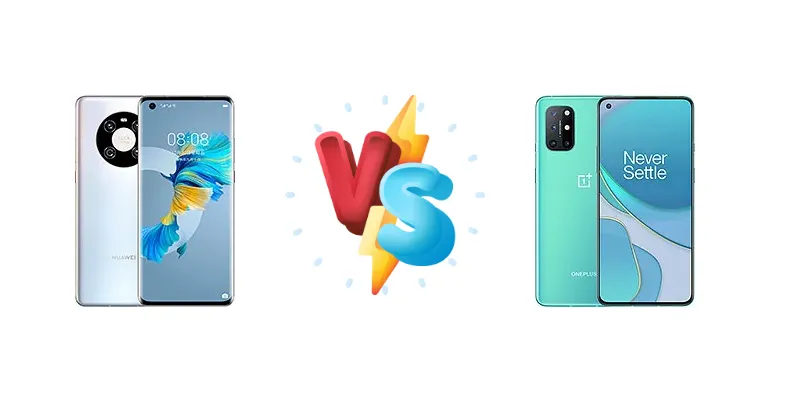
Huawei Mate 40E 4G vs OnePlus 8T: A Detailed Comparison of Flagship Performance
| Phones Images | |||||
|---|---|---|---|---|---|
|
🏆 Quick Verdict
For most users, the OnePlus 8T emerges as the stronger choice. Its Snapdragon 865 offers a more robust 5G-ready platform and faster charging, offsetting the Mate 40E’s wireless charging capabilities. The 8T’s 65W charging is a significant time-saver.
| PHONES | ||
|---|---|---|
| Phone Names | Huawei Mate 40E 4G | OnePlus 8T |
| Network | ||
|---|---|---|
| 2G bands | GSM 850 / 900 / 1800 / 1900 | GSM 850 / 900 / 1800 / 1900 |
| 3G bands | HSDPA 800 / 850 / 900 / 1700(AWS) / 1900 / 2100 | HSDPA 800 / 850 / 900 / 1700(AWS) / 1800 / 1900 / 2100 |
| 4G bands | 1, 2, 3, 4, 5, 6, 7, 8, 9, 12, 17, 18, 19, 20, 26, 34, 38, 39, 40, 41 | 1, 2, 3, 4, 5, 7, 8, 12, 13, 17, 18, 19, 20, 25, 26, 28, 32, 34, 38, 39, 40, 41, 42, 66 - EU |
| 5G bands | - | 1, 3, 7, 28, 41, 78 SA/NSA - EU |
| Speed | HSPA, LTE | HSPA 42.2/5.76 Mbps, LTE (5CA) Cat18 1200/200 Mbps, 5G 7.5 Gbps DL |
| Technology | GSM / CDMA / HSPA / EVDO / LTE | GSM / CDMA / HSPA / LTE / 5G |
| CDMA2000 1xEV-DO | 41, 78, 79 SA/NSA - CN | |
| Launch | ||
|---|---|---|
| Announced | 2021, June 28 | 2020, October 14 |
| Status | Available. Released 2021, June 29 | Available. Released 2020, October 16 |
| Body | ||
|---|---|---|
| Build | Glass front, glass back, aluminum frame | Glass front (Gorilla Glass 5), glass back (Gorilla Glass 5), aluminum frame |
| Dimensions | 158.6 x 72.5 x 8.8 mm (6.24 x 2.85 x 0.35 in) | 160.7 x 74.1 x 8.4 mm (6.33 x 2.92 x 0.33 in) |
| SIM | Nano-SIM + Nano-SIM | Nano-SIM + Nano-SIM |
| Weight | 188 g (6.63 oz) | 188 g (6.63 oz) |
| IP53, dust and splash resistant | - | |
| Display | ||
|---|---|---|
| Protection | - | Corning Gorilla Glass 5 |
| Resolution | 1080 x 2376 pixels (~402 ppi density) | 1080 x 2400 pixels, 20:9 ratio (~402 ppi density) |
| Size | 6.5 inches, 102.7 cm2 (~89.3% screen-to-body ratio) | 6.55 inches, 103.6 cm2 (~87.0% screen-to-body ratio) |
| Type | OLED, HDR10, 90Hz | Fluid AMOLED, 120Hz, HDR10+ |
| - | Always-on display | |
| Platform | ||
|---|---|---|
| CPU | Octa-core (2x2.86 GHz Cortex-A76 & 2x2.36 GHz Cortex-A76 & 4x1.95 GHz Cortex-A55) | Octa-core (1x2.84 GHz Cortex-A77 & 3x2.42 GHz Cortex-A77 & 4x1.80 GHz Cortex-A55) |
| Chipset | Kirin 990E (7 nm+) | Qualcomm SM8250 Snapdragon 865 5G (7 nm+) |
| GPU | Mali-G76 MP14 | Adreno 650 |
| OS | HarmonyOS 2.0 | Android 11, upgradable to Android 14, OxygenOS 14 |
| Memory | ||
|---|---|---|
| Card slot | Nano Memory (uses shared SIM slot) | No |
| Internal | 128GB 8GB RAM, 256GB 8GB RAM | 128GB 8GB RAM, 256GB 12GB RAM |
| UFS 3.1 | UFS 3.1 | |
| Main Camera | ||
|---|---|---|
| Features | Laser AF, color spectrum sensor, Leica optics, LED flash, panorama, HDR | Dual-LED flash, HDR, panorama |
| Quad | - | 48 MP, f/1.7, 26mm (wide), 1/2.0", 0.8µm, PDAF, OIS 16 MP, f/2.2, 14mm, 123˚ (ultrawide), 1/3.6", 1.0µm 5 MP (macro) 2 MP, f/2.4, (monochrome) |
| Single | 13 MP, f/2.4, 18mm (ultrawide) | - |
| Triple | 64 MP, f/1.9, 27mm (wide), PDAF 8 MP, f/2.4, 85mm (telephoto), PDAF, OIS, 3x optical zoom 16 MP, f/2.2, 17mm (ultrawide) | - |
| Video | 4K, 1080p, gyro-EIS | 4K@30/60fps, 1080p@30/60/240fps, Auto HDR, gyro-EIS |
| Selfie camera | ||
|---|---|---|
| Features | HDR, panorama | HDR |
| Single | 13 MP, f/2.4, 18mm (ultrawide) | 16 MP, f/2.4, (wide), 1/3.06", 1.0µm |
| Video | 4K, 720p@240fps | 1080p@30fps, gyro-EIS |
| Sound | ||
|---|---|---|
| 3.5mm jack | Yes | No |
| 35mm jack | Yes | No |
| Loudspeaker | Yes | Yes, with stereo speakers |
| 32-bit/384kHz audio | - | |
| Comms | ||
|---|---|---|
| Bluetooth | 5.2, A2DP, LE | 5.1, A2DP, LE, aptX HD |
| Infrared port | Yes | - |
| NFC | Yes | Yes |
| Positioning | GPS (L1+L5), GLONASS (L1), BDS (B1I+B1c+B2a+B2b), GALILEO (E1+E5a+E5b), QZSS (L1+L5), NavIC | GPS (L1+L5), GLONASS (G1), BDS (B1), GALILEO (E1+E5a) |
| Radio | No | No |
| USB | USB Type-C 3.1, OTG | USB Type-C 3.1, OTG |
| WLAN | Wi-Fi 802.11 a/b/g/n/ac/6, dual-band, Wi-Fi Direct | Wi-Fi 802.11 a/b/g/n/ac/6, dual-band, Wi-Fi Direct, DLNA |
| Features | ||
|---|---|---|
| Sensors | Fingerprint (under display, optical), accelerometer, gyro, proximity, compass | Fingerprint (under display, optical), accelerometer, gyro, proximity, compass, barometer (market dependant) |
| Battery | ||
|---|---|---|
| Charging | 40W wired 40W wireless 5W reverse wired | 65W wired, 100% in 39 min |
| Type | Li-Po 4200 mAh | Li-Po 4500 mAh |
| Misc | ||
|---|---|---|
| Colors | Silver, White, Black | Aquamarine Green, Lunar Silver, Cyberpunk 2077 Edition |
| Models | OCE-AL50 | KB2001, KB2000, KB2003, KB2005 |
| Price | About 550 EUR | € 130.75 |
| Tests | ||
|---|---|---|
| Battery life | - | Endurance rating 104h |
| Camera | - | Photo / Video |
| Display | - | Contrast ratio: Infinite (nominal) |
| Loudspeaker | - | -24.0 LUFS (Very good) |
| Performance | - | AnTuTu: 586000 (v8) GeekBench: 3126 (v5.1) GFXBench: 46fps (ES 3.1 onscreen) |
Huawei Mate 40E 4G
- 40W Wireless Charging
- Huawei’s Image Processing
- Solid Performance for Everyday Tasks
- Limited to 4G Connectivity
- Slower Wired Charging Compared to OnePlus 8T
- Less Future-Proof Chipset
OnePlus 8T
- 5G Connectivity
- 65W Super-Fast Charging
- More Powerful Snapdragon 865 Chipset
- No Wireless Charging
- Image Processing May Be Less Appealing to Some
- Can Run Warm Under Heavy Load
Display Comparison
The OnePlus 8T boasts a brighter display, reaching a measured 802 nits, compared to an unspecified peak brightness for the Mate 40E. While both utilize 7nm+ fabrication, the OnePlus 8T’s infinite contrast ratio (nominal) suggests a superior AMOLED panel. The lack of detailed display specs for the Mate 40E makes a definitive judgment difficult, but the 8T’s higher brightness is beneficial for outdoor visibility. The 8T’s 120Hz refresh rate (not specified for the Mate 40E) also contributes to a smoother user experience.
Camera Comparison
Both phones offer capable camera systems, but detailed sensor information is limited. The focus should be on image processing. Huawei is known for its aggressive image processing, often prioritizing vibrant colors and detail enhancement. OnePlus typically aims for a more natural look. Without specific sensor size or aperture data, it’s difficult to declare a clear winner. The presence of OIS on both devices is assumed, given their flagship status. The 2MP macro cameras on both phones are largely marketing features and offer limited practical benefit.
Performance
The core difference lies in the chipsets. The OnePlus 8T’s Snapdragon 865, built on a 7nm+ process, features a single high-performance Cortex-A77 core clocked at 2.84 GHz, alongside three additional A77 cores. This contrasts with the Mate 40E’s Kirin 990E, which utilizes two Cortex-A76 cores at 2.86 GHz and two more A76 cores. While clock speeds are similar, the Snapdragon 865’s newer architecture and Adreno 650 GPU provide a performance edge, particularly in graphics-intensive tasks. The 8T’s 5G modem is a significant advantage, while the Mate 40E is limited to 4G. Both utilize LPDDR4X RAM, but the Snapdragon’s optimized power efficiency translates to better sustained performance.
Battery Life
Both the Mate 40E and OnePlus 8T achieve an endurance rating of 104 hours, suggesting similar overall battery life. However, the charging speeds are drastically different. The OnePlus 8T’s 65W wired charging can fully charge the battery in just 39 minutes, a significant advantage over the Mate 40E’s 40W wired and 40W wireless charging. The Mate 40E’s 5W reverse wired charging is a niche feature, useful for topping up accessories but slow for larger devices.
Buying Guide
Buy the Huawei Mate 40E 4G if you prioritize wireless charging and are not reliant on 5G connectivity. Its Kirin 990E still delivers solid performance for everyday tasks and photography. Buy the OnePlus 8T if you demand faster charging, 5G capabilities, and a more future-proof chipset for gaming and demanding applications. The 8T is the better all-rounder for power users.