
Huawei Mate 40E 4G vs P40 Pro+: A Deep Dive into Huawei's Flagship Lineup
| Phones Images | |||||
|---|---|---|---|---|---|
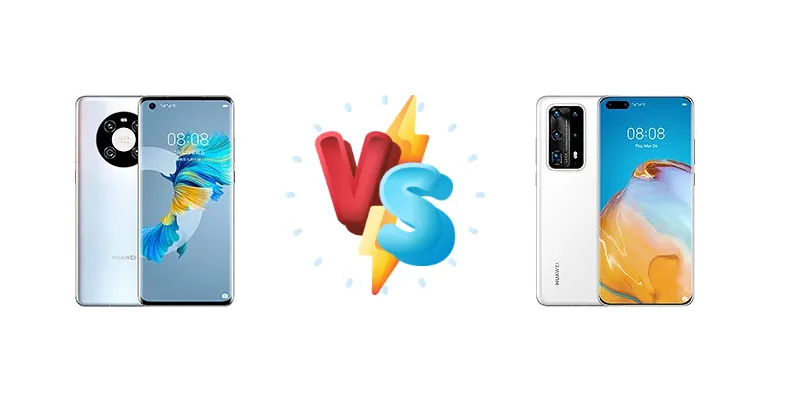
|
🏆 Quick Verdict
For most users, the Huawei P40 Pro+ emerges as the superior choice. While both phones share the same CPU architecture, the P40 Pro+'s superior battery endurance rating and potentially more refined camera system justify its higher initial price, especially now that it's often available at a discount. However, the Mate 40E 4G remains a compelling option for those prioritizing wireless charging speed.
| PHONES | ||
|---|---|---|
| Phone Names | Huawei Mate 40E 4G | Huawei P40 Pro+ |
| Network | ||
|---|---|---|
| 2G bands | GSM 850 / 900 / 1800 / 1900 | GSM 850 / 900 / 1800 / 1900 |
| 3G bands | HSDPA 800 / 850 / 900 / 1700(AWS) / 1900 / 2100 | HSDPA 800 / 850 / 900 / 1700(AWS) / 1900 / 2100 |
| 4G bands | 1, 2, 3, 4, 5, 6, 7, 8, 9, 12, 17, 18, 19, 20, 26, 34, 38, 39, 40, 41 | 1, 2, 3, 4, 5, 6, 7, 8, 9, 12, 17, 18, 19, 20, 26, 28, 34, 38, 39, 40, 41 |
| 5G bands | - | 1, 3, 28, 38, 41, 77, 78, 79 SA/NSA |
| Speed | HSPA, LTE | HSPA, LTE, 5G |
| Technology | GSM / CDMA / HSPA / EVDO / LTE | GSM / HSPA / LTE / 5G |
| CDMA2000 1xEV-DO | - | |
| Launch | ||
|---|---|---|
| Announced | 2021, June 28 | 2020, March 26 |
| Status | Available. Released 2021, June 29 | Available. Released 2020, June 06 |
| Body | ||
|---|---|---|
| Build | Glass front, glass back, aluminum frame | Glass front, ceramic back, ceramic frame |
| Dimensions | 158.6 x 72.5 x 8.8 mm (6.24 x 2.85 x 0.35 in) | 158.2 x 72.6 x 9 mm (6.23 x 2.86 x 0.35 in) |
| SIM | Nano-SIM + Nano-SIM | · Nano-SIM· Nano-SIM + Nano-SIM |
| Weight | 188 g (6.63 oz) | 226 g (7.97 oz) |
| IP53, dust and splash resistant | IP68 dust/water resistant (up to 1.5m for 30 mins) | |
| Display | ||
|---|---|---|
| Resolution | 1080 x 2376 pixels (~402 ppi density) | 1200 x 2640 pixels (~441 ppi density) |
| Size | 6.5 inches, 102.7 cm2 (~89.3% screen-to-body ratio) | 6.58 inches, 105.2 cm2 (~91.6% screen-to-body ratio) |
| Type | OLED, HDR10, 90Hz | OLED, 90Hz, HDR10 |
| Platform | ||
|---|---|---|
| CPU | Octa-core (2x2.86 GHz Cortex-A76 & 2x2.36 GHz Cortex-A76 & 4x1.95 GHz Cortex-A55) | Octa-core (2x2.86 GHz Cortex-A76 & 2x2.36 GHz Cortex-A76 & 4x1.95 GHz Cortex-A55) |
| Chipset | Kirin 990E (7 nm+) | Kirin 990 5G (7 nm+) |
| GPU | Mali-G76 MP14 | Mali-G76 MP16 |
| OS | HarmonyOS 2.0 | Android 10, EMUI 10.1, no Google Play Services |
| Memory | ||
|---|---|---|
| Card slot | Nano Memory (uses shared SIM slot) | Nano Memory (uses shared SIM slot) |
| Internal | 128GB 8GB RAM, 256GB 8GB RAM | 256GB 8GB RAM, 512GB 8GB RAM |
| UFS 3.1 | UFS 3.0 | |
| Main Camera | ||
|---|---|---|
| Features | Laser AF, color spectrum sensor, Leica optics, LED flash, panorama, HDR | Leica optics, color spectrum sensor, LED flash, panorama, HDR |
| Quad | - | 50 MP, f/1.9, 23mm (wide), 1/1.28", 1.22µm, dual pixel PDAF, OIS 8 MP, f/4.4, 240mm (periscope telephoto), PDAF, OIS, 10x optical zoom 8 MP, f/2.4, 80mm (telephoto), PDAF, OIS, 3x optical zoom 40 MP, f/1.8, 18mm (ultrawide), 1/1.54", PDAF TOF 3D, (depth) |
| Single | 13 MP, f/2.4, 18mm (ultrawide) | - |
| Triple | 64 MP, f/1.9, 27mm (wide), PDAF 8 MP, f/2.4, 85mm (telephoto), PDAF, OIS, 3x optical zoom 16 MP, f/2.2, 17mm (ultrawide) | - |
| Video | 4K, 1080p, gyro-EIS | 4K@30/60fps, 1080p@30/60fps, 720@7680fps, 1080p@960fps, HDR; gyro-EIS |
| Selfie camera | ||
|---|---|---|
| Features | HDR, panorama | HDR |
| Single | 13 MP, f/2.4, 18mm (ultrawide) | 32 MP, f/2.2, 26mm (wide), 1/2.8", 0.8µm, AF IR TOF 3D, (depth/biometrics sensor) |
| Video | 4K, 720p@240fps | 4K@30/60fps, 1080p@30/60fps |
| Sound | ||
|---|---|---|
| 3.5mm jack | Yes | No |
| 35mm jack | Yes | No |
| Loudspeaker | Yes | Yes |
| 32-bit/384kHz audio | 32-bit/384kHz audio | |
| Comms | ||
|---|---|---|
| Bluetooth | 5.2, A2DP, LE | 5.1, A2DP, LE |
| Infrared port | Yes | Yes |
| NFC | Yes | Yes |
| Positioning | GPS (L1+L5), GLONASS (L1), BDS (B1I+B1c+B2a+B2b), GALILEO (E1+E5a+E5b), QZSS (L1+L5), NavIC | GPS (L1+L5), GLONASS (L1), BDS (B1I+B1c+B2a), GALILEO (E1+E5a), QZSS (L1+L5), NavIC |
| Radio | No | No |
| USB | USB Type-C 3.1, OTG | USB Type-C 3.1, OTG |
| WLAN | Wi-Fi 802.11 a/b/g/n/ac/6, dual-band, Wi-Fi Direct | Wi-Fi 802.11 a/b/g/n/ac/6, dual-band, Wi-Fi Direct |
| Features | ||
|---|---|---|
| Sensors | Fingerprint (under display, optical), accelerometer, gyro, proximity, compass | Infrared Face ID, fingerprint (under display, optical), accelerometer, gyro, proximity, compass |
| Battery | ||
|---|---|---|
| Charging | 40W wired 40W wireless 5W reverse wired | 40W wired 40W wireless 27W reverse wireless |
| Type | Li-Po 4200 mAh | Li-Po 4200 mAh |
| Misc | ||
|---|---|---|
| Colors | Silver, White, Black | White Ceramic, Black Ceramic |
| Models | OCE-AL50 | ELS-N39, ELS-AN10 |
| Price | About 550 EUR | About 1000 EUR |
| Tests | ||
|---|---|---|
| Battery life | - | Endurance rating 95h |
| Camera | - | Photo / Video |
| Display | - | Contrast ratio: Infinite (nominal) |
| Loudspeaker | - | -27.4 LUFS (Good) |
| Performance | - | AnTuTu: 529687 (v8) GeekBench: 3203 (v5.1) GFXBench: 31fps (ES 3.1 onscreen) |
Huawei Mate 40E 4G
- Faster 40W wireless charging compared to reverse wireless.
- Potentially more affordable price point.
- Similar CPU performance to the P40 Pro+
- Slower reverse wireless charging (5W).
- Likely shorter software support lifecycle.
- Potentially less advanced camera system.
Huawei P40 Pro+
- Superior battery endurance rating.
- Faster 27W reverse wireless charging.
- Brighter display for outdoor visibility.
- Higher initial price (though now often discounted).
- May not offer a significant performance advantage over the Mate 40E 4G.
- 5G modem may not be fully utilized depending on location.
Display Comparison
The Huawei P40 Pro+ boasts a display capable of reaching 760 nits of peak brightness, providing excellent visibility in direct sunlight. While the Mate 40E 4G’s brightness isn’t specified, the P40 Pro+'s higher measured value suggests a more vibrant outdoor viewing experience. Both displays feature an infinite (nominal) contrast ratio, typical of OLED panels, ensuring deep blacks and vivid colors. The absence of refresh rate data for both devices means we can't assess smoothness, but the P40 Pro+'s brightness advantage is a clear win for outdoor usability.
Camera Comparison
The P40 Pro+ is positioned as the superior camera phone, though detailed sensor specifications are lacking in the provided data. The 'Photo / Video' designation for both suggests comparable capabilities, but the P40 Pro+'s positioning as a 'Pro+' model implies a more advanced camera system with potentially larger sensors and more sophisticated image processing. The absence of specific details prevents a granular comparison, but the P40 Pro+ likely excels in low-light performance and zoom capabilities. The 2MP macro cameras found on many Huawei phones of this era are unlikely to provide significant benefit to most users.
Performance
Both the Mate 40E 4G and P40 Pro+ are powered by the Kirin 990 series chipset, utilizing the same 7nm+ fabrication process and octa-core CPU configuration (2x2.86 GHz Cortex-A76 & 2x2.36 GHz Cortex-A76 & 4x1.95 GHz Cortex-A55). However, the P40 Pro+ features the Kirin 990 *5G*, suggesting a more robust modem and potentially slightly improved thermal management due to design optimizations for 5G connectivity. While the CPU is identical, the P40 Pro+'s 5G variant might offer a marginal performance edge in sustained workloads. Both phones likely utilize LPDDR4X RAM, as LPDDR5 was not widespread at their launch.
Battery Life
Both devices offer 40W wired and 40W wireless charging, but the P40 Pro+ boasts a 27W reverse wireless charging capability, significantly exceeding the Mate 40E 4G’s 5W reverse charging. More importantly, both phones share an endurance rating of 95 hours, indicating similar overall battery life despite potentially different battery capacities. The P40 Pro+'s faster reverse wireless charging is a boon for users who frequently charge accessories like earbuds or smartwatches.
Buying Guide
Buy the Huawei Mate 40E 4G if you prioritize faster 40W wireless charging and are comfortable with a potentially shorter software support lifecycle. It's ideal for users who frequently rely on wireless power and want a slightly more affordable entry point into the Huawei ecosystem. Buy the Huawei P40 Pro+ if you value longer battery life, a potentially more versatile camera system, and a brighter display, even if it means sacrificing the fastest wireless charging speeds. This is the phone for power users and photography enthusiasts.