
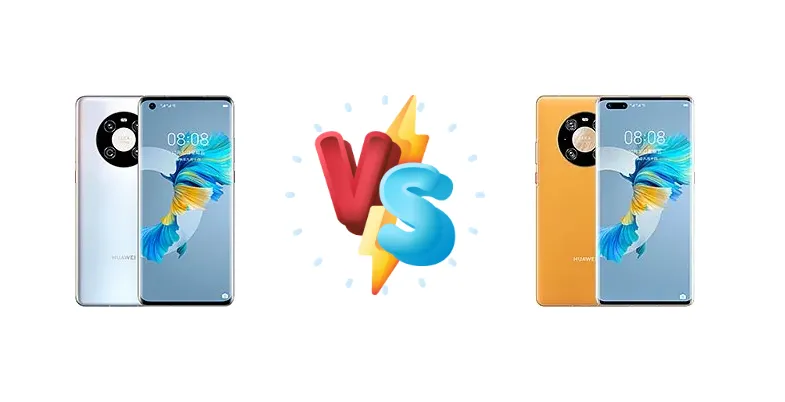
Huawei Mate 40E 4G vs Mate 40 Pro 4G: A Clash of Flagship Features
| Phones Images | |||||
|---|---|---|---|---|---|
|
🏆 Quick Verdict
The Mate 40 Pro is the clear winner, offering a significantly faster processor, superior camera system, and faster charging. However, the Mate 40E provides a more budget-friendly option with a still-capable Kirin 990E and a solid overall experience for users who don't need the absolute best.
| PHONES | ||
|---|---|---|
| Phone Names | Huawei Mate 40E 4G | Huawei Mate 40 Pro 4G |
| Network | ||
|---|---|---|
| 2G bands | GSM 850 / 900 / 1800 / 1900 | GSM 850 / 900 / 1800 / 1900 |
| 3G bands | HSDPA 800 / 850 / 900 / 1700(AWS) / 1900 / 2100 | HSDPA 800 / 850 / 900 / 1700(AWS) / 1900 / 2100 |
| 4G bands | 1, 2, 3, 4, 5, 6, 7, 8, 9, 12, 17, 18, 19, 20, 26, 34, 38, 39, 40, 41 | 1, 2, 3, 4, 5, 6, 7, 8, 9, 12, 17, 18, 19, 20, 26, 34, 38, 39, 40, 41 |
| Speed | HSPA, LTE | HSPA, LTE |
| Technology | GSM / CDMA / HSPA / EVDO / LTE | GSM / CDMA / HSPA / EVDO / LTE |
| CDMA2000 1xEV-DO | CDMA2000 1xEV-DO | |
| Launch | ||
|---|---|---|
| Announced | 2021, June 28 | 2021, June 28 |
| Status | Available. Released 2021, June 29 | Available. Released 2021, July 09 |
| Body | ||
|---|---|---|
| Build | Glass front, glass back, aluminum frame | Glass front, glass back or eco leather back, aluminum frame |
| Dimensions | 158.6 x 72.5 x 8.8 mm (6.24 x 2.85 x 0.35 in) | 162.9 x 75.5 x 9.1 mm (Glass) / 9.5mm (Leather) |
| SIM | Nano-SIM + Nano-SIM | Nano-SIM + Nano-SIM |
| Weight | 188 g (6.63 oz) | 212 g (7.48 oz) |
| IP53, dust and splash resistant | IP68 dust/water resistant | |
| Display | ||
|---|---|---|
| Resolution | 1080 x 2376 pixels (~402 ppi density) | 1344 x 2772 pixels, 18.5:9 ratio (~456 ppi density) |
| Size | 6.5 inches, 102.7 cm2 (~89.3% screen-to-body ratio) | 6.76 inches, 115.7 cm2 (~94.1% screen-to-body ratio) |
| Type | OLED, HDR10, 90Hz | OLED, HDR10, 90Hz |
| Platform | ||
|---|---|---|
| CPU | Octa-core (2x2.86 GHz Cortex-A76 & 2x2.36 GHz Cortex-A76 & 4x1.95 GHz Cortex-A55) | Octa-core (1x3.13 GHz Cortex-A77 & 3x2.54 GHz Cortex-A77 & 4x2.05 GHz Cortex-A55) |
| Chipset | Kirin 990E (7 nm+) | Kirin 9000 (5 nm) |
| GPU | Mali-G76 MP14 | Mali-G78 MP24 |
| OS | HarmonyOS 2.0 | HarmonyOS 2.0 |
| Memory | ||
|---|---|---|
| Card slot | Nano Memory (uses shared SIM slot) | Nano Memory (uses shared SIM slot) |
| Internal | 128GB 8GB RAM, 256GB 8GB RAM | 128GB 8GB RAM, 256GB 8GB RAM, 512GB 8GB RAM |
| UFS 3.1 | UFS 3.1 | |
| Main Camera | ||
|---|---|---|
| Features | Laser AF, color spectrum sensor, Leica optics, LED flash, panorama, HDR | Laser AF, color spectrum sensor, Leica optics, LED flash, panorama, HDR |
| Single | 13 MP, f/2.4, 18mm (ultrawide) | 13 MP, f/2.4, 18mm (ultrawide) TOF 3D, (depth/biometrics sensor) |
| Triple | 64 MP, f/1.9, 27mm (wide), PDAF 8 MP, f/2.4, 85mm (telephoto), PDAF, OIS, 3x optical zoom 16 MP, f/2.2, 17mm (ultrawide) | 50 MP, f/1.9, 23mm (wide), 1/1.28", 1.22µm, multi-directional PDAF 12 MP, f/3.4, 125mm (periscope telephoto), PDAF, OIS, 5x optical zoom 20 MP, f/1.8, 18mm (ultrawide), PDAF |
| Video | 4K, 1080p, gyro-EIS | 4K@30/60fps, 1080p@30/60/120/240/480fps, 720p@960fps, 720p@3840fps, HDR, gyro-EIS |
| Selfie camera | ||
|---|---|---|
| Features | HDR, panorama | HDR, panorama |
| Single | 13 MP, f/2.4, 18mm (ultrawide) | 13 MP, f/2.4, 18mm (ultrawide) TOF 3D, (depth/biometrics sensor) |
| Video | 4K, 720p@240fps | 4K@30/60fps, 1080p@30/60/240fps |
| Sound | ||
|---|---|---|
| 3.5mm jack | Yes | No |
| 35mm jack | Yes | No |
| Loudspeaker | Yes | Yes, with stereo speakers |
| 32-bit/384kHz audio | 32-bit/384kHz audio | |
| Comms | ||
|---|---|---|
| Bluetooth | 5.2, A2DP, LE | 5.2, A2DP, LE |
| Infrared port | Yes | Yes |
| NFC | Yes | Yes |
| Positioning | GPS (L1+L5), GLONASS (L1), BDS (B1I+B1c+B2a+B2b), GALILEO (E1+E5a+E5b), QZSS (L1+L5), NavIC | GPS (L1+L5), GLONASS (L1), BDS (B1I+B1c+B2a+B2b), GALILEO (E1+E5a+E5b), QZSS (L1+L5), NavIC |
| Radio | No | No |
| USB | USB Type-C 3.1, OTG | USB Type-C 3.1, OTG |
| WLAN | Wi-Fi 802.11 a/b/g/n/ac/6, dual-band, Wi-Fi Direct | Wi-Fi 802.11 a/b/g/n/ac/6, dual-band, Wi-Fi Direct |
| Features | ||
|---|---|---|
| Sensors | Fingerprint (under display, optical), accelerometer, gyro, proximity, compass | Face ID, fingerprint (under display, optical), accelerometer, gyro, proximity, barometer, compass |
| Battery | ||
|---|---|---|
| Charging | 40W wired 40W wireless 5W reverse wired | 66W wired 50W wireless 5W reverse wireless |
| Type | Li-Po 4200 mAh | Li-Po 4400 mAh |
| Misc | ||
|---|---|---|
| Colors | Silver, White, Black | Mystic Silver, White, Black, Green, Yellow |
| Models | OCE-AL50 | NOH-AL00, NOH-AL10 |
| Price | About 550 EUR | About 800 EUR |
Huawei Mate 40E 4G
- More affordable
- Good camera for the price
- Solid build quality
- Reverse wireless charging
- Slower processor
- Lower refresh rate display
- Less versatile camera system
- Slower charging
Huawei Mate 40 Pro 4G
- Flagship performance
- Exceptional camera system
- Fast charging (wired & wireless)
- Premium design with curved display
- 90Hz display
- Higher price
- No Google Play Services (requires workarounds)
- Curved display can be prone to accidental touches
Display Comparison
Both phones feature OLED displays, but the Mate 40 Pro boasts a curved display and a higher refresh rate (90Hz vs 60Hz on the Mate 40E), resulting in smoother scrolling and a more immersive viewing experience. The Pro also has a slightly higher resolution, contributing to sharper visuals.
Camera Comparison
The Mate 40 Pro's camera system is a standout feature. It includes a periscope telephoto lens with 5x optical zoom and a higher resolution main sensor, offering superior image quality, especially in low light and at longer zoom ranges. The Mate 40E has a capable camera, but lacks the versatility and advanced features of the Pro.
Performance
The Kirin 9000 in the Mate 40 Pro is a substantial upgrade over the Kirin 990E in the Mate 40E. The 5nm process and improved architecture of the 9000 translate to significantly faster processing speeds, better multitasking capabilities, and improved gaming performance. The Mate 40E is still capable, but struggles with demanding tasks compared to the Pro.
Battery Life
The Mate 40 Pro's 4400mAh battery is slightly larger than the Mate 40E's 4200mAh battery. Combined with its faster 66W wired charging and 50W wireless charging, the Pro offers significantly quicker charging times and potentially longer battery life under heavy use.
Buying Guide
The Huawei Mate 40E 4G is ideal for users seeking a reliable smartphone with a good camera and decent performance without breaking the bank. It's a great choice for everyday tasks and casual photography. The Huawei Mate 40 Pro 4G is for power users and photography enthusiasts who demand top-tier performance, a cutting-edge camera system, and the fastest charging speeds available.