
Huawei Mate 40E 4G vs Honor V40 Lite: Which Mid-Range Phone Reigns Supreme?
| Phones Images | |||||
|---|---|---|---|---|---|
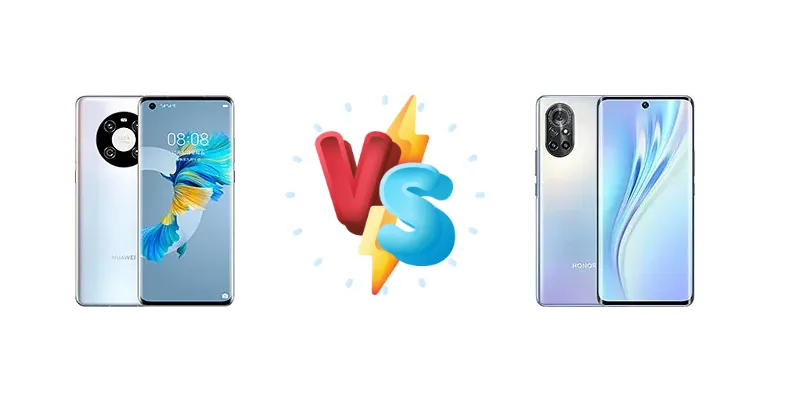
|
🏆 Quick Verdict
For the average user prioritizing rapid charging and a more modern chipset, the Honor V40 Lite is the better choice. Its 66W charging significantly outperforms the Mate 40E 4G’s 40W wired and wireless options. While the Kirin 990E is a capable chip, the Dimensity 800U offers a competitive experience with faster charging and potentially better software support.
| PHONES | ||
|---|---|---|
| Phone Names | Huawei Mate 40E 4G | Honor V40 Lite |
| Network | ||
|---|---|---|
| 2G bands | GSM 850 / 900 / 1800 / 1900 | GSM 850 / 900 / 1800 / 1900 |
| 3G bands | HSDPA 800 / 850 / 900 / 1700(AWS) / 1900 / 2100 | HSDPA 800 / 850 / 900 / 1700(AWS) / 1900 / 2100 |
| 4G bands | 1, 2, 3, 4, 5, 6, 7, 8, 9, 12, 17, 18, 19, 20, 26, 34, 38, 39, 40, 41 | 1, 2, 3, 4, 5, 8, 18, 19, 26, 34, 38, 39, 40, 41 |
| 5G bands | - | 1, 28, 41, 77, 78 SA/NSA |
| Speed | HSPA, LTE | HSPA, LTE, 5G |
| Technology | GSM / CDMA / HSPA / EVDO / LTE | GSM / CDMA / HSPA / LTE / 5G |
| CDMA2000 1xEV-DO | CDMA 800 | |
| Launch | ||
|---|---|---|
| Announced | 2021, June 28 | 2021, March 23 |
| Status | Available. Released 2021, June 29 | Available. Released 2021, March 28 |
| Body | ||
|---|---|---|
| Build | Glass front, glass back, aluminum frame | - |
| Dimensions | 158.6 x 72.5 x 8.8 mm (6.24 x 2.85 x 0.35 in) | 160.1 x 74.1 x 7.6 mm (6.30 x 2.92 x 0.30 in) |
| SIM | Nano-SIM + Nano-SIM | Nano-SIM + Nano-SIM |
| Weight | 188 g (6.63 oz) | 169 g (5.96 oz) |
| IP53, dust and splash resistant | - | |
| Display | ||
|---|---|---|
| Resolution | 1080 x 2376 pixels (~402 ppi density) | 1080 x 2340 pixels, 19.5:9 ratio (~392 ppi density) |
| Size | 6.5 inches, 102.7 cm2 (~89.3% screen-to-body ratio) | 6.57 inches, 106.0 cm2 (~89.3% screen-to-body ratio) |
| Type | OLED, HDR10, 90Hz | OLED, 1B colors, HDR10, 90Hz |
| Platform | ||
|---|---|---|
| CPU | Octa-core (2x2.86 GHz Cortex-A76 & 2x2.36 GHz Cortex-A76 & 4x1.95 GHz Cortex-A55) | Octa-core (2x2.4 GHz Cortex-A76 & 6x2.0 GHz Cortex-A55) |
| Chipset | Kirin 990E (7 nm+) | Mediatek Dimensity 800U (7 nm) |
| GPU | Mali-G76 MP14 | Mali-G57 MC3 |
| OS | HarmonyOS 2.0 | Android 10, Magic UI 4.0, no Google Play Services |
| Memory | ||
|---|---|---|
| Card slot | Nano Memory (uses shared SIM slot) | No |
| Internal | 128GB 8GB RAM, 256GB 8GB RAM | 128GB 8GB RAM, 256GB 8GB RAM |
| UFS 3.1 | UFS | |
| Main Camera | ||
|---|---|---|
| Features | Laser AF, color spectrum sensor, Leica optics, LED flash, panorama, HDR | LED flash, panorama, HDR |
| Quad | - | 64 MP, f/1.9, 26mm (wide), PDAF 8 MP, f/2.4, 120˚, 17mm (ultrawide) 2 MP (macro) Auxiliary lens |
| Single | 13 MP, f/2.4, 18mm (ultrawide) | 32 MP, f/2.0, 26mm (wide) |
| Triple | 64 MP, f/1.9, 27mm (wide), PDAF 8 MP, f/2.4, 85mm (telephoto), PDAF, OIS, 3x optical zoom 16 MP, f/2.2, 17mm (ultrawide) | - |
| Video | 4K, 1080p, gyro-EIS | 4K, 1080p, 720p@960fps, gyro-EIS |
| Selfie camera | ||
|---|---|---|
| Features | HDR, panorama | HDR |
| Single | 13 MP, f/2.4, 18mm (ultrawide) | 32 MP, f/2.0, 26mm (wide) |
| Video | 4K, 720p@240fps | 4K |
| Sound | ||
|---|---|---|
| 3.5mm jack | Yes | No |
| 35mm jack | Yes | No |
| Loudspeaker | Yes | Yes |
| 32-bit/384kHz audio | - | |
| Comms | ||
|---|---|---|
| Bluetooth | 5.2, A2DP, LE | 5.1, A2DP, LE |
| Infrared port | Yes | - |
| NFC | Yes | Yes |
| Positioning | GPS (L1+L5), GLONASS (L1), BDS (B1I+B1c+B2a+B2b), GALILEO (E1+E5a+E5b), QZSS (L1+L5), NavIC | GPS, GLONASS, BDS, GALILEO |
| Radio | No | No |
| USB | USB Type-C 3.1, OTG | USB Type-C 2.0, OTG |
| WLAN | Wi-Fi 802.11 a/b/g/n/ac/6, dual-band, Wi-Fi Direct | Wi-Fi 802.11 a/b/g/n/ac, dual-band, Wi-Fi Direct |
| Features | ||
|---|---|---|
| Sensors | Fingerprint (under display, optical), accelerometer, gyro, proximity, compass | Fingerprint (under display, optical), accelerometer, gyro, proximity, compass |
| Battery | ||
|---|---|---|
| Charging | 40W wired 40W wireless 5W reverse wired | 66W wired, 60% in 15 min, 100% in 35 min 5W reverse wired |
| Type | Li-Po 4200 mAh | Li-Po 3800 mAh |
| Misc | ||
|---|---|---|
| Colors | Silver, White, Black | Black, Blue, Green |
| Models | OCE-AL50 | ALA-AN70 |
| Price | About 550 EUR | About 390 EUR |
Huawei Mate 40E 4G
- Potentially more refined image processing from Huawei.
- More complex CPU core configuration for multi-tasking.
- Wireless charging capability.
- Significantly slower charging speeds.
- Older chipset with potentially limited software updates.
- 4G only connectivity.
Honor V40 Lite
- Ultra-fast 66W wired charging.
- More recent chipset with potential for longer software support.
- Potentially better thermal management with Dimensity 800U.
- May have less refined image processing compared to Huawei.
- Lacks wireless charging.
- Potentially less established brand reputation.
Display Comparison
Neither device’s display specifications are provided, so a direct comparison is limited. However, given the market positioning, both likely feature LCD panels. The absence of high refresh rate information suggests both are standard 60Hz displays. The V40 Lite, being a newer model, *may* benefit from slightly improved color calibration and viewing angles, but this is speculative. Bezels are likely comparable, focusing on cost optimization in this segment.
Camera Comparison
Without detailed camera specifications, a precise comparison is difficult. However, Huawei historically emphasizes image processing and color science. The Mate 40E 4G likely delivers vibrant, saturated images. The Honor V40 Lite, inheriting Honor’s camera philosophy, may lean towards more natural color reproduction. The absence of sensor size information makes it hard to assess low-light performance. The presence of a 2MP macro camera on either device is largely inconsequential; its utility is limited by the small sensor and lack of optical image stabilization (OIS).
Performance
The Kirin 990E (7nm+) in the Mate 40E 4G and the Dimensity 800U (7nm) in the V40 Lite represent different approaches to mid-range performance. The Kirin 990E’s CPU configuration (2x2.86 GHz Cortex-A76, 2x2.36 GHz Cortex-A76, 4x1.95 GHz Cortex-A55) is more complex, potentially offering a slight edge in multi-threaded tasks. However, the Dimensity 800U’s (2x2.4 GHz Cortex-A76, 6x2.0 GHz Cortex-A55) architecture is optimized for efficiency. The Dimensity 800U also benefits from integrated 5G modem support, even though the Mate 40E 4G is a 4G-only device. Real-world performance will be similar for most tasks, but the Dimensity 800U may exhibit better sustained performance due to its more efficient node and thermal design.
Battery Life
The Honor V40 Lite’s 66W wired charging is the clear winner here. The advertised 60% charge in 15 minutes and 100% in 35 minutes drastically reduces downtime. The Mate 40E 4G’s 40W wired and wireless charging, while respectable, are significantly slower. Both devices offer 5W reverse wired charging, a niche feature for topping up accessories. Battery capacity is not specified, but the faster charging of the V40 Lite mitigates the impact of a potentially smaller battery.
Buying Guide
Buy the Huawei Mate 40E 4G if you prioritize the established Huawei ecosystem and potentially prefer the image processing style of their cameras. Buy the Honor V40 Lite if you value significantly faster charging speeds, a more recent chipset with potentially longer software support, and a more competitive price point. The V40 Lite is ideal for users who frequently need to top up their battery quickly.