
Huawei Mate 40E 4G vs iPhone 14 Plus: A Detailed Showdown
| Phones Images | |||||
|---|---|---|---|---|---|
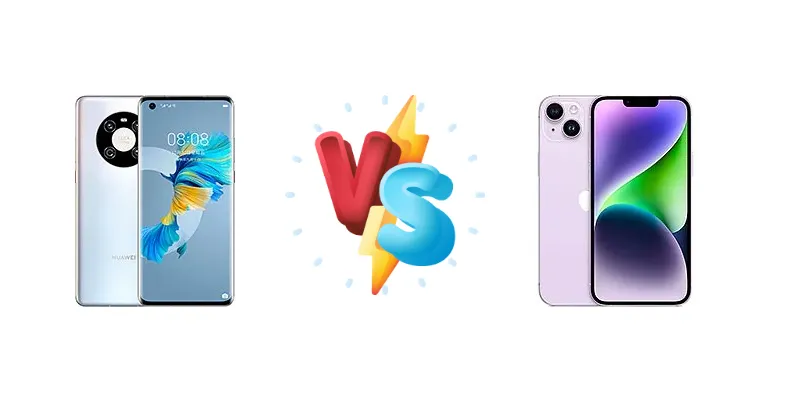
|
🏆 Quick Verdict
The iPhone 14 Plus wins overall due to its superior performance, ecosystem integration, and camera capabilities. While the Mate 40E 4G offers a competitive price and decent features, the iPhone's power and polish make it the better choice for most users.
| PHONES | ||
|---|---|---|
| Phone Names | Huawei Mate 40E 4G | Apple iPhone 14 Plus |
| Network | ||
|---|---|---|
| 2G bands | GSM 850 / 900 / 1800 / 1900 | GSM 850 / 900 / 1800 / 1900 |
| 3G bands | HSDPA 800 / 850 / 900 / 1700(AWS) / 1900 / 2100 | HSDPA 850 / 900 / 1700(AWS) / 1900 / 2100 |
| 4G bands | 1, 2, 3, 4, 5, 6, 7, 8, 9, 12, 17, 18, 19, 20, 26, 34, 38, 39, 40, 41 | 1, 2, 3, 4, 5, 7, 8, 12, 13, 17, 18, 19, 20, 25, 26, 28, 30, 32, 34, 38, 39, 40, 41, 42, 46, 48, 66 - A2886, A2888 |
| 5G bands | - | 1, 2, 3, 5, 7, 8, 12, 20, 25, 26, 28, 30, 38, 40, 41, 48, 66, 70, 77, 78, 79 SA/NSA/Sub6 - A2886, A2888 |
| Speed | HSPA, LTE | HSPA, LTE, 5G, EV-DO Rev.A 3.1 Mbps |
| Technology | GSM / CDMA / HSPA / EVDO / LTE | GSM / CDMA / HSPA / EVDO / LTE / 5G |
| CDMA2000 1xEV-DO | 1, 2, 3, 5, 7, 8, 12, 20, 25, 26, 28, 30, 38, 40, 41, 48, 66, 70, 77, 78, 79 SA/NSA/Sub6 - A2887 | |
| Launch | ||
|---|---|---|
| Announced | 2021, June 28 | 2022, September 07 |
| Status | Available. Released 2021, June 29 | Available. Released 2022, October 07 |
| Body | ||
|---|---|---|
| Build | Glass front, glass back, aluminum frame | Glass front, glass back, aluminum frame |
| Dimensions | 158.6 x 72.5 x 8.8 mm (6.24 x 2.85 x 0.35 in) | 160.8 x 78.1 x 7.8 mm (6.33 x 3.07 x 0.31 in) |
| SIM | Nano-SIM + Nano-SIM | · Nano-SIM + eSIM + eSIM (max 2 at a time; International)· eSIM + eSIM (8 or more, max 2 at a time; USA)· Nano-SIM + Nano-SIM (China) |
| Weight | 188 g (6.63 oz) | 203 g (7.16 oz) |
| IP53, dust and splash resistant | IP68 dust/water resistant (up to 6m for 30 min) Apple Pay (Visa, MasterCard, AMEX certified) | |
| Display | ||
|---|---|---|
| Protection | - | Ceramic Shield glass |
| Resolution | 1080 x 2376 pixels (~402 ppi density) | 1284 x 2778 pixels, 19.5:9 ratio (~458 ppi density) |
| Size | 6.5 inches, 102.7 cm2 (~89.3% screen-to-body ratio) | 6.7 inches, 109.8 cm2 (~87.4% screen-to-body ratio) |
| Type | OLED, HDR10, 90Hz | Super Retina XDR OLED, HDR10, Dolby Vision, 800 nits (HBM), 1200 nits (peak) |
| Platform | ||
|---|---|---|
| CPU | Octa-core (2x2.86 GHz Cortex-A76 & 2x2.36 GHz Cortex-A76 & 4x1.95 GHz Cortex-A55) | Hexa-core (2x3.23 GHz Avalanche + 4x1.82 GHz Blizzard) |
| Chipset | Kirin 990E (7 nm+) | Apple A15 Bionic (5 nm) |
| GPU | Mali-G76 MP14 | Apple GPU (5-core graphics) |
| OS | HarmonyOS 2.0 | iOS 16, upgradable to iOS 26.1 |
| Memory | ||
|---|---|---|
| Card slot | Nano Memory (uses shared SIM slot) | No |
| Internal | 128GB 8GB RAM, 256GB 8GB RAM | 128GB 6GB RAM, 256GB 6GB RAM, 512GB 6GB RAM |
| UFS 3.1 | NVMe | |
| Main Camera | ||
|---|---|---|
| Dual | - | 12 MP, f/1.5, 26mm (wide), 1/1.7", 1.9µm, dual pixel PDAF, sensor-shift OIS 12 MP, f/2.4, 13mm, 120˚ (ultrawide) |
| Features | Laser AF, color spectrum sensor, Leica optics, LED flash, panorama, HDR | Dual-LED dual-tone flash, HDR (photo/panorama) |
| Single | 13 MP, f/2.4, 18mm (ultrawide) | 12 MP, f/1.9, 23mm (wide), 1/3.6", PDAF SL 3D, (depth/biometrics sensor) |
| Triple | 64 MP, f/1.9, 27mm (wide), PDAF 8 MP, f/2.4, 85mm (telephoto), PDAF, OIS, 3x optical zoom 16 MP, f/2.2, 17mm (ultrawide) | - |
| Video | 4K, 1080p, gyro-EIS | 4K@24/25/30/60fps, 1080p@25/30/60/120/240fps, HDR, Dolby Vision HDR (up to 60fps), stereo sound rec. |
| Selfie camera | ||
|---|---|---|
| Features | HDR, panorama | HDR |
| Single | 13 MP, f/2.4, 18mm (ultrawide) | 12 MP, f/1.9, 23mm (wide), 1/3.6", 1.0µm, PDAF SL 3D, (depth/biometrics sensor) |
| Video | 4K, 720p@240fps | 4K@24/25/30/60fps, 1080p@25/30/60/120fps, gyro-EIS |
| Sound | ||
|---|---|---|
| 3.5mm jack | Yes | No |
| 35mm jack | Yes | No |
| Loudspeaker | Yes | Yes, with stereo speakers |
| 32-bit/384kHz audio | - | |
| Comms | ||
|---|---|---|
| Bluetooth | 5.2, A2DP, LE | 5.3, A2DP, LE |
| Infrared port | Yes | - |
| NFC | Yes | Yes |
| Positioning | GPS (L1+L5), GLONASS (L1), BDS (B1I+B1c+B2a+B2b), GALILEO (E1+E5a+E5b), QZSS (L1+L5), NavIC | GPS, GLONASS, GALILEO, BDS, QZSS |
| Radio | No | No |
| USB | USB Type-C 3.1, OTG | Lightning, USB 2.0 |
| WLAN | Wi-Fi 802.11 a/b/g/n/ac/6, dual-band, Wi-Fi Direct | Wi-Fi 802.11 a/b/g/n/ac/6, dual-band, hotspot |
| Features | ||
|---|---|---|
| Sensors | Fingerprint (under display, optical), accelerometer, gyro, proximity, compass | Face ID, accelerometer, gyro, proximity, compass, barometer |
| - | Ultra Wideband (UWB) support Emergency SOS via satellite (SMS sending/receiving) | |
| Battery | ||
|---|---|---|
| Charging | 40W wired 40W wireless 5W reverse wired | Wired, PD2.0, 50% in 30 min 15W wireless (MagSafe) 15W wireless (Qi2) - requires iOS 17.2 update |
| Type | Li-Po 4200 mAh | Li-Ion 4323 mAh (16.68 Wh) |
| Misc | ||
|---|---|---|
| Colors | Silver, White, Black | Midnight, Purple, Starlight, Blue, Red, Yellow |
| Models | OCE-AL50 | A2886, A2632, A2885, A2888, A2887, iphone14,8 |
| Price | About 550 EUR | € 391.58 / $ 329.97 / £ 335.00 |
| SAR | - | 1.14 W/kg (head) 1.15 W/kg (body) |
| SAR EU | - | 0.99 W/kg (head) 0.98 W/kg (body) |
| Tests | ||
|---|---|---|
| Battery life | - | Endurance rating 102h |
| Camera | - | Photo / Video |
| Display | - | Contrast ratio: Infinite (nominal) |
| Loudspeaker | - | -24.7 LUFS (Very good) |
| Performance | - | AnTuTu: 797976 (v9) GeekBench: 4582 (v5.1) GFXBench: 60fps (ES 3.1 onscreen) |
Huawei Mate 40E 4G
- Competitive price
- Decent OLED display
- Reverse wireless charging
- Good battery life
- Outdated chipset
- Limited software support
- No 5G connectivity
- Less powerful camera
Apple iPhone 14 Plus
- Exceptional performance
- Superior camera system
- Bright and vibrant display
- Excellent software support
- MagSafe wireless charging
- Higher price
- Lightning port (not USB-C)
- Limited customization compared to Android
Display Comparison
The iPhone 14 Plus boasts a significantly brighter display (797 nits vs. Mate 40E's estimated 500-600 nits) and an 'infinite' contrast ratio, providing a more vibrant and immersive viewing experience. While the Mate 40E has a decent OLED panel, the iPhone's display is noticeably superior. Both offer good color accuracy.
Camera Comparison
While the Mate 40E 4G has a capable camera system, the iPhone 14 Plus consistently delivers better image quality, especially in challenging lighting conditions. The iPhone's computational photography is also more advanced, resulting in more natural-looking photos and videos. Video recording capabilities are also superior on the iPhone.
Performance
The Apple A15 Bionic chip in the iPhone 14 Plus utterly dominates the Kirin 990E in the Mate 40E 4G. The A15 offers significantly faster processing speeds, smoother multitasking, and better graphics performance. iOS optimization also contributes to a more fluid user experience.
Battery Life
Both phones offer impressive battery life, with an endurance rating of 102 hours. However, the iPhone 14 Plus charges faster with PD2.0 and MagSafe, providing more convenience.
Buying Guide
The Huawei Mate 40E 4G is ideal for budget-conscious users who prefer Android and don't require the absolute latest technology. The iPhone 14 Plus is perfect for those invested in the Apple ecosystem, prioritizing performance, camera quality, and long-term software support.