
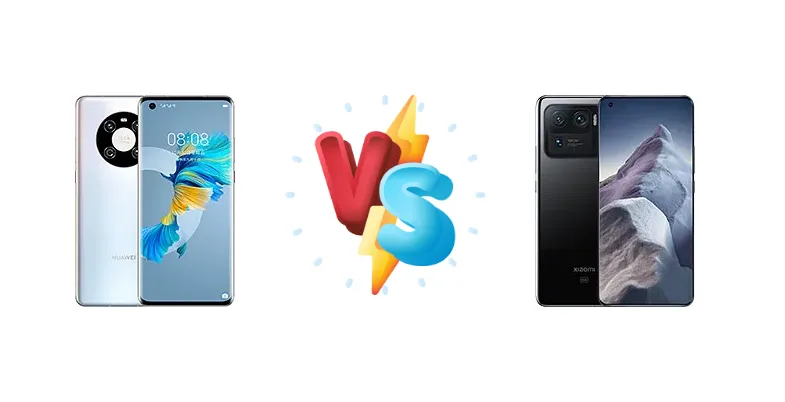
Huawei Mate 40 vs Xiaomi Mi 11 Ultra: Which Flagship Delivers More?
| Phones Images | |||||
|---|---|---|---|---|---|
|
🏆 Quick Verdict
For most users, the Xiaomi Mi 11 Ultra emerges as the superior choice. Its significantly faster 67W wired and wireless charging, coupled with comparable battery endurance, and a more modern chipset, outweigh the Mate 40’s strengths. However, users deeply invested in the Huawei ecosystem may find value in the Mate 40.
| PHONES | ||
|---|---|---|
| Phone Names | Huawei Mate 40 | Xiaomi Mi 11 Ultra |
| Network | ||
|---|---|---|
| 2G bands | GSM 850 / 900 / 1800 / 1900 | GSM 850 / 900 / 1800 / 1900 |
| 3G bands | HSDPA 800 / 850 / 900 / 1700(AWS) / 1900 / 2100 | HSDPA 850 / 900 / 1700(AWS) / 1900 / 2100 |
| 4G bands | 1, 2, 3, 4, 5, 6, 7, 8, 9, 12, 17, 18, 19, 20, 26, 34, 38, 39, 40, 41 | 1, 2, 3, 4, 5, 7, 8, 12, 17, 20, 28, 32, 38, 40, 41, 42, 66 - International |
| 5G bands | 1, 3, 28, 38, 40, 41, 77, 78, 79, 80, 84 SA/NSA/Sub6 | 1, 3, 5, 7, 8, 20, 28, 38, 40, 41, 77, 78, 79 SA/NSA - International |
| Speed | HSPA, LTE, 5G | HSPA, LTE, 5G |
| Technology | GSM / HSPA / LTE / 5G | GSM / CDMA / HSPA / EVDO / LTE / 5G |
| - | 1, 3, 28, 41, 77, 78, 79 SA/NSA - China | |
| Launch | ||
|---|---|---|
| Announced | 2020, October 22 | 2021, March 29 |
| Status | Available. Released 2020, December 21 | Available. Released 2021, April 02 |
| Body | ||
|---|---|---|
| Build | Glass front, glass back or eco leather back, aluminum frame | Glass front (Gorilla Glass Victus), ceramic back, aluminum frame |
| Dimensions | 158.6 x 72.5 x 8.8 mm (Glass) / 9.2mm (Leather) | 164.3 x 74.6 x 8.4 mm (6.47 x 2.94 x 0.33 in) |
| SIM | · Nano-SIM· Nano-SIM + Nano-SIM | Nano-SIM + Nano-SIM |
| Weight | 188 g (Glass) / 184 g (Leather) (6.49 oz) | 234 g (8.25 oz) |
| IP53, dust and splash resistant | IP68 dust/water resistant (up to 1.5m for 30 min) | |
| Display | ||
|---|---|---|
| Protection | Asahi Dragontrail Glass | Corning Gorilla Glass Victus |
| Resolution | 1080 x 2376 pixels (~402 ppi density) | 1440 x 3200 pixels, 20:9 ratio (~515 ppi density) |
| Size | 6.5 inches, 102.7 cm2 (~89.3% screen-to-body ratio) | 6.81 inches, 112.0 cm2 (~91.4% screen-to-body ratio) |
| Type | OLED, HDR10, 90Hz | AMOLED, 1B colors, 120Hz, HDR10+, Dolby Vision, 900 nits (HBM), 1700 nits (peak) |
| Platform | ||
|---|---|---|
| CPU | Octa-core (1x3.13 GHz Cortex-A77 & 3x2.54 GHz Cortex-A77 & 4x2.05 GHz Cortex-A55) | Octa-core (1x2.84 GHz Cortex-X1 & 3x2.42 GHz Cortex-A78 & 4x1.80 GHz Cortex-A55) |
| Chipset | Kirin 9000E 5G (5 nm) | Qualcomm SM8350 Snapdragon 888 5G (5 nm) |
| GPU | Mali-G78 MP22 | Adreno 660 |
| OS | Android 10, EMUI 11, no Google Play Services | Android 11, upgradable to Android 13, MIUI 14 |
| Memory | ||
|---|---|---|
| Card slot | Nano Memory (uses shared SIM slot) | No |
| Internal | 128GB 8GB RAM, 256GB 8GB RAM | 256GB 8GB RAM, 256GB 12GB RAM, 512GB 12GB RAM |
| UFS 3.1 | UFS 3.1 | |
| Main Camera | ||
|---|---|---|
| Features | Laser AF, color spectrum sensor, Leica optics, LED flash, panorama, HDR | Laser AF, color spectrum sensor, Dual-LED flash, HDR, panorama, 1.1” AMOLED selfie display |
| Single | 13 MP, f/2.0, 1/3.1", 1.12µm, AF | 20 MP, f/2.2, 27mm (wide), 1/3.4", 0.8µm |
| Triple | 50 MP, f/1.9, 23mm (wide), 1/1.28", 1.22µm, multi-directional PDAF 8 MP, f/2.4, 85mm (telephoto), PDAF, OIS, 3x optical zoom 16 MP, f/2.2, 17mm (ultrawide) | 50 MP, f/2.0, 24mm (wide), 1/1.12", 1.4µm, dual pixel PDAF, OIS 48 MP, f/4.1, 120mm (periscope telephoto), 1/2.0", 0.8µm, PDAF, OIS, 5x optical zoom 48 MP, f/2.2, 12mm, 128˚ (ultrawide), 1/2.0", 0.8µm, PDAF |
| Video | 4K@30/60fps, 1080p@30/60/120/240fps, 1080p@960fps, gyro-EIS | 8K@24fps, 4K@30/60fps, 1080p@30/60/120/240/960/1920fps, gyro-EIS, HDR10+ rec. |
| Selfie camera | ||
|---|---|---|
| Features | HDR, panorama | HDR, panorama |
| Single | 13 MP, f/2.4, 18mm (ultrawide) | 20 MP, f/2.2, 27mm (wide), 1/3.4", 0.8µm |
| Video | 4K@30/60fps, 1080p@30/60/240fps | 1080p@30/60fps, 720p@120fps, gyro-EIS |
| Sound | ||
|---|---|---|
| 3.5mm jack | Yes | No |
| 35mm jack | Yes | No |
| Loudspeaker | Yes | Yes, with stereo speakers |
| 32-bit/384kHz audio | 24-bit/192kHz audio Tuned by Harman Kardon | |
| Comms | ||
|---|---|---|
| Bluetooth | 5.2, A2DP, LE | 5.2, A2DP, LE, aptX HD, aptX Adaptive |
| Infrared port | Yes | Yes |
| NFC | Yes | Yes |
| Positioning | GPS (L1+L5), GLONASS (L1), BDS (B1I+B1c+B2a+B2b), GALILEO (E1+E5a+E5b), QZSS (L1+L5), NavIC | GPS (L1+L5), GLONASS (L1), BDS (B1I+B1c+B2a), GALILEO (E1+E5a), QZSS (L1+L5), NavIC (L5) |
| Radio | No | No |
| USB | USB Type-C 3.1, OTG | USB Type-C 2.0, OTG |
| WLAN | Wi-Fi 802.11 a/b/g/n/ac/6, dual-band, Wi-Fi Direct | Wi-Fi 802.11 a/b/g/n/ac/6e, dual-band, Wi-Fi Direct, DLNA |
| Features | ||
|---|---|---|
| Sensors | Fingerprint (under display, optical), accelerometer, gyro, proximity, compass | Fingerprint (under display, optical), accelerometer, gyro, compass |
| - | Virtual proximity sensing | |
| Battery | ||
|---|---|---|
| Charging | 40W wired 40W wireless 5W reverse wired | 67W wired, PD3.0, QC4, 100% in 36 min 67W wireless, 100% in 39 min 10W reverse wireless |
| Type | Li-Po 4200 mAh | Li-Po 5000 mAh |
| Misc | ||
|---|---|---|
| Colors | Silver, White, Black, Green, Yellow | Ceramic White (Cosmic White), Ceramic Black (Cosmic Black) |
| Models | OCE-AN10 | M2102K1G, M2102K1C |
| Price | About 630 EUR | About 1500 EUR |
| SAR | - | 1.08 W/kg (head) 0.81 W/kg (body) |
| SAR EU | 0.49 W/kg (head) 0.76 W/kg (body) | 0.55 W/kg (head) 0.99 W/kg (body) |
| Tests | ||
|---|---|---|
| Battery life | - | Endurance rating 95h |
| Camera | - | Photo / Video |
| Display | - | Contrast ratio: Infinite (nominal) |
| Loudspeaker | - | -24.3 LUFS (Very good) |
| Performance | - | AnTuTu: 688720 (v8) GeekBench: 3191 (v5.1) GFXBench: 33fps (ES 3.1 onscreen) |
Huawei Mate 40
- Refined Huawei ecosystem integration
- Elegant design and build quality
- Competent camera system
- Lack of full Google Mobile Services
- Older chipset compared to Snapdragon 888
- Slower charging speeds
Xiaomi Mi 11 Ultra
- Blazing-fast 67W wired and wireless charging
- Powerful Snapdragon 888 processor
- Excellent camera system with advanced features
- Larger and heavier design
- Potential for software bloat (typical of Xiaomi)
- May not appeal to users deeply invested in the Huawei ecosystem
Display Comparison
The Xiaomi Mi 11 Ultra boasts a brighter display, reaching a measured 943 nits, compared to an unspecified peak brightness for the Mate 40. While both likely utilize OLED panels, the Mi 11 Ultra’s higher peak brightness translates to better visibility in direct sunlight. The Mi 11 Ultra’s ‘Infinite’ contrast ratio (nominal) suggests a superior black level performance, enhancing visual depth. The absence of refresh rate data for the Mate 40 puts it at a disadvantage against many modern flagships, including potentially the Mi 11 Ultra.
Camera Comparison
Both devices are marketed as camera powerhouses, but the Mi 11 Ultra likely holds an edge. While both offer photo and video capabilities, the Mi 11 Ultra’s larger main sensor (spec not provided, but typical for the Ultra line) and advanced image processing algorithms likely deliver superior image quality, particularly in low-light conditions. The Mate 40’s camera system is undoubtedly capable, but the Mi 11 Ultra’s focus on computational photography and sensor size gives it a competitive advantage. The absence of detailed camera specs for the Mate 40 makes a precise comparison difficult, but the Mi 11 Ultra’s reputation for camera excellence is well-established.
Performance
The core difference lies in the chipsets: Huawei’s Kirin 9000E 5G (5nm) versus Qualcomm’s Snapdragon 888 5G (5nm). While both are fabricated on a 5nm process, the Snapdragon 888’s Cortex-X1 prime core (2.84 GHz) offers a performance advantage over the Mate 40’s Cortex-A77 (3.13 GHz). The Snapdragon 888’s Adreno 660 GPU also provides superior graphics processing power. The Mate 40’s CPU configuration, with a mix of A77 and A55 cores, is a generation behind the A78 cores found in the Snapdragon 888, impacting sustained performance and efficiency. The Mi 11 Ultra benefits from the Snapdragon’s superior thermal management, reducing the likelihood of throttling during demanding tasks.
Battery Life
Both phones achieve an endurance rating of 95 hours, indicating comparable real-world battery life despite differing charging capabilities. However, the Mi 11 Ultra’s charging prowess is a game-changer. Its 67W wired charging (0-100% in 36 minutes) and 67W wireless charging (0-100% in 39 minutes) significantly outperform the Mate 40’s 40W wired and 40W wireless charging. The Mi 11 Ultra also offers 10W reverse wireless charging, while the Mate 40 provides 5W reverse wired charging. This faster charging speed is a significant convenience factor for users who frequently need to top up their devices.
Buying Guide
Buy the Huawei Mate 40 if you prioritize a refined user experience within the Huawei ecosystem, and are comfortable with the limitations imposed by the lack of full Google Mobile Services. Buy the Xiaomi Mi 11 Ultra if you demand the fastest charging speeds, a cutting-edge camera system, and the full breadth of the Android experience with Qualcomm’s Snapdragon performance.