
Huawei Mate 40 vs Samsung Galaxy S21 Ultra 5G: A Head-to-Head Flagship Battle
| Phones Images | |||||
|---|---|---|---|---|---|
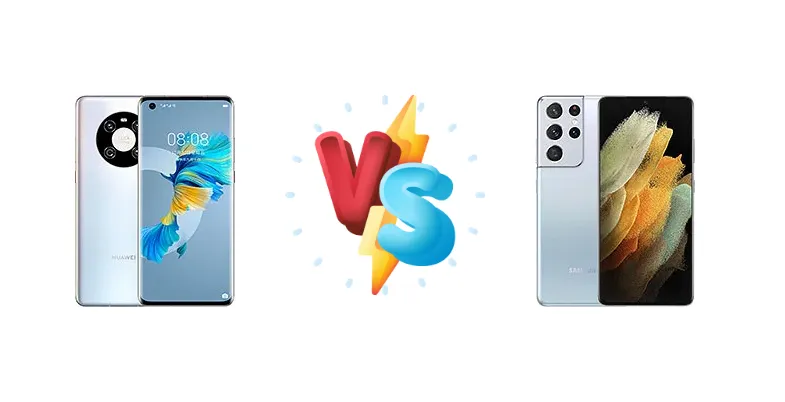
|
🏆 Quick Verdict
For the average user prioritizing a robust software experience, wider app compatibility, and a brighter display, the Samsung Galaxy S21 Ultra 5G is the better choice. However, the Huawei Mate 40 offers competitive performance and a unique aesthetic, appealing to those within the Huawei ecosystem.
| PHONES | ||
|---|---|---|
| Phone Names | Huawei Mate 40 | Samsung Galaxy S21 Ultra 5G |
| Network | ||
|---|---|---|
| 2G bands | GSM 850 / 900 / 1800 / 1900 | GSM 850 / 900 / 1800 / 1900 |
| 3G bands | HSDPA 800 / 850 / 900 / 1700(AWS) / 1900 / 2100 | HSDPA 850 / 900 / 1700(AWS) / 1900 / 2100 |
| 4G bands | 1, 2, 3, 4, 5, 6, 7, 8, 9, 12, 17, 18, 19, 20, 26, 34, 38, 39, 40, 41 | 1, 2, 3, 4, 5, 7, 8, 12, 13, 14, 18, 19, 20, 25, 26, 28, 30, 38, 39, 40, 41, 46, 48, 66, 71 - SM-G998U1 |
| 5G bands | 1, 3, 28, 38, 40, 41, 77, 78, 79, 80, 84 SA/NSA/Sub6 | 2, 5, 25, 41, 66, 71, 260, 261 SA/NSA/Sub6/mmWave - SM-G998U1 |
| Speed | HSPA, LTE, 5G | HSPA 42.2/5.76 Mbps, LTE (7CA) Cat20 2000/200 Mbps, 5G (5+ Gbps DL) |
| Technology | GSM / HSPA / LTE / 5G | GSM / CDMA / HSPA / EVDO / LTE / 5G |
| - | 1, 3, 5, 7, 8, 20, 28, 38, 40, 41, 66, 77, 78 SA/NSA/Sub6 - SM-G998B | |
| Launch | ||
|---|---|---|
| Announced | 2020, October 22 | 2021, January 14 |
| Status | Available. Released 2020, December 21 | Available. Released 2021, January 29 |
| Body | ||
|---|---|---|
| Build | Glass front, glass back or eco leather back, aluminum frame | Glass front (Gorilla Glass Victus), glass back (Gorilla Glass Victus), aluminum frame |
| Dimensions | 158.6 x 72.5 x 8.8 mm (Glass) / 9.2mm (Leather) | 165.1 x 75.6 x 8.9 mm (6.5 x 2.98 x 0.35 in) |
| SIM | · Nano-SIM· Nano-SIM + Nano-SIM | · Nano-SIM + eSIM· Nano-SIM + Nano-SIM + eSIM (max 2 at a time) |
| Weight | 188 g (Glass) / 184 g (Leather) (6.49 oz) | 227 g (Sub6), 229 g (mmWave) (8.01 oz) |
| IP53, dust and splash resistant | IP68 dust/water resistant (up to 1.5m for 30 min) Stylus support | |
| Display | ||
|---|---|---|
| Protection | Asahi Dragontrail Glass | Corning Gorilla Glass Victus |
| Resolution | 1080 x 2376 pixels (~402 ppi density) | 1440 x 3200 pixels, 20:9 ratio (~515 ppi density) |
| Size | 6.5 inches, 102.7 cm2 (~89.3% screen-to-body ratio) | 6.8 inches, 112.1 cm2 (~89.8% screen-to-body ratio) |
| Type | OLED, HDR10, 90Hz | Dynamic AMOLED 2X, 120Hz, HDR10+, 1500 nits (peak) |
| - | Always-on display | |
| Platform | ||
|---|---|---|
| CPU | Octa-core (1x3.13 GHz Cortex-A77 & 3x2.54 GHz Cortex-A77 & 4x2.05 GHz Cortex-A55) | Octa-core (1x2.9 GHz Cortex-X1 & 3x2.80 GHz Cortex-A78 & 4x2.2 GHz Cortex-A55) - InternationalOcta-core (1x2.84 GHz Cortex-X1 & 3x2.42 GHz Cortex-A78 & 4x1.80 GHz Cortex-A55) - USA/China |
| Chipset | Kirin 9000E 5G (5 nm) | Exynos 2100 (5 nm) - InternationalQualcomm SM8350 Snapdragon 888 5G (5 nm) - USA/China |
| GPU | Mali-G78 MP22 | Mali-G78 MP14 - InternationalAdreno 660 - USA/China |
| OS | Android 10, EMUI 11, no Google Play Services | Android 11, up to 4 major Android upgrades, One UI 6.1 |
| Memory | ||
|---|---|---|
| Card slot | Nano Memory (uses shared SIM slot) | No |
| Internal | 128GB 8GB RAM, 256GB 8GB RAM | 128GB 8GB RAM, 128GB 12GB RAM, 256GB 12GB RAM, 256GB 16GB RAM, 512GB 12GB RAM, 512GB 16GB RAM |
| UFS 3.1 | UFS 3.1 | |
| Main Camera | ||
|---|---|---|
| Features | Laser AF, color spectrum sensor, Leica optics, LED flash, panorama, HDR | Laser AF, LED flash, auto-HDR, panorama |
| Quad | - | 108 MP, f/1.8, 24mm (wide), 1/1.33", 0.8µm, PDAF, OIS 10 MP, f/2.4, 72mm (telephoto), 1/3.24", 1.22µm, dual pixel PDAF, OIS, 3x optical zoom 10 MP, f/4.9, 240mm (periscope telephoto), 1/3.24", 1.22µm, dual pixel PDAF, OIS, 10x optical zoom 12 MP, f/2.2, 13mm (ultrawide), 1/2.55", 1.4µm, dual pixel PDAF, Super Steady video |
| Single | 13 MP, f/2.0, 1/3.1", 1.12µm, AF | - |
| Triple | 50 MP, f/1.9, 23mm (wide), 1/1.28", 1.22µm, multi-directional PDAF 8 MP, f/2.4, 85mm (telephoto), PDAF, OIS, 3x optical zoom 16 MP, f/2.2, 17mm (ultrawide) | - |
| Video | 4K@30/60fps, 1080p@30/60/120/240fps, 1080p@960fps, gyro-EIS | 8K@24fps, 4K@30/60fps, 1080p@30/60/120/240fps, HDR10+, stereo sound rec., gyro-EIS |
| Selfie camera | ||
|---|---|---|
| Features | HDR, panorama | HDR |
| Single | 13 MP, f/2.4, 18mm (ultrawide) | 40 MP, f/2.2, 26mm (wide), 1/2.8", 0.7µm, PDAF |
| Video | 4K@30/60fps, 1080p@30/60/240fps | 4K@30/60fps, 1080p@30fps |
| Sound | ||
|---|---|---|
| 3.5mm jack | Yes | No |
| 35mm jack | Yes | No |
| Loudspeaker | Yes | Yes, with stereo speakers |
| 32-bit/384kHz audio | 32-bit/384kHz audio Tuned by AKG | |
| Comms | ||
|---|---|---|
| Bluetooth | 5.2, A2DP, LE | 5.2, A2DP, LE |
| Infrared port | Yes | - |
| NFC | Yes | Yes |
| Positioning | GPS (L1+L5), GLONASS (L1), BDS (B1I+B1c+B2a+B2b), GALILEO (E1+E5a+E5b), QZSS (L1+L5), NavIC | GPS, GLONASS, BDS, GALILEO |
| Radio | No | FM radio (Snapdragon model only; market/operator dependent) |
| USB | USB Type-C 3.1, OTG | USB Type-C 3.2, OTG |
| WLAN | Wi-Fi 802.11 a/b/g/n/ac/6, dual-band, Wi-Fi Direct | Wi-Fi 802.11 a/b/g/n/ac/6e, dual-band, Wi-Fi Direct |
| Features | ||
|---|---|---|
| Sensors | Fingerprint (under display, optical), accelerometer, gyro, proximity, compass | Fingerprint (under display, ultrasonic), accelerometer, gyro, proximity, compass, barometer |
| - | Samsung DeX, Samsung Wireless DeX (desktop experience support) Bixby natural language commands and dictation Samsung Pay (Visa, MasterCard certified) Ultra Wideband (UWB) support | |
| Battery | ||
|---|---|---|
| Charging | 40W wired 40W wireless 5W reverse wired | 25W wired, PD3.0 15W wireless (Qi) 4.5W reverse wireless |
| Type | Li-Po 4200 mAh | Li-Ion 5000 mAh |
| Misc | ||
|---|---|---|
| Colors | Silver, White, Black, Green, Yellow | Phantom Black, Phantom Silver, Phantom Titanium, Phantom Navy, Phantom Brown, Navy |
| Models | OCE-AN10 | SM-G998B, SM-G998B/DS, SM-G998U, SM-G998U1, SM-G998W, SM-G998N, SM-G9980 |
| Price | About 630 EUR | $ 240.01 / C$ 353.20 / £ 202.99 / € 264.99 |
| SAR | - | 0.77 W/kg (head) 1.02 W/kg (body) |
| SAR EU | 0.49 W/kg (head) 0.76 W/kg (body) | 0.71 W/kg (head) 1.58 W/kg (body) |
| Pricing | ||
|---|---|---|
| 128GB 12GB RAM | - | $ 384.99 |
| 256GB 12GB RAM | - | $ 998.00 |
| 512GB 12GB RAM | - | $ 1,179.99 |
| RENEWED | - | $ 459.00 |
| Tests | ||
|---|---|---|
| Battery life | - | Endurance rating 114h |
| Camera | - | Photo / Video |
| Display | - | Contrast ratio: Infinite (nominal) |
| Loudspeaker | - | -25.5 LUFS (Very good) |
| Performance | - | AnTuTu: 657150 (v8) GeekBench: 3518 (v5.1) GFXBench: 33fps (ES 3.1 onscreen) |
Huawei Mate 40
- Faster charging speeds (40W wired/wireless)
- Unique and distinctive design aesthetic
- Strong performance from the Kirin 9000E chipset
- Limited app availability due to geopolitical restrictions
- Software ecosystem less mature than Samsung’s
- Uncertainty regarding long-term software updates
Samsung Galaxy S21 Ultra 5G
- Brighter and more vibrant display
- Wider app compatibility and software support
- Versatile camera system with advanced zoom capabilities
- Slower charging speeds (25W wired/15W wireless)
- Potential for thermal throttling with the Snapdragon 888
- Higher price point for comparable storage configurations
Display Comparison
The Samsung Galaxy S21 Ultra 5G immediately stands out with its measured peak brightness of 1023 nits, significantly exceeding what’s likely available on the Mate 40 (Huawei doesn’t publish peak brightness figures). This translates to superior visibility in direct sunlight. While both utilize 5nm chipsets, the S21 Ultra’s display technology, likely LTPO, allows for a variable refresh rate, potentially improving battery efficiency. The S21 Ultra’s ‘Infinite’ contrast ratio suggests a superior OLED panel, though real-world differences in color accuracy would require detailed calibration.
Camera Comparison
Both devices excel in photography, but approach it differently. The S21 Ultra’s camera system, while details are limited to 'Photo/Video', likely features a larger main sensor and more advanced computational photography algorithms. The Mate 40’s camera prowess is well-documented, but the S21 Ultra’s versatility, particularly in zoom capabilities, is a significant advantage. The presence of OIS on both is expected, but the S21 Ultra’s dual-telephoto lens system provides greater flexibility. Ignoring the often-underperforming 2MP macro cameras on both devices, the core imaging experience will hinge on software processing and sensor size.
Performance
Both phones employ 5nm chipsets, but the architectural differences are crucial. The Galaxy S21 Ultra’s Exynos 2100 (International) or Snapdragon 888 (USA/China) feature the Cortex-X1 prime core clocked at 2.9 GHz (Exynos) or 2.84 GHz (Snapdragon), offering a potential edge in single-core performance over the Mate 40’s Cortex-A77 prime core at 3.13 GHz. However, the Mate 40’s Kirin 9000E utilizes three Cortex-A77 cores versus the S21 Ultra’s three Cortex-A78 cores, which offer improved efficiency. The S21 Ultra’s LPDDR5 RAM, while sharing the same 12GB capacity in some configurations, may offer slightly faster speeds than the Mate 40’s RAM. Thermal management will be key; the Snapdragon 888 is known to throttle under sustained load, a potential concern for gamers.
Battery Life
The Galaxy S21 Ultra boasts an endurance rating of 114 hours, indicating solid battery life. While the Mate 40’s battery capacity isn’t specified, its 40W wired and 40W wireless charging capabilities significantly outpace the S21 Ultra’s 25W wired and 15W wireless charging. This means the Mate 40 can replenish its battery much faster, even if its overall capacity is smaller. The S21 Ultra’s 4.5W reverse wireless charging is also slower than the Mate 40’s 5W offering, but both are primarily for emergency top-ups.
Buying Guide
Buy the Huawei Mate 40 if you prioritize a distinctive design, are deeply embedded in the Huawei ecosystem, and can navigate the limitations of the HarmonyOS/EMUI software environment. Buy the Samsung Galaxy S21 Ultra 5G if you value a vibrant, high-brightness display, a versatile camera system, and the convenience of a mature Android experience with guaranteed updates and broader app support.