
Huawei Mate 40 Pro vs Sony Xperia 1 III: A Flagship Face-Off
| Phones Images | |||||
|---|---|---|---|---|---|
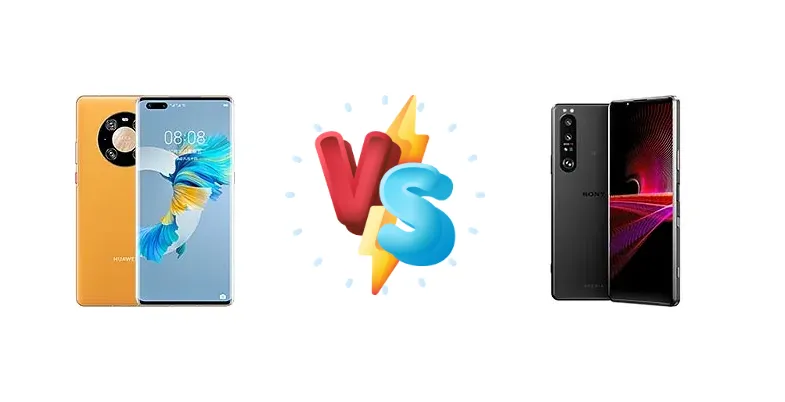
|
🏆 Quick Verdict
For the average user prioritizing longevity and fast charging, the Huawei Mate 40 Pro is the better choice. Its 97-hour endurance rating and 66W wired charging significantly outperform the Xperia 1 III’s 82-hour rating and 30W charging. However, the Xperia 1 III appeals to a niche audience valuing a dedicated camera experience and a unique display.
| PHONES | ||
|---|---|---|
| Phone Names | Huawei Mate 40 Pro | Sony Xperia 1 III |
| Network | ||
|---|---|---|
| 2G bands | GSM 850 / 900 / 1800 / 1900 | GSM 850 / 900 / 1800 / 1900 |
| 3G bands | HSDPA 800 / 850 / 900 / 1700(AWS) / 1900 / 2100 | HSDPA 800 / 850 / 900 / 1700(AWS) / 1900 / 2100 |
| 4G bands | 1, 2, 3, 4, 5, 6, 7, 8, 9, 12, 17, 18, 19, 20, 26, 28, 32, 34, 38, 39, 40, 41, 42 | 1, 2, 3, 4, 5, 7, 8, 12, 13, 17, 19, 20, 25, 26, 28, 29, 32, 34, 38, 39, 40, 41, 46, 66 - Europe |
| 5G bands | 1, 3, 5, 7, 8, 28, 38, 40, 41, 77, 78, 79, 80, 84 SA/NSA/Sub6 | 1, 3, 5, 7, 8, 20, 28, 38, 40, 41, 77, 78 SA/NSA/Sub6 - Europe |
| Speed | HSPA, LTE, 5G | HSPA, LTE, 5G |
| Technology | GSM / CDMA / HSPA / EVDO / LTE / 5G | GSM / HSPA / LTE / 5G |
| CDMA2000 1xEV-DO | SA/NSA/Sub6/mmWave - USA (specific) | |
| Launch | ||
|---|---|---|
| Announced | 2020, October 22 | 2021, April 14 |
| Status | Available. Released 2020, November 01 | Available. Released 2021, August 25 |
| Body | ||
|---|---|---|
| Build | Glass front, glass back or eco leather back, aluminum frame | Glass front (Gorilla Glass Victus), glass back (Gorilla Glass 6), aluminum frame |
| Dimensions | 162.9 x 75.5 x 9.1 mm (Glass) / 9.5mm (Leather) | 165 x 71 x 8.2 mm (6.50 x 2.80 x 0.32 in) |
| SIM | · Nano-SIM + eSIM· Nano-SIM + Nano-SIM | Nano-SIM + Nano-SIM |
| Weight | 212 g (7.48 oz) | 186 g / 187.1 g (mmWave) (6.56 oz) |
| IP68 dust/water resistant | IP65/IP68 dust/water resistant (up to 1.5m for 30 min) | |
| Display | ||
|---|---|---|
| Protection | - | Corning Gorilla Glass Victus |
| Resolution | 1344 x 2772 pixels, 18.5:9 ratio (~456 ppi density) | 1644 x 3840 pixels, 21:9 ratio (~643 ppi density) |
| Size | 6.76 inches, 115.7 cm2 (~94.1% screen-to-body ratio) | 6.5 inches, 98.6 cm2 (~84.2% screen-to-body ratio) |
| Type | OLED, HDR10, 90Hz | OLED, 1B colors, 120Hz, HDR BT.2020 |
| - | Runs at 1096 x 2560 pixels except for select use cases | |
| Platform | ||
|---|---|---|
| CPU | Octa-core (1x3.13 GHz Cortex-A77 & 3x2.54 GHz Cortex-A77 & 4x2.05 GHz Cortex-A55) | Octa-core (1x2.84 GHz Cortex-X1 & 3x2.42 GHz Cortex-A78 & 4x1.80 GHz Cortex-A55) |
| Chipset | Kirin 9000 5G (5 nm) | Qualcomm SM8350 Snapdragon 888 5G (5 nm) |
| GPU | Mali-G78 MP24 | Adreno 660 |
| OS | Android 10, EMUI 11, no Google Play Services | Android 11, upgradable to Android 13 |
| Memory | ||
|---|---|---|
| Card slot | Nano Memory (uses shared SIM slot) | microSDXC (uses shared SIM slot) |
| Internal | 128GB 8GB RAM, 256GB 8GB RAM, 512GB 8GB RAM | 256GB 12GB RAM, 512GB 12GB RAM |
| UFS 3.1 | UFS 3.X | |
| Main Camera | ||
|---|---|---|
| Features | Laser AF, color spectrum sensor, Leica optics, LED flash, panorama, HDR | Zeiss optics, Zeiss T* lens coating, color spectrum sensor, LED flash, panorama, HDR, eye tracking |
| Single | - | 8 MP, f/2.0, 24mm (wide), 1/4", 1.12µm |
| Triple | 50 MP, f/1.9, 23mm (wide), 1/1.28", 1.22µm, multi-directional PDAF 12 MP, f/3.4, 125mm (periscope telephoto), PDAF, OIS, 5x optical zoom 20 MP, f/1.8, 18mm (ultrawide), PDAF | 12 MP, f/1.7, 24mm (wide), 1/1.7", 1.8µm, dual pixel PDAF, OIS 12 MP, f/2.3, 70mm (telephoto), f/2.8, 105mm (telephoto), 1/2.9", dual pixel PDAF, 3x/4.4x optical zoom, OIS 12 MP, f/2.2, 124˚, 16mm (ultrawide), 1/2.6", dual pixel PDAF 0.3 MP, TOF 3D, (depth) |
| Video | 4K@30/60fps, 1080p@30/60/120/240/480fps, 720p@960fps, 720p@3840fps, HDR, gyro-EIS | 4K@24/25/30/60/120fps HDR, 1080p@30/60/120fps; 5-axis gyro-EIS, OIS |
| Selfie camera | ||
|---|---|---|
| Features | HDR, panorama | HDR |
| Single | 13 MP, f/2.4, 18mm (ultrawide) TOF 3D, (depth/biometrics sensor) | 8 MP, f/2.0, 24mm (wide), 1/4.0", 1.12µm |
| Video | 4K@30/60fps, 1080p@30/60/240fps | 1080p@30fps, 5-axis gyro-EIS |
| Sound | ||
|---|---|---|
| 3.5mm jack | No | Yes |
| 35mm jack | No | Yes |
| Loudspeaker | Yes, with stereo speakers | Yes, with stereo speakers |
| 32-bit/384kHz audio | 24-bit/192kHz audio Dynamic vibration system | |
| Comms | ||
|---|---|---|
| Bluetooth | 5.2, A2DP, LE | 5.2, A2DP, LE, aptX HD, aptX Adaptive |
| Infrared port | Yes | - |
| NFC | Yes | Yes |
| Positioning | GPS (L1+L5), GLONASS (L1), BDS (B1I+B1c+B2a+B2b), GALILEO (E1+E5a+E5b), QZSS (L1+L5), NavIC | GPS, GLONASS, BDS, GALILEO, QZSS |
| Radio | No | No |
| USB | USB Type-C 3.1, OTG | USB Type-C 3.1, OTG, video output |
| WLAN | Wi-Fi 802.11 a/b/g/n/ac/6, dual-band, Wi-Fi Direct | Wi-Fi 802.11 a/b/g/n/ac/6, dual-band, Wi-Fi Direct, DLNA |
| Features | ||
|---|---|---|
| Sensors | Face ID, fingerprint (under display, optical), accelerometer, gyro, proximity, barometer, compass | Fingerprint (side-mounted), accelerometer, gyro, proximity, barometer, compass |
| - | Native Sony Alpha camera support | |
| Battery | ||
|---|---|---|
| Charging | 66W wired 50W wireless 5W reverse wireless | 30W wired, PD, 50% in 30 min Wireless Reverse wireless |
| Type | Li-Po 4400 mAh | Li-Po 4500 mAh |
| Misc | ||
|---|---|---|
| Colors | Mystic Silver, White, Black, Green, Yellow | Frosted Black, Frosted Gray, Frosted Purple |
| Models | NOH-NX9, NOH-AN00, NOH-AN01 | XQBC62/V, XQBC52V.UKCX, SO-51B, SOG03, A101SO, XQ-BC62, XQ-BC72, XQ-BC52, XQ-BC01, XQ-BC11, XQ-BC21, XQ-BC72 |
| Price | About 790 EUR | € 505.26 / $ 903.43 |
| Tests | ||
|---|---|---|
| Battery life | Endurance rating 97h | Endurance rating 82h |
| Camera | Photo / Video | Photo / Video |
| Display | Contrast ratio: Infinite (nominal) | Contrast ratio: Infinite (nominal) |
| Loudspeaker | -24.9 LUFS (Very good) | -26.5 LUFS (Good) |
| Performance | AnTuTu: 686835 (v8) GeekBench: 3704 (v5.1) GFXBench: 43fps (ES 3.1 onscreen) | AnTuTu: 607423 (v8) GeekBench: 3515 (v5.1) GFXBench: 54fps (ES 3.1 onscreen) |
Huawei Mate 40 Pro
- Exceptional battery life (97h endurance)
- Ultra-fast 66W wired charging
- Strong overall performance with Kirin 9000
- Software limitations due to US sanctions
- Less versatile zoom capabilities compared to Xperia 1 III
Sony Xperia 1 III
- Professional-grade camera with manual controls
- Unique 21:9 cinematic display
- Snapdragon 888 offers strong single-core performance
- Shorter battery life (82h endurance)
- Slower 30W charging
- Potential for thermal throttling
Display Comparison
The Sony Xperia 1 III’s 620 nits of peak brightness falls short of the Huawei Mate 40 Pro’s measured 807 nits, meaning the Mate 40 Pro will offer better visibility in direct sunlight. Both displays share an infinite (nominal) contrast ratio, typical of OLED panels. However, the Xperia 1 III’s 21:9 aspect ratio, while excellent for video, can present compatibility issues with some apps and games. The Mate 40 Pro’s more conventional aspect ratio offers broader compatibility. While neither spec sheet details refresh rate, the Xperia 1 III is known for its 120Hz refresh rate, a feature absent in the Mate 40 Pro.
Camera Comparison
Both devices offer comprehensive camera systems, but their approaches diverge. While both are capable of photo and video, the Xperia 1 III focuses on manual control and professional features, including real-time tracking and 4K 120fps video recording. The Mate 40 Pro, while also capable, leans towards computational photography and AI enhancements. Without detailed sensor size information, it’s difficult to definitively declare a winner, but the Mate 40 Pro’s reputation for excellent low-light performance suggests a larger main sensor. The Xperia 1 III’s variable telephoto lens offers greater versatility in zoom ranges, a significant advantage for photographers.
Performance
Both phones utilize 5nm fabrication processes, but the chipsets differ significantly. The Huawei Mate 40 Pro’s Kirin 9000 features a tri-cluster architecture with Cortex-A77 cores, while the Sony Xperia 1 III employs the Qualcomm Snapdragon 888 5G with a Cortex-X1 prime core. The X1 core in the Snapdragon 888 generally provides a performance edge in single-core tasks, but the Kirin 9000’s more efficient architecture and larger core count could offer better sustained performance in multi-threaded workloads. Thermal management is a key consideration; the Snapdragon 888 is known to throttle under sustained load, a potential drawback for gamers, while the Kirin 9000 generally exhibits better thermal efficiency.
Battery Life
The Huawei Mate 40 Pro’s 97-hour endurance rating is a clear win over the Xperia 1 III’s 82-hour rating. This translates to significantly longer real-world usage between charges. Furthermore, the Mate 40 Pro’s 66W wired charging is substantially faster than the Xperia 1 III’s 30W charging, allowing for a full charge in under an hour. The Mate 40 Pro also supports 50W wireless charging and 5W reverse wireless charging, features the Xperia 1 III offers but lacks the speed of Huawei’s implementation.
Buying Guide
Buy the Huawei Mate 40 Pro if you need exceptional battery life, incredibly fast charging speeds, and a well-rounded flagship experience. It’s ideal for power users and those who rely heavily on their phone throughout the day. Buy the Sony Xperia 1 III if you prioritize a professional-grade camera system with manual controls, a cinematic 21:9 display for media consumption, and a more minimalist Android experience.