
Huawei Mate 40 Pro 4G vs. Apple iPhone 12 Pro Max: A Head-to-Head Flagship Battle
| Phones Images | |||||
|---|---|---|---|---|---|
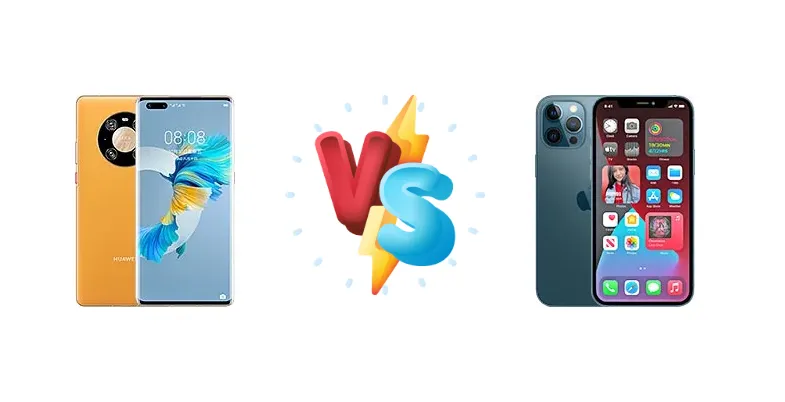
|
🏆 Quick Verdict
For the average user prioritizing a seamless software experience and long-term ecosystem support, the Apple iPhone 12 Pro Max is the better choice. However, the Huawei Mate 40 Pro 4G offers significantly faster charging and a compelling alternative for those seeking cutting-edge hardware and a different software experience.
| PHONES | ||
|---|---|---|
| Phone Names | Huawei Mate 40 Pro 4G | Apple iPhone 12 Pro Max |
| Network | ||
|---|---|---|
| 2G bands | GSM 850 / 900 / 1800 / 1900 | GSM 850 / 900 / 1800 / 1900 |
| 3G bands | HSDPA 800 / 850 / 900 / 1700(AWS) / 1900 / 2100 | HSDPA 850 / 900 / 1700(AWS) / 1900 / 2100 |
| 4G bands | 1, 2, 3, 4, 5, 6, 7, 8, 9, 12, 17, 18, 19, 20, 26, 34, 38, 39, 40, 41 | 1, 2, 3, 4, 5, 7, 8, 12, 13, 14, 17, 18, 19, 20, 25, 26, 28, 29, 30, 32, 34, 38, 39, 40, 41, 42, 46, 48, 66, 71 - A2342 |
| 5G bands | - | 1, 2, 3, 5, 7, 8, 12, 20, 25, 28, 38, 40, 41, 66, 71, 77, 78, 79, 260, 261 Sub6/mmWave - A2342 |
| Speed | HSPA, LTE | HSPA, LTE, 5G, EV-DO Rev.A 3.1 Mbps |
| Technology | GSM / CDMA / HSPA / EVDO / LTE | GSM / CDMA / HSPA / EVDO / LTE / 5G |
| CDMA2000 1xEV-DO | 1, 2, 3, 5, 7, 8, 12, 20, 25, 28, 38, 40, 41, 66, 77, 78, 79 Sub6 - A2410, A2411, A2412 | |
| Launch | ||
|---|---|---|
| Announced | 2021, June 28 | 2020, October 13 |
| Status | Available. Released 2021, July 09 | Available. Released 2020, November 13 |
| Body | ||
|---|---|---|
| Build | Glass front, glass back or eco leather back, aluminum frame | Glass front, glass back, stainless steel frame |
| Dimensions | 162.9 x 75.5 x 9.1 mm (Glass) / 9.5mm (Leather) | 160.8 x 78.1 x 7.4 mm (6.33 x 3.07 x 0.29 in) |
| SIM | Nano-SIM + Nano-SIM | · Nano-SIM + eSIM· Nano-SIM + Nano-SIM (China) |
| Weight | 212 g (7.48 oz) | 228 g (8.04 oz) |
| IP68 dust/water resistant | IP68 dust/water resistant (up to 6m for 30 min) Apple Pay (Visa, MasterCard, AMEX certified) | |
| Display | ||
|---|---|---|
| Protection | - | Ceramic Shield glass |
| Resolution | 1344 x 2772 pixels, 18.5:9 ratio (~456 ppi density) | 1284 x 2778 pixels, 19.5:9 ratio (~458 ppi density) |
| Size | 6.76 inches, 115.7 cm2 (~94.1% screen-to-body ratio) | 6.7 inches, 109.8 cm2 (~87.4% screen-to-body ratio) |
| Type | OLED, HDR10, 90Hz | Super Retina XDR OLED, HDR10, Dolby Vision, 800 nits (HBM), 1200 nits (peak) |
| Platform | ||
|---|---|---|
| CPU | Octa-core (1x3.13 GHz Cortex-A77 & 3x2.54 GHz Cortex-A77 & 4x2.05 GHz Cortex-A55) | Hexa-core (2x3.1 GHz Firestorm + 4x1.8 GHz Icestorm) |
| Chipset | Kirin 9000 (5 nm) | Apple A14 Bionic (5 nm) |
| GPU | Mali-G78 MP24 | Apple GPU (4-core graphics) |
| OS | HarmonyOS 2.0 | iOS 14.1, upgradable to iOS 26.1 |
| Memory | ||
|---|---|---|
| Card slot | Nano Memory (uses shared SIM slot) | No |
| Internal | 128GB 8GB RAM, 256GB 8GB RAM, 512GB 8GB RAM | 128GB 6GB RAM, 256GB 6GB RAM, 512GB 6GB RAM |
| UFS 3.1 | NVMe | |
| Main Camera | ||
|---|---|---|
| Features | Laser AF, color spectrum sensor, Leica optics, LED flash, panorama, HDR | Dual-LED dual-tone flash, HDR (photo/panorama) |
| Single | 13 MP, f/2.4, 18mm (ultrawide) TOF 3D, (depth/biometrics sensor) | - |
| Triple | 50 MP, f/1.9, 23mm (wide), 1/1.28", 1.22µm, multi-directional PDAF 12 MP, f/3.4, 125mm (periscope telephoto), PDAF, OIS, 5x optical zoom 20 MP, f/1.8, 18mm (ultrawide), PDAF | 12 MP, f/1.6, 26mm (wide), 1/1.9", 1.7µm, dual pixel PDAF, sensor-shift OIS 12 MP, f/2.2, 65mm (telephoto), 1/3.4", 1.0µm, PDAF, OIS, 2.5x optical zoom 12 MP, f/2.4, 13mm, 120˚ (ultrawide), 1/3.4", 1.0µm TOF 3D LiDAR scanner (depth) |
| Video | 4K@30/60fps, 1080p@30/60/120/240/480fps, 720p@960fps, 720p@3840fps, HDR, gyro-EIS | 4K@24/25/30/60fps, 1080p@25/30/60/120/240fps, 10‑bit HDR, Dolby Vision HDR (up to 60fps), stereo sound rec. |
| Selfie camera | ||
|---|---|---|
| Features | HDR, panorama | HDR |
| Single | 13 MP, f/2.4, 18mm (ultrawide) TOF 3D, (depth/biometrics sensor) | 12 MP, f/2.2, 23mm (wide), 1/3.6", 1.0µm SL 3D, (depth/biometrics sensor) |
| Video | 4K@30/60fps, 1080p@30/60/240fps | 4K@24/25/30/60fps, 1080p@25/30/60/120fps, gyro-EIS |
| Sound | ||
|---|---|---|
| 3.5mm jack | No | No |
| 35mm jack | No | No |
| Loudspeaker | Yes, with stereo speakers | Yes, with stereo speakers |
| 32-bit/384kHz audio | - | |
| Comms | ||
|---|---|---|
| Bluetooth | 5.2, A2DP, LE | 5.0, A2DP, LE |
| Infrared port | Yes | - |
| NFC | Yes | Yes |
| Positioning | GPS (L1+L5), GLONASS (L1), BDS (B1I+B1c+B2a+B2b), GALILEO (E1+E5a+E5b), QZSS (L1+L5), NavIC | GPS, GLONASS, GALILEO, QZSS |
| Radio | No | No |
| USB | USB Type-C 3.1, OTG | Lightning, USB 2.0 |
| WLAN | Wi-Fi 802.11 a/b/g/n/ac/6, dual-band, Wi-Fi Direct | Wi-Fi 802.11 a/b/g/n/ac/6, dual-band, hotspot |
| Features | ||
|---|---|---|
| Sensors | Face ID, fingerprint (under display, optical), accelerometer, gyro, proximity, barometer, compass | Face ID, accelerometer, gyro, proximity, compass, barometer |
| - | Ultra Wideband (UWB) support | |
| Battery | ||
|---|---|---|
| Charging | 66W wired 50W wireless 5W reverse wireless | Wired, PD2.0, 50% in 30 min 15W wireless (MagSafe) 15W wireless (Qi2) - requires iOS 17.4 update |
| Type | Li-Po 4400 mAh | Li-Ion 3687 mAh (14.13 Wh) |
| Misc | ||
|---|---|---|
| Colors | Mystic Silver, White, Black, Green, Yellow | Silver, Graphite, Gold, Pacific Blue |
| Models | NOH-AL00, NOH-AL10 | A2411, A2342, A2410, A2412, iPhone13,4 |
| Price | About 800 EUR | $ 328.00 / C$ 549.75 / £ 270.67 / € 339.00 |
| SAR EU | - | 0.99 W/kg (head) 0.99 W/kg (body) |
| Pricing | ||
|---|---|---|
| 128GB 6GB RAM | - | $ 599.99 |
| 256GB 6GB RAM | - | $ 728.45 |
| 512GB 6GB RAM | - | $ 886.67 |
| RENEWED | - | $ 627.00 |
| Tests | ||
|---|---|---|
| Battery life | - | Endurance rating 95h |
| Camera | - | Photo / Video |
| Display | - | Contrast ratio: Infinite (nominal) |
| Loudspeaker | - | -23.8 LUFS (Very good) |
| Performance | - | AnTuTu: 638584 (v8) GeekBench: 4240 (v5.1) GFXBench: 55fps (ES 3.1 onscreen) |
Huawei Mate 40 Pro 4G
- Significantly faster wired and wireless charging (66W/50W)
- Potentially superior multi-core performance with Kirin 9000
- Reverse wireless charging capability
- Often more competitive pricing
- EMUI software may not appeal to all users
- Potential for thermal throttling under heavy load
- Limited app ecosystem compared to iOS
- Long-term software update support is uncertain
Apple iPhone 12 Pro Max
- Seamless iOS ecosystem and user experience
- Strong app ecosystem and long-term software support
- Excellent video recording capabilities
- High resale value
- Slower charging speeds compared to Mate 40 Pro 4G
- Higher price point
- Less customization options compared to Android
- No reverse wireless charging
Display Comparison
The iPhone 12 Pro Max boasts a measured peak brightness of 822 nits, providing excellent visibility in direct sunlight. While the Mate 40 Pro 4G’s display specifications aren’t provided, Huawei typically employs OLED panels with comparable brightness levels. The iPhone’s ‘infinite’ contrast ratio, characteristic of OLED technology, delivers deep blacks and vibrant colors. The lack of LTPO technology in either device means refresh rates are capped at 60Hz, a notable omission compared to newer flagships. Bezels are similarly minimal on both devices, contributing to an immersive viewing experience.
Camera Comparison
Both phones are equipped with sophisticated camera systems, but their approaches differ. The iPhone 12 Pro Max excels in video recording, offering ProRes video capabilities (though not available on this model). The Mate 40 Pro 4G’s camera specifications aren’t detailed enough to make a direct sensor size comparison, but Huawei historically focuses on large sensors and advanced computational photography. Both devices offer excellent image stabilization (OIS). The iPhone’s image processing tends towards natural colors and accurate skin tones, while Huawei often employs more aggressive processing for vibrant, eye-catching results. The absence of detailed camera specs for the Mate 40 Pro 4G makes a definitive comparison challenging, but its reputation for camera innovation is well-established.
Performance
Both the Kirin 9000 and the Apple A14 Bionic are fabricated on a 5nm process, promising excellent performance and efficiency. However, their architectural approaches differ significantly. The Kirin 9000 utilizes a tri-cluster configuration with Cortex-A77 cores, while the A14 Bionic employs Apple’s custom Firestorm and Icestorm cores. The A14’s single-core performance is generally superior, benefiting from Apple’s tight hardware-software integration. The Kirin 9000, however, excels in multi-core tasks due to its eight cores. Both devices feature 6GB of RAM, but the iPhone benefits from Apple’s optimized memory management. Thermal management is a key consideration; the Kirin 9000, while powerful, has been known to exhibit throttling under sustained load, while the A14 Bionic generally maintains more consistent performance.
Battery Life
Both the Huawei Mate 40 Pro 4G and the iPhone 12 Pro Max achieve an endurance rating of 95 hours, indicating comparable overall battery life. However, their charging capabilities are vastly different. The Mate 40 Pro 4G supports blazing-fast 66W wired charging, capable of fully charging the battery in under an hour, and 50W wireless charging. The iPhone 12 Pro Max, in contrast, offers slower wired charging (50% in 30 minutes via PD2.0) and 15W wireless charging with MagSafe or Qi2 (requiring iOS 17.4). The Mate 40 Pro 4G also includes 5W reverse wireless charging, a feature absent on the iPhone.
Buying Guide
Buy the Huawei Mate 40 Pro 4G if you prioritize incredibly fast 66W wired and 50W wireless charging, and are comfortable with Huawei’s EMUI software. You’ll also benefit from the Kirin 9000’s raw processing power. Buy the Apple iPhone 12 Pro Max if you value a polished, intuitive user experience, a robust app ecosystem, and guaranteed software updates for years to come. The iPhone’s strong resale value is also a significant advantage.