
Huawei Mate 30E Pro 5G vs. Samsung Galaxy S20 Ultra 5G: A Flagship Face-Off
| Phones Images | |||||
|---|---|---|---|---|---|
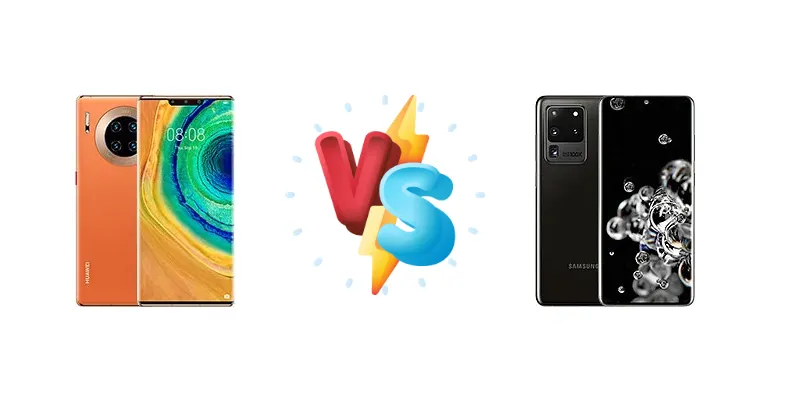
|
🏆 Quick Verdict
For the average user prioritizing camera versatility and display quality, the Samsung Galaxy S20 Ultra 5G is the stronger choice. However, the Huawei Mate 30E Pro 5G offers a compelling alternative for those seeking a potentially more efficient chipset and faster wired charging, especially if software restrictions aren't a concern.
| PHONES | ||
|---|---|---|
| Phone Names | Huawei Mate 30E Pro 5G | Samsung Galaxy S20 Ultra 5G |
| Network | ||
|---|---|---|
| 2G bands | GSM 850 / 900 / 1800 / 1900 | GSM 850 / 900 / 1800 / 1900 |
| 3G bands | HSDPA 800 / 850 / 900 / 1700(AWS) / 1900 / 2100 | HSDPA 850 / 900 / 1700(AWS) / 1900 / 2100 |
| 4G bands | 1, 2, 3, 4, 5, 6, 7, 8, 9, 12, 17, 18, 19, 20, 26, 28, 34, 38, 39, 40, 41 | 1, 2, 3, 4, 5, 7, 8, 12, 13, 17, 18, 19, 20, 25, 26, 28, 32, 38, 39, 40, 41, 66 - SM-G988B |
| 5G bands | 1, 3, 28, 41, 77, 78, 79 NSA/Sub6 | 1, 3, 5, 7, 8, 28, 40, 77, 78 SA/NSA/Sub6 - SM-G988B |
| Speed | HSPA, LTE, 5G (2+ Gbps DL) | HSPA 42.2/5.76 Mbps, LTE (7CA) Cat20 2000/200 Mbps, 5G (5+ Gbps DL) |
| Technology | GSM / HSPA / LTE / 5G | GSM / CDMA / HSPA / EVDO / LTE / 5G |
| Launch | ||
|---|---|---|
| Announced | 2020, October 22. Released 2020, November 01 | 2020, February 11 |
| Status | Discontinued | Available. Released 2020, March 06 |
| Body | ||
|---|---|---|
| Build | Glass front, glass back, aluminum frame | Glass front (Gorilla Glass 6), glass back (Gorilla Glass 6), aluminum frame |
| Dimensions | 158.1 x 73.1 x 8.8 mm (6.22 x 2.88 x 0.35 in) | 166.9 x 76 x 8.8 mm (6.57 x 2.99 x 0.35 in) |
| SIM | Nano-SIM + Nano-SIM | · Nano-SIM + eSIM· Nano-SIM + Nano-SIM |
| Weight | 198 g (6.98 oz) | 222 g (7.83 oz) |
| IP68 dust/water resistant (up to 2m for 30 mins) | - | |
| Display | ||
|---|---|---|
| Protection | - | Corning Gorilla Glass 6 |
| Resolution | 1176 x 2400 pixels, 18.5:9 ratio (~409 ppi density) | 1440 x 3200 pixels, 20:9 ratio (~511 ppi density) |
| Size | 6.53 inches, 108.7 cm2 (~94.1% screen-to-body ratio) | 6.9 inches, 114.0 cm2 (~89.9% screen-to-body ratio) |
| Type | OLED, HDR10 | Dynamic AMOLED 2X, 120Hz, HDR10+, 1400 nits (peak) |
| Platform | ||
|---|---|---|
| CPU | Octa-core (2x2.86 GHz Cortex-A76 & 2x2.36 GHz Cortex-A76 & 4x1.95 GHz Cortex-A55) | Octa-core (2x2.73 GHz Mongoose M5 & 2x2.50 GHz Cortex-A76 & 4x2.0 GHz Cortex-A55) - GlobalOcta-core (1x2.84 GHz Cortex-A77 & 3x2.42 GHz Cortex-A77 & 4x1.80 GHz Cortex-A55) - USA |
| Chipset | Kirin 990E 5G (7 nm+) | Exynos 990 (7 nm+) - GlobalQualcomm SM8250 Snapdragon 865 5G (7 nm+) - USA |
| GPU | Mali-G76 MP14 | Mali-G77 MP11 - GlobalAdreno 650 - USA |
| OS | Android 10, EMUI 11, no Google Play Services | Android 10, upgradable to Android 13, One UI 5.1 |
| Memory | ||
|---|---|---|
| Card slot | Nano Memory (uses shared SIM slot) | microSDXC (uses shared SIM slot) |
| Internal | 128GB 8GB RAM, 256GB 8GB RAM | 128GB 12GB RAM, 256GB 12GB RAM, 512GB 16GB RAM |
| UFS 3.0 | - | |
| Main Camera | ||
|---|---|---|
| Features | Leica optics, color spectrum sensor, dual-LED dual-tone flash, panorama, HDR | LED flash, auto-HDR, panorama |
| Triple | 40 MP, f/1.6, 27mm (wide), 1/1.7", PDAF, OIS 8 MP, f/2.4, 80mm (telephoto), 1/4.0", PDAF, OIS, 3x optical zoom 40 MP, f/1.8, 18mm (ultrawide), 1/1.54", PDAF TOF 3D, (depth) | 108 MP, f/1.8, 26mm (wide), 1/1.33", 0.8µm, PDAF, OIS 48 MP, f/3.5, 103mm (periscope telephoto), 1/2.0", 0.8µm, PDAF, OIS, 4x optical zoom, 10x hybrid zoom 12 MP, f/2.2, 13mm, 120˚ (ultrawide), 1/2.55" 1.4µm, Super Steady video 0.3 MP, TOF 3D, f/1.0, (depth) |
| Video | 4K@30/60fps, 1080p@30/60/120fps, 1080p@960fps, 720p@7680fps, gyro-EIS | 8K@24fps, 4K@30/60fps, 1080p@30/60/240fps, 720p@960fps, HDR10+, stereo sound rec., gyro-EIS & OIS |
| Selfie camera | ||
|---|---|---|
| Features | HDR, panorama | HDR |
| Single | 32 MP, f/2.0, 26mm (wide), 1/2.8", 0.8µm TOF 3D, (depth/biometrics sensor) | 40 MP, f/2.2, 26mm (wide), 1/2.8", 0.7µm, PDAF |
| Video | 1080p@30fps | 4K@30/60fps, 1080p@30fps |
| Sound | ||
|---|---|---|
| 3.5mm jack | No | - |
| 35mm jack | No | No |
| Loudspeaker | Yes | Yes, with stereo speakers |
| 32-bit/384kHz audio | - | |
| Comms | ||
|---|---|---|
| Bluetooth | 5.1, A2DP, LE | 5.0, A2DP, LE |
| Infrared port | Yes | - |
| NFC | Yes | Yes |
| Positioning | GPS (L1+L5), GLONASS (L1), BDS (B1), GALILEO (E1+E5a), QZSS (L1+L5) | GPS, GLONASS, BDS, GALILEO |
| Radio | No | FM radio (Snapdragon model only; market/operator dependent) |
| USB | USB Type-C 3.1, OTG | USB Type-C 3.2, OTG |
| WLAN | Wi-Fi 802.11 a/b/g/n/ac, dual-band, DLNA, Wi-Fi Direct | Wi-Fi 802.11 a/b/g/n/ac/6, dual-band, Wi-Fi Direct |
| Features | ||
|---|---|---|
| Sensors | Face ID, fingerprint (under display, optical), accelerometer, gyro, proximity, barometer, compass | Fingerprint (under display, ultrasonic), accelerometer, gyro, proximity, compass, barometer |
| Battery | ||
|---|---|---|
| Charging | 40W wired 27W wireless Reverse wireless | 45W wired, PD3.0 15W wireless (Qi) 4.5W reverse wireless |
| Type | Li-Po 4500 mAh | Li-Ion 5000 mAh |
| Misc | ||
|---|---|---|
| Colors | Black, Space Silver, Cosmic Purple, Emerald Green, Orange, Forest Green | Cosmic Grey, Cosmic Black, Cloud White |
| Models | LIO-AN00m | SM-G988, SM-G988U, SM-G988U1, SM-G9880, SM-G988B/DS, SM-G988N, SM-G988B, SM-G988W, SCG03 |
| Price | About 680 EUR | € 227.11 / $ 184.00 / £ 335.00 |
| SAR | - | 0.94 W/kg (head) 0.95 W/kg (body) |
| SAR EU | - | 0.32 W/kg (head) 1.56 W/kg (body) |
Huawei Mate 30E Pro 5G
- Faster 40W wired charging
- Potentially more power-efficient Kirin 990E 5G chipset
- Reverse wireless charging
- Lack of full Google Mobile Services
- Less versatile camera system compared to S20 Ultra
Samsung Galaxy S20 Ultra 5G
- Brighter and higher-resolution display
- More versatile camera system with advanced zoom capabilities
- Full Android experience with Samsung One UI
- Exynos 990 variant can suffer from thermal throttling
- Slower wireless charging compared to Mate 30E Pro 5G
Display Comparison
The Samsung Galaxy S20 Ultra 5G boasts a significantly brighter display, reaching a measured 894 nits. While the Mate 30E Pro 5G’s display specs aren’t explicitly provided, Samsung’s peak brightness provides a clear advantage for outdoor visibility. The S20 Ultra’s larger screen size and higher resolution also contribute to a more immersive viewing experience. The S20 Ultra likely utilizes a higher PWM dimming rate, potentially making it more comfortable for users sensitive to screen flicker, a detail absent from the Mate 30E Pro 5G’s specifications.
Camera Comparison
The Samsung Galaxy S20 Ultra 5G’s camera system is more comprehensively specified. While the Mate 30E Pro 5G is known for its strong camera performance, details are limited. The S20 Ultra’s emphasis on sensor size and optical image stabilization (OIS) suggests superior low-light performance and video stabilization. The S20 Ultra’s camera system is designed for versatility, offering a range of focal lengths and shooting modes. The presence of a dedicated telephoto lens with high zoom capabilities is a significant advantage over the Mate 30E Pro 5G, which likely relies more on digital zoom.
Performance
The chipset is a key differentiator. The Galaxy S20 Ultra 5G shipped with either the Exynos 990 (globally) or the Snapdragon 865 (USA). The Snapdragon 865, built on a 7nm+ process, generally offers superior sustained performance and thermal management compared to the Exynos 990. The Mate 30E Pro 5G utilizes the Kirin 990E 5G, also a 7nm+ chip. While the Kirin 990E’s CPU core configuration (2x2.86 GHz Cortex-A76, 2x2.36 GHz Cortex-A76, 4x1.95 GHz Cortex-A55) is complex, the Snapdragon 865’s Cortex-A77 cores (in the US variant) provide a performance edge. The S20 Ultra’s LPDDR5 RAM further enhances its multitasking capabilities.
Battery Life
The Galaxy S20 Ultra 5G achieved an Endurance rating of 87 hours, indicating solid battery life. While the Mate 30E Pro 5G’s battery capacity isn’t specified, the S20 Ultra’s endurance rating suggests it can comfortably last a full day of moderate to heavy use. The S20 Ultra supports 45W wired charging with PD3.0, enabling faster charging speeds than the Mate 30E Pro 5G’s 40W charging. The S20 Ultra also offers 15W wireless charging (Qi standard) and 4.5W reverse wireless charging, while the Mate 30E Pro 5G provides 27W wireless and reverse wireless charging.
Buying Guide
Buy the Huawei Mate 30E Pro 5G if you need fast 40W wired charging, a potentially more power-efficient Kirin 990E 5G chipset, and are comfortable navigating a software ecosystem without full Google Mobile Services. Buy the Samsung Galaxy S20 Ultra 5G if you prioritize a brighter, higher-quality display, a more versatile camera system, and the convenience of the full Android experience with Samsung’s One UI.