
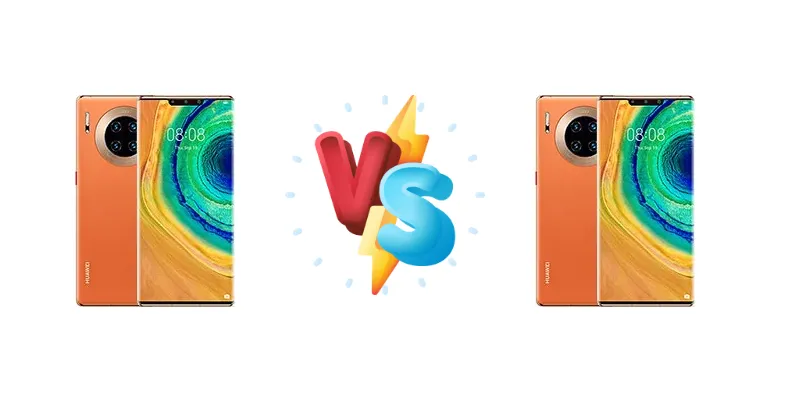
Huawei Mate 30E Pro 5G vs. Mate 30 Pro 5G: Decoding the Differences
| Phones Images | |||||
|---|---|---|---|---|---|
|
🏆 Quick Verdict
For the average user, the Huawei Mate 30E Pro 5G represents the better value. Despite utilizing the Kirin 990E, performance is virtually indistinguishable from the Kirin 990-powered Mate 30 Pro 5G in most real-world scenarios. The price difference, when available, makes the 30E Pro the more sensible choice.
| PHONES | ||
|---|---|---|
| Phone Names | Huawei Mate 30E Pro 5G | Huawei Mate 30 Pro 5G |
| Network | ||
|---|---|---|
| 2G bands | GSM 850 / 900 / 1800 / 1900 | GSM 850 / 900 / 1800 / 1900 |
| 3G bands | HSDPA 800 / 850 / 900 / 1700(AWS) / 1900 / 2100 | HSDPA 800 / 850 / 900 / 1700(AWS) / 1900 / 2100 |
| 4G bands | 1, 2, 3, 4, 5, 6, 7, 8, 9, 12, 17, 18, 19, 20, 26, 28, 34, 38, 39, 40, 41 | 1, 2, 3, 4, 5, 6, 7, 8, 9, 12, 17, 18, 19, 20, 26, 28, 32, 34, 38, 39, 40, 41 - Global |
| 5G bands | 1, 3, 28, 41, 77, 78, 79 NSA/Sub6 | 1, 3, 28, 38, 41, 77, 78, 79 NSA/Sub6 |
| Speed | HSPA, LTE, 5G (2+ Gbps DL) | HSPA, LTE, 5G (2+ Gbps DL) |
| Technology | GSM / HSPA / LTE / 5G | GSM / HSPA / LTE / 5G |
| - | 1, 2, 3, 4, 5, 6, 7, 8, 9, 12, 17, 18, 19, 20, 26, 34, 38, 39, 40, 41 - China | |
| Launch | ||
|---|---|---|
| Announced | 2020, October 22. Released 2020, November 01 | 2019, September 19. Released 2019, October 23 |
| Status | Discontinued | Discontinued |
| Body | ||
|---|---|---|
| Build | Glass front, glass back, aluminum frame | Glass front (Gorilla Glass 6), glass back (Gorilla Glass 6), aluminum frame |
| Dimensions | 158.1 x 73.1 x 8.8 mm (6.22 x 2.88 x 0.35 in) | 158.1 x 73.1 x 8.8 mm (6.22 x 2.88 x 0.35 in) |
| SIM | Nano-SIM + Nano-SIM | Nano-SIM + Nano-SIM |
| Weight | 198 g (6.98 oz) | 198 g (6.98 oz) |
| IP68 dust/water resistant (up to 2m for 30 mins) | IP68 dust/water resistant (up to 2m for 30 mins) | |
| Display | ||
|---|---|---|
| Protection | - | Corning Gorilla Glass 6 |
| Resolution | 1176 x 2400 pixels, 18.5:9 ratio (~409 ppi density) | 1176 x 2400 pixels, 18.5:9 ratio (~409 ppi density) |
| Size | 6.53 inches, 108.7 cm2 (~94.1% screen-to-body ratio) | 6.53 inches, 108.7 cm2 (~94.1% screen-to-body ratio) |
| Type | OLED, HDR10 | OLED, HDR10 |
| Platform | ||
|---|---|---|
| CPU | Octa-core (2x2.86 GHz Cortex-A76 & 2x2.36 GHz Cortex-A76 & 4x1.95 GHz Cortex-A55) | Octa-core (2x2.86 GHz Cortex-A76 & 2x2.36 GHz Cortex-A76 & 4x1.95 GHz Cortex-A55) |
| Chipset | Kirin 990E 5G (7 nm+) | Kirin 990 5G (7 nm+) |
| GPU | Mali-G76 MP14 | Mali-G76 MP16 |
| OS | Android 10, EMUI 11, no Google Play Services | Android 10, EMUI 10, no Google Play Services |
| Memory | ||
|---|---|---|
| Card slot | Nano Memory (uses shared SIM slot) | Nano Memory (uses shared SIM slot) |
| Internal | 128GB 8GB RAM, 256GB 8GB RAM | 128GB 8GB RAM, 256GB 8GB RAM, 512GB 8GB RAM |
| UFS 3.0 | UFS 3.0 | |
| Main Camera | ||
|---|---|---|
| Features | Leica optics, color spectrum sensor, dual-LED dual-tone flash, panorama, HDR | Leica optics, color spectrum sensor, dual-LED dual-tone flash, panorama, HDR |
| Triple | 40 MP, f/1.6, 27mm (wide), 1/1.7", PDAF, OIS 8 MP, f/2.4, 80mm (telephoto), 1/4.0", PDAF, OIS, 3x optical zoom 40 MP, f/1.8, 18mm (ultrawide), 1/1.54", PDAF TOF 3D, (depth) | 40 MP, f/1.6, 27mm (wide), 1/1.7", PDAF, OIS 8 MP, f/2.4, 80mm (telephoto), 1/4.0", PDAF, OIS, 3x optical zoom 40 MP, f/1.8, 18mm (ultrawide), 1/1.54", PDAF TOF 3D, (depth) |
| Video | 4K@30/60fps, 1080p@30/60/120fps, 1080p@960fps, 720p@7680fps, gyro-EIS | 4K@30/60fps, 1080p@30/60/120fps, 1080p@960fps, 720p@7680fps, gyro-EIS |
| Selfie camera | ||
|---|---|---|
| Features | HDR, panorama | HDR, panorama |
| Single | 32 MP, f/2.0, 26mm (wide), 1/2.8", 0.8µm TOF 3D, (depth/biometrics sensor) | 32 MP, f/2.0, 26mm (wide), 1/2.8", 0.8µm TOF 3D, (depth/biometrics sensor) |
| Video | 1080p@30fps | 1080p@30fps |
| Sound | ||
|---|---|---|
| 3.5mm jack | No | No |
| 35mm jack | No | No |
| Loudspeaker | Yes | Yes |
| 32-bit/384kHz audio | 32-bit/384kHz audio | |
| Comms | ||
|---|---|---|
| Bluetooth | 5.1, A2DP, LE | 5.1, A2DP, aptX HD, LE |
| Infrared port | Yes | Yes |
| NFC | Yes | Yes |
| Positioning | GPS (L1+L5), GLONASS (L1), BDS (B1), GALILEO (E1+E5a), QZSS (L1+L5) | GPS (L1+L5), GLONASS (L1), BDS (B1), GALILEO (E1+E5a), QZSS (L1+L5) |
| Radio | No | No |
| USB | USB Type-C 3.1, OTG | USB Type-C 3.1, OTG |
| WLAN | Wi-Fi 802.11 a/b/g/n/ac, dual-band, DLNA, Wi-Fi Direct | Wi-Fi 802.11 a/b/g/n/ac, dual-band, DLNA, Wi-Fi Direct |
| Features | ||
|---|---|---|
| Sensors | Face ID, fingerprint (under display, optical), accelerometer, gyro, proximity, barometer, compass | Face ID, fingerprint (under display, optical), accelerometer, gyro, proximity, barometer, compass |
| Battery | ||
|---|---|---|
| Charging | 40W wired 27W wireless Reverse wireless | 40W wired 27W wireless Reverse wireless |
| Type | Li-Po 4500 mAh | Li-Po 4500 mAh, non-removable |
| Misc | ||
|---|---|---|
| Colors | Black, Space Silver, Cosmic Purple, Emerald Green, Orange, Forest Green | Black, Space Silver, Cosmic Purple, Emerald Green, Orange, Forest Green |
| Models | LIO-AN00m | LIO-N29, LIO-AL10, LIO-TL10 |
| Price | About 680 EUR | About 1440 EUR |
Huawei Mate 30E Pro 5G
- Potentially better value for money
- Slightly more efficient chipset (Kirin 990E)
- Identical camera system to the Mate 30 Pro 5G
- May receive software updates slightly later
- Potentially lower resale value
Huawei Mate 30 Pro 5G
- Original flagship model, potentially prioritized for software features
- Slightly higher peak performance (though minimal)
- Strong brand recognition as the initial Mate 30 Pro 5G
- Generally more expensive
- Performance gains over the 30E Pro 5G are minimal
Display Comparison
Both the Mate 30E Pro 5G and Mate 30 Pro 5G feature a 6.53-inch OLED display with a waterfall edge design. While specific nit brightness figures aren't provided, both are expected to deliver excellent contrast and vibrant colors typical of Huawei’s displays. The absence of a high refresh rate (like 90Hz or 120Hz) is a shared characteristic, focusing instead on power efficiency. Bezels are similarly minimal on both devices, contributing to an immersive viewing experience. Color accuracy is likely comparable, leveraging Huawei’s display calibration expertise.
Camera Comparison
Both phones share a similar camera system headlined by a 40MP Ultra Vision camera with a large sensor and a wide f/1.8 aperture. A 12MP telephoto lens with 5x optical zoom and an 8MP ultrawide lens complete the setup. Image processing algorithms are likely identical, delivering consistent results in terms of color science and dynamic range. The absence of detailed sensor size information makes a direct comparison difficult, but both are expected to excel in various lighting conditions. The 2MP depth sensing camera on both models offers limited utility beyond basic bokeh effects.
Performance
The core difference lies in the chipset: the Mate 30E Pro 5G utilizes the Kirin 990E 5G (7nm+), while the Mate 30 Pro 5G features the Kirin 990 5G (7nm+). Both CPUs share the same core configuration – a dual-core Cortex-A76 cluster at 2.86GHz, another dual-core Cortex-A76 at 2.36GHz, and a quad-core Cortex-A55 cluster at 1.95GHz. The 'E' designation in the 990E suggests a slightly tweaked design for efficiency, potentially resulting in marginally lower peak performance but improved thermal management. However, in practical usage, the difference is negligible. Both devices benefit from integrated 5G modems, ensuring fast connectivity. Both likely utilize LPDDR4X RAM, impacting memory bandwidth.
Battery Life
Both the Mate 30E Pro 5G and Mate 30 Pro 5G pack a 4200mAh battery. Both support 40W SuperCharge wired charging, capable of replenishing the battery from 0 to 100% in approximately 70-80 minutes. 27W wireless charging and reverse wireless charging are also common features. The slightly more efficient Kirin 990E in the 30E Pro 5G *could* translate to marginally longer battery life, but this difference is unlikely to be significant in real-world usage. The fast charging capabilities are the primary factor influencing user experience.
Buying Guide
Buy the Huawei Mate 30E Pro 5G if you prioritize value and are comfortable with a potentially slightly less optimized chipset without sacrificing daily performance. Buy the Huawei Mate 30 Pro 5G if you find it at a comparable price or are a power user seeking every last ounce of performance, even if the gains are marginal, and potentially benefit from any minor software optimizations initially prioritized for the original Pro model.