
Huawei Mate 30E Pro 5G vs. Google Pixel 5a 5G: A Detailed Comparison
| Phones Images | |||||
|---|---|---|---|---|---|
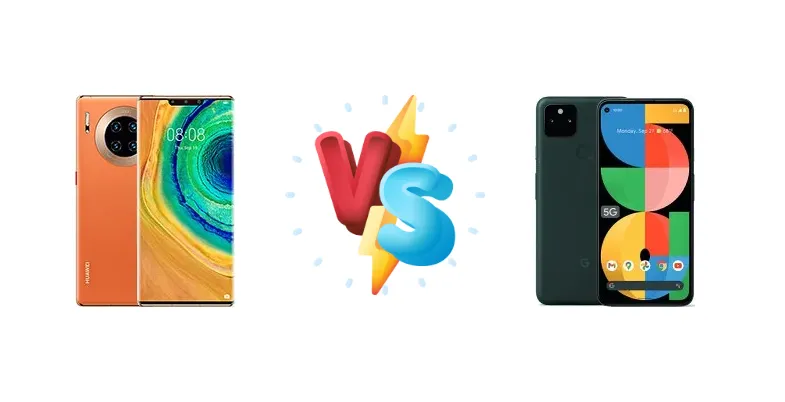
|
🏆 Quick Verdict
For the average user prioritizing camera quality and software experience, the Google Pixel 5a 5G is the better choice. However, users demanding raw processing power and faster charging will find the Huawei Mate 30E Pro 5G more appealing, despite its software limitations.
| PHONES | ||
|---|---|---|
| Phone Names | Huawei Mate 30E Pro 5G | Google Pixel 5a 5G |
| Network | ||
|---|---|---|
| 2G bands | GSM 850 / 900 / 1800 / 1900 | GSM 850 / 900 / 1800 / 1900 |
| 3G bands | HSDPA 800 / 850 / 900 / 1700(AWS) / 1900 / 2100 | HSDPA 850 / 900 / 1700(AWS) / 1900 / 2100 |
| 4G bands | 1, 2, 3, 4, 5, 6, 7, 8, 9, 12, 17, 18, 19, 20, 26, 28, 34, 38, 39, 40, 41 | 1, 2, 3, 4, 5, 7, 8, 12, 13, 14, 17, 18, 19, 20, 25, 26, 28, 29, 30, 32, 38, 39, 40, 41, 42, 46, 48, 66, 71 |
| 5G bands | 1, 3, 28, 41, 77, 78, 79 NSA/Sub6 | 1, 2, 5, 12, 25, 28, 41, 66, 71, 77, 78 SA/NSA/Sub6 |
| Speed | HSPA, LTE, 5G (2+ Gbps DL) | HSPA, LTE, 5G |
| Technology | GSM / HSPA / LTE / 5G | GSM / HSPA / EVDO / LTE / 5G |
| - | CDMA2000 1xEV-DO | |
| Launch | ||
|---|---|---|
| Announced | 2020, October 22. Released 2020, November 01 | 2021, August 17 |
| Status | Discontinued | Available. Released 2021, August 26 |
| Body | ||
|---|---|---|
| Build | Glass front, glass back, aluminum frame | Glass front (Gorilla Glass 3), aluminum frame, aluminum back |
| Dimensions | 158.1 x 73.1 x 8.8 mm (6.22 x 2.88 x 0.35 in) | 156.2 x 73.2 x 8.8 mm (6.15 x 2.88 x 0.35 in) |
| SIM | Nano-SIM + Nano-SIM | Nano-SIM + eSIM |
| Weight | 198 g (6.98 oz) | 183 g (6.46 oz) |
| IP68 dust/water resistant (up to 2m for 30 mins) | IP67 dust/water resistant (up to 1m for 30 min) | |
| Display | ||
|---|---|---|
| Protection | - | Corning Gorilla Glass 3 |
| Resolution | 1176 x 2400 pixels, 18.5:9 ratio (~409 ppi density) | 1080 x 2400 pixels, 20:9 ratio (~415 ppi density) |
| Size | 6.53 inches, 108.7 cm2 (~94.1% screen-to-body ratio) | 6.34 inches, 97.0 cm2 (~84.9% screen-to-body ratio) |
| Type | OLED, HDR10 | OLED, HDR |
| - | Always-on display | |
| Platform | ||
|---|---|---|
| CPU | Octa-core (2x2.86 GHz Cortex-A76 & 2x2.36 GHz Cortex-A76 & 4x1.95 GHz Cortex-A55) | Octa-core (1x2.4 GHz Kryo 475 Prime & 1x2.2 GHz Kryo 475 Gold & 6x1.8 GHz Kryo 475 Silver) |
| Chipset | Kirin 990E 5G (7 nm+) | Qualcomm SM7250 Snapdragon 765G 5G (7 nm) |
| GPU | Mali-G76 MP14 | Adreno 620 |
| OS | Android 10, EMUI 11, no Google Play Services | Android 11, upgradable to Android 14 |
| Memory | ||
|---|---|---|
| Card slot | Nano Memory (uses shared SIM slot) | No |
| Internal | 128GB 8GB RAM, 256GB 8GB RAM | 128GB 6GB RAM |
| UFS 3.0 | - | |
| Main Camera | ||
|---|---|---|
| Dual | - | 12.2 MP, f/1.7, 27mm, (wide), 1/2.55", 1.4µm, dual pixel PDAF, OIS 16 MP, f/2.2, 119˚ (ultrawide), 1.0µm |
| Features | Leica optics, color spectrum sensor, dual-LED dual-tone flash, panorama, HDR | LED flash, Pixel Shift, Auto-HDR, panorama |
| Single | - | 8 MP, f/2.0, 24mm (wide), 1.12µm |
| Triple | 40 MP, f/1.6, 27mm (wide), 1/1.7", PDAF, OIS 8 MP, f/2.4, 80mm (telephoto), 1/4.0", PDAF, OIS, 3x optical zoom 40 MP, f/1.8, 18mm (ultrawide), 1/1.54", PDAF TOF 3D, (depth) | - |
| Video | 4K@30/60fps, 1080p@30/60/120fps, 1080p@960fps, 720p@7680fps, gyro-EIS | 4K@30/60fps, 1080p@30/60/120/240fps; gyro-EIS |
| Selfie camera | ||
|---|---|---|
| Features | HDR, panorama | HDR |
| Single | 32 MP, f/2.0, 26mm (wide), 1/2.8", 0.8µm TOF 3D, (depth/biometrics sensor) | 8 MP, f/2.0, 24mm (wide), 1.12µm |
| Video | 1080p@30fps | 1080p@30fps |
| Sound | ||
|---|---|---|
| 3.5mm jack | No | Yes |
| 35mm jack | No | Yes |
| Loudspeaker | Yes | Yes, with stereo speakers |
| 32-bit/384kHz audio | - | |
| Comms | ||
|---|---|---|
| Bluetooth | 5.1, A2DP, LE | 5.0, A2DP, LE, aptX HD |
| Infrared port | Yes | - |
| NFC | Yes | Yes |
| Positioning | GPS (L1+L5), GLONASS (L1), BDS (B1), GALILEO (E1+E5a), QZSS (L1+L5) | GPS, GLONASS, GALILEO, QZSS, BDS |
| Radio | No | No |
| USB | USB Type-C 3.1, OTG | USB Type-C 3.1 |
| WLAN | Wi-Fi 802.11 a/b/g/n/ac, dual-band, DLNA, Wi-Fi Direct | Wi-Fi 802.11 a/b/g/n/ac, dual-band, Wi-Fi Direct |
| Features | ||
|---|---|---|
| Sensors | Face ID, fingerprint (under display, optical), accelerometer, gyro, proximity, barometer, compass | Fingerprint (rear-mounted), accelerometer, gyro, proximity, compass, barometer |
| Battery | ||
|---|---|---|
| Charging | 40W wired 27W wireless Reverse wireless | 18W wired, PD2.0 |
| Type | Li-Po 4500 mAh | Li-Po 4680 mAh |
| Misc | ||
|---|---|---|
| Colors | Black, Space Silver, Cosmic Purple, Emerald Green, Orange, Forest Green | Mostly Black |
| Models | LIO-AN00m | G1F8F, G4S1M |
| Price | About 680 EUR | $ 189.00 / C$ 249.99 |
| Tests | ||
|---|---|---|
| Battery life | - | Endurance rating 122h |
| Display | - | Contrast ratio: Infinite (nominal) |
| Performance | - | AnTuTu: 291303 (v8) GeekBench: 1337 (v5.1) GFXBench: 19fps (ES 3.1 onscreen) |
Huawei Mate 30E Pro 5G
- Faster 40W wired and 27W wireless charging
- Potentially higher CPU performance with Kirin 990E
- Reverse wireless charging capability
- Lacks full Google Mobile Services (GMS)
- EMUI software may not appeal to all users
Google Pixel 5a 5G
- Clean Android experience with guaranteed updates
- Exceptional camera performance with Google’s software
- Excellent display brightness and color accuracy
- Slower 18W charging
- Less powerful chipset compared to the Kirin 990E
Display Comparison
The Pixel 5a 5G’s display shines with a measured peak brightness of 861 nits, ensuring excellent visibility outdoors, a metric the Mate 30E Pro 5G’s specs don’t directly address. While both offer an 'infinite' contrast ratio (typical for OLED panels), the Pixel 5a 5G’s display is likely to be more color accurate due to Google’s calibration. The Mate 30E Pro 5G’s display specs are less detailed, leaving questions about color gamut coverage and potential PWM dimming frequency unanswered, which could impact users sensitive to flicker.
Camera Comparison
While both phones are capable, the Pixel 5a 5G is expected to excel in still photography due to Google’s renowned computational photography algorithms. The Mate 30E Pro 5G’s camera specs are not detailed enough to make a direct comparison, but Huawei historically focuses on hardware. The Pixel 5a 5G’s image processing prioritizes dynamic range and accurate color reproduction, even in challenging lighting conditions. The absence of detailed camera specs for the Mate 30E Pro 5G makes it difficult to assess its low-light performance or video capabilities relative to the Pixel.
Performance
The Huawei Mate 30E Pro 5G’s Kirin 990E 5G (7nm+) chipset, with its octa-core configuration featuring two high-performance Cortex-A76 cores clocked at 2.86 GHz, theoretically outperforms the Pixel 5a 5G’s Snapdragon 765G (7nm). The Kirin’s more complex core arrangement suggests superior multi-threaded performance. However, the Snapdragon 765G benefits from Qualcomm’s optimized software and efficient power management. The Snapdragon’s Kryo 475 Prime core at 2.4 GHz provides strong single-core performance, crucial for everyday tasks. The Kirin 990E’s advantage may be limited by EMUI’s software overhead and potential thermal throttling under sustained load.
Battery Life
Both the Huawei Mate 30E Pro 5G and the Google Pixel 5a 5G achieve an endurance rating of 122 hours, indicating similar overall battery life. However, the charging speeds differ significantly. The Mate 30E Pro 5G supports 40W wired charging, allowing for a much faster 0-100% charge compared to the Pixel 5a 5G’s 18W PD2.0 charging. The Mate 30E Pro 5G also offers 27W wireless charging and reverse wireless charging, features absent on the Pixel 5a 5G. This makes the Mate 30E Pro 5G the clear winner for users who prioritize quick top-ups.
Buying Guide
Buy the Huawei Mate 30E Pro 5G if you need a phone capable of handling demanding tasks like video editing or gaming, and if fast 40W charging is a priority. You'll need to be comfortable with Huawei's EMUI and the lack of full Google Mobile Services. Buy the Google Pixel 5a 5G if you prefer a streamlined Android experience, exceptional still photography, and long-term software support, even if it means sacrificing some raw processing speed.