
Huawei Mate 30E Pro 5G vs. Apple iPhone 11 Pro Max: A Detailed Comparison
| Phones Images | |||||
|---|---|---|---|---|---|
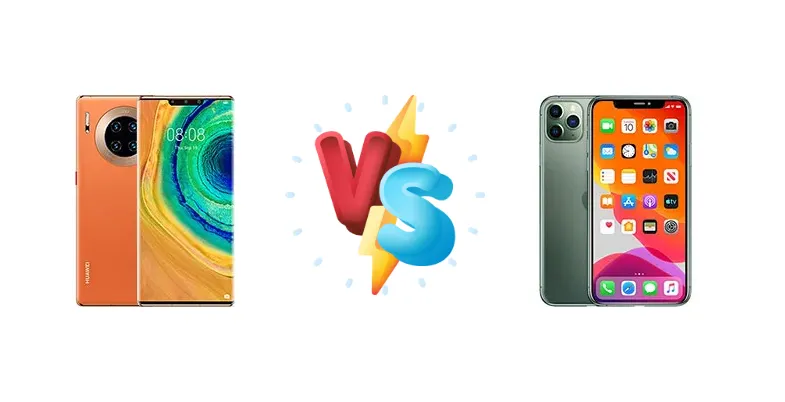
|
🏆 Quick Verdict
For the average user prioritizing long-term software support and a refined user experience, the Apple iPhone 11 Pro Max remains a solid choice, despite its age. However, the Huawei Mate 30E Pro 5G delivers comparable performance with faster charging and 5G connectivity, making it a compelling alternative for those seeking value and aren't reliant on Google Mobile Services.
| PHONES | ||
|---|---|---|
| Phone Names | Huawei Mate 30E Pro 5G | Apple iPhone 11 Pro Max |
| Network | ||
|---|---|---|
| 2G bands | GSM 850 / 900 / 1800 / 1900 | GSM 850 / 900 / 1800 / 1900 |
| 3G bands | HSDPA 800 / 850 / 900 / 1700(AWS) / 1900 / 2100 | HSDPA 850 / 900 / 1700(AWS) / 1900 / 2100 |
| 4G bands | 1, 2, 3, 4, 5, 6, 7, 8, 9, 12, 17, 18, 19, 20, 26, 28, 34, 38, 39, 40, 41 | 1, 2, 3, 4, 5, 7, 8, 11, 12, 13, 17, 18, 19, 20, 21, 25, 26, 28, 29, 30, 32, 34, 38, 39, 40, 41, 42, 46, 48, 66 - A2218 |
| 5G bands | 1, 3, 28, 41, 77, 78, 79 NSA/Sub6 | - |
| Speed | HSPA, LTE, 5G (2+ Gbps DL) | HSPA, LTE 1.6 Gbps DL, EV-DO Rev.A 3.1 Mbps |
| Technology | GSM / HSPA / LTE / 5G | GSM / CDMA / HSPA / EVDO / LTE |
| - | 1, 2, 3, 4, 5, 7, 8, 12, 13, 14, 17, 18, 19, 20, 25, 26, 29, 30, 34, 38, 39, 40, 41, 42, 46, 48, 66, 71 - A2161, A2220 | |
| Launch | ||
|---|---|---|
| Announced | 2020, October 22. Released 2020, November 01 | 2019, September 10 |
| Status | Discontinued | Available. Released 2019, September 20 |
| Body | ||
|---|---|---|
| Build | Glass front, glass back, aluminum frame | Glass front (Corning-made glass), glass back (Corning-made glass), stainless steel frame |
| Dimensions | 158.1 x 73.1 x 8.8 mm (6.22 x 2.88 x 0.35 in) | 158 x 77.8 x 8.1 mm (6.22 x 3.06 x 0.32 in) |
| SIM | Nano-SIM + Nano-SIM | · Nano-SIM + eSIM· Nano-SIM + Nano-SIM (China) |
| Weight | 198 g (6.98 oz) | 226 g (7.97 oz) |
| IP68 dust/water resistant (up to 2m for 30 mins) | IP68 dust/water resistant (up to 4m for 30 min) Apple Pay (Visa, MasterCard, AMEX certified) | |
| Display | ||
|---|---|---|
| Protection | - | Scratch-resistant glass |
| Resolution | 1176 x 2400 pixels, 18.5:9 ratio (~409 ppi density) | 1242 x 2688 pixels, 19.5:9 ratio (~458 ppi density) |
| Size | 6.53 inches, 108.7 cm2 (~94.1% screen-to-body ratio) | 6.5 inches, 102.9 cm2 (~83.7% screen-to-body ratio) |
| Type | OLED, HDR10 | Super Retina XDR OLED, HDR10, Dolby Vision, 800 nits (HBM), 1200 nits (peak) |
| Platform | ||
|---|---|---|
| CPU | Octa-core (2x2.86 GHz Cortex-A76 & 2x2.36 GHz Cortex-A76 & 4x1.95 GHz Cortex-A55) | Hexa-core (2x2.65 GHz Lightning + 4x1.8 GHz Thunder) |
| Chipset | Kirin 990E 5G (7 nm+) | Apple A13 Bionic (7 nm+) |
| GPU | Mali-G76 MP14 | Apple GPU (4-core graphics) |
| OS | Android 10, EMUI 11, no Google Play Services | iOS 13, upgradable to iOS 26.1 |
| Memory | ||
|---|---|---|
| Card slot | Nano Memory (uses shared SIM slot) | No |
| Internal | 128GB 8GB RAM, 256GB 8GB RAM | 64GB 4GB RAM, 256GB 4GB RAM, 512GB 4GB RAM |
| UFS 3.0 | NVMe | |
| Main Camera | ||
|---|---|---|
| Features | Leica optics, color spectrum sensor, dual-LED dual-tone flash, panorama, HDR | Dual-LED dual-tone flash, HDR (photo/panorama) |
| Single | - | 13 MP, f/2.2, PDAF |
| Triple | 40 MP, f/1.6, 27mm (wide), 1/1.7", PDAF, OIS 8 MP, f/2.4, 80mm (telephoto), 1/4.0", PDAF, OIS, 3x optical zoom 40 MP, f/1.8, 18mm (ultrawide), 1/1.54", PDAF TOF 3D, (depth) | 12 MP, f/1.8, 26mm (wide), 1/2.55", 1.4µm, dual pixel PDAF, OIS 12 MP, f/2.0, 52mm (telephoto), 1/3.4", 1.0µm, PDAF, OIS, 2x optical zoom 12 MP, f/2.4, 120˚, 13mm (ultrawide), 1/3.6" |
| Video | 4K@30/60fps, 1080p@30/60/120fps, 1080p@960fps, 720p@7680fps, gyro-EIS | 4K@24/25/30/60fps, 1080p@25/30/60/120/240fps, HDR, stereo sound rec. |
| Selfie camera | ||
|---|---|---|
| Features | HDR, panorama | HDR |
| Single | 32 MP, f/2.0, 26mm (wide), 1/2.8", 0.8µm TOF 3D, (depth/biometrics sensor) | 12 MP, f/2.2, 23mm (wide), 1/3.6", 1.0µm SL 3D, (depth/biometrics sensor) |
| Video | 1080p@30fps | 4K@24/25/30/60fps, 1080p@25/30/60/120fps, gyro-EIS |
| Sound | ||
|---|---|---|
| 3.5mm jack | No | No |
| 35mm jack | No | No |
| Loudspeaker | Yes | Yes, with stereo speakers |
| 32-bit/384kHz audio | - | |
| Comms | ||
|---|---|---|
| Bluetooth | 5.1, A2DP, LE | 5.0, A2DP, LE |
| Infrared port | Yes | - |
| NFC | Yes | Yes |
| Positioning | GPS (L1+L5), GLONASS (L1), BDS (B1), GALILEO (E1+E5a), QZSS (L1+L5) | GPS, GLONASS, GALILEO, QZSS |
| Radio | No | No |
| USB | USB Type-C 3.1, OTG | Lightning, USB 2.0 |
| WLAN | Wi-Fi 802.11 a/b/g/n/ac, dual-band, DLNA, Wi-Fi Direct | Wi-Fi 802.11 a/b/g/n/ac/6, dual-band, hotspot |
| Features | ||
|---|---|---|
| Sensors | Face ID, fingerprint (under display, optical), accelerometer, gyro, proximity, barometer, compass | Face ID, accelerometer, gyro, proximity, compass, barometer |
| - | Ultra Wideband (UWB) support | |
| Battery | ||
|---|---|---|
| Charging | 40W wired 27W wireless Reverse wireless | Wired, PD2.0, 50% in 30 min Wireless (Qi) |
| Type | Li-Po 4500 mAh | Li-Ion 3969 mAh, non-removable (15.04 Wh) |
| Misc | ||
|---|---|---|
| Colors | Black, Space Silver, Cosmic Purple, Emerald Green, Orange, Forest Green | Matte Space Gray, Matte Silver, Matte Gold, Matte Midnight Green |
| Models | LIO-AN00m | A2218, A2161, A2220, iPhone12,5 |
| Price | About 680 EUR | $ 233.00 / C$ 369.75 / £ 226.95 / € 249.00 |
| SAR | - | 1.16 W/kg (head) 1.17 W/kg (body) |
| SAR EU | - | 0.95 W/kg (head) 0.99 W/kg (body) |
| Pricing | ||
|---|---|---|
| 256GB 4GB RAM | - | $ 874.46 |
| 512GB 4GB RAM | - | $ 1,004.31 |
| 64GB 4GB RAM | - | $ 435.00 |
| RENEWED | - | $ 485.00 |
| Tests | ||
|---|---|---|
| Audio quality | - | Noise -94.3dB / Crosstalk -81.5dB |
| Battery life | - | Endurance rating 102h |
| Camera | - | Photo / Video |
| Display | - | Contrast ratio: Infinite (nominal) |
| Loudspeaker | - | -25.6 LUFS (Very good) |
| Performance | - | AnTuTu: 459713 (v7), 536883 (v8) GeekBench: 13870 (v4.4), 3503 (v5.1) GFXBench: 57fps (ES 3.1 onscreen) |
Huawei Mate 30E Pro 5G
- Faster 40W wired and 27W wireless charging
- Integrated 5G modem for faster connectivity
- Potentially lower price point
- Reverse wireless charging capability
- Lacks Google Mobile Services (GMS)
- Software update support is uncertain
- RAM capacity limited to 4GB
Apple iPhone 11 Pro Max
- Excellent battery life (102h endurance)
- Mature and stable iOS ecosystem
- Strong resale value
- Industry-leading video recording
- Slower wired charging speed
- No 5G connectivity
- Higher price (depending on storage configuration)
Display Comparison
The iPhone 11 Pro Max boasts a display capable of reaching 820 nits of peak brightness, ensuring excellent visibility even in direct sunlight. While the Mate 30E Pro 5G’s display specifications aren’t provided, Huawei typically employs OLED panels with vibrant colors. The iPhone’s infinite (nominal) contrast ratio provides deeper blacks and a more dynamic image. The lack of high refresh rate support on either device is noticeable by today’s standards, but the iPhone’s superior brightness and color accuracy give it a slight edge for media consumption.
Camera Comparison
Both phones are described as having capable photo and video capabilities, but detailed sensor information is limited for the Mate 30E Pro 5G. The iPhone 11 Pro Max is known for its excellent image processing and consistent results across all lenses. The absence of specific sensor size or aperture details for the Huawei makes a direct comparison difficult. However, Huawei often emphasizes computational photography, potentially offering competitive image quality despite hardware differences. It's important to note that the iPhone's video recording capabilities are widely regarded as industry-leading.
Performance
Both devices utilize 7nm+ fabrication processes, but their CPU architectures differ significantly. The iPhone 11 Pro Max’s A13 Bionic features a hexa-core design with two high-performance 'Lightning' cores and four efficiency cores ('Thunder'). The Huawei Mate 30E Pro 5G’s Kirin 990E 5G employs an octa-core configuration with a mix of Cortex-A76 and A55 cores. While core count isn’t everything, Apple’s custom CPU design and tight software integration generally result in superior single-core performance. However, the Kirin 990E 5G’s integrated 5G modem offers a connectivity advantage. Both devices feature 4GB of RAM, which, while sufficient for typical tasks, may show limitations with heavy multitasking compared to newer devices with 8GB or more.
Battery Life
The iPhone 11 Pro Max achieves an impressive endurance rating of 102 hours, indicating exceptional battery life. The Mate 30E Pro 5G’s battery capacity is not specified, but its 40W wired charging significantly surpasses the iPhone’s wired charging speed (50% in 30 minutes with PD2.0). The Mate 30E Pro 5G also supports 27W wireless charging and reverse wireless charging, features absent on the iPhone. While the iPhone’s overall endurance is higher, the Mate 30E Pro 5G’s faster charging capabilities offer greater convenience.
Buying Guide
Buy the Huawei Mate 30E Pro 5G if you need 5G connectivity, faster 40W wired and 27W wireless charging, and are comfortable operating without Google Mobile Services. Buy the Apple iPhone 11 Pro Max if you prioritize a seamless user experience, guaranteed software updates, a mature app ecosystem, and strong resale value. The iPhone is also the better choice for users heavily invested in the Apple ecosystem.