
Huawei Mate 30 vs. Sony Xperia 1 III: A Detailed Comparison of Flagship Androids
| Phones Images | |||||
|---|---|---|---|---|---|
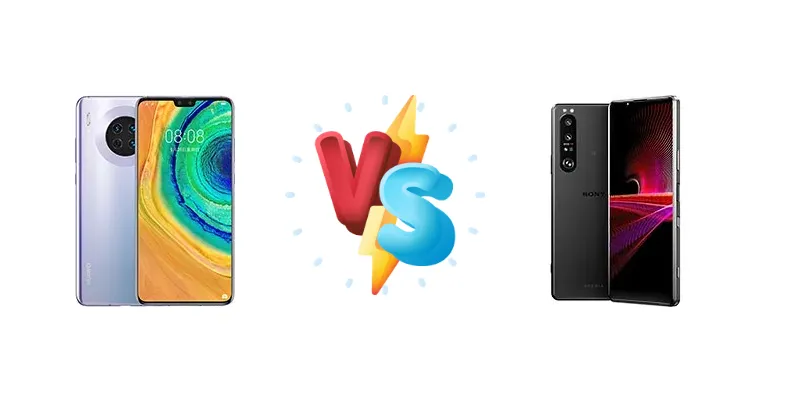
|
🏆 Quick Verdict
For most users, the Sony Xperia 1 III is the superior choice. Its Snapdragon 888 chipset delivers significantly better performance and future-proofing, while the 620 nit display offers a brighter and more vibrant viewing experience. However, the Mate 30’s 40W wired and 27W wireless charging are compelling advantages for those prioritizing convenience.
| PHONES | ||
|---|---|---|
| Phone Names | Huawei Mate 30 | Sony Xperia 1 III |
| Network | ||
|---|---|---|
| 2G bands | GSM 850 / 900 / 1800 / 1900 | GSM 850 / 900 / 1800 / 1900 |
| 3G bands | HSDPA 800 / 850 / 900 / 1700(AWS) / 1900 / 2100 | HSDPA 800 / 850 / 900 / 1700(AWS) / 1900 / 2100 |
| 4G bands | 1, 2, 3, 4, 5, 6, 7, 8, 9, 12, 17, 18, 19, 20, 26, 28, 32, 34, 38, 39, 40, 41, 66 - Global | 1, 2, 3, 4, 5, 7, 8, 12, 13, 17, 19, 20, 25, 26, 28, 29, 32, 34, 38, 39, 40, 41, 46, 66 - Europe |
| 5G bands | - | 1, 3, 5, 7, 8, 20, 28, 38, 40, 41, 77, 78 SA/NSA/Sub6 - Europe |
| Speed | HSPA, LTE | HSPA, LTE, 5G |
| Technology | GSM / HSPA / LTE | GSM / HSPA / LTE / 5G |
| 1, 2, 3, 4, 5, 6, 7, 8, 9, 12, 17, 18, 19, 20, 26, 34, 38, 39, 40, 41 - China | SA/NSA/Sub6/mmWave - USA (specific) | |
| Launch | ||
|---|---|---|
| Announced | 2019, September. Released 2019, September | 2021, April 14 |
| Status | Discontinued | Available. Released 2021, August 25 |
| Body | ||
|---|---|---|
| Build | Glass front, glass back, aluminum frame | Glass front (Gorilla Glass Victus), glass back (Gorilla Glass 6), aluminum frame |
| Dimensions | 160.8 x 76.1 x 8.4 mm (6.33 x 3.00 x 0.33 in) | 165 x 71 x 8.2 mm (6.50 x 2.80 x 0.32 in) |
| SIM | · Nano-SIM· Nano-SIM + Nano-SIM | Nano-SIM + Nano-SIM |
| Weight | 196 g (6.91 oz) | 186 g / 187.1 g (mmWave) (6.56 oz) |
| IP53, dust and splash resistant | IP65/IP68 dust/water resistant (up to 1.5m for 30 min) | |
| Display | ||
|---|---|---|
| Protection | - | Corning Gorilla Glass Victus |
| Resolution | 1080 x 2340 pixels, 19.5:9 ratio (~389 ppi density) | 1644 x 3840 pixels, 21:9 ratio (~643 ppi density) |
| Size | 6.62 inches, 107.6 cm2 (~87.9% screen-to-body ratio) | 6.5 inches, 98.6 cm2 (~84.2% screen-to-body ratio) |
| Type | OLED, HDR10 | OLED, 1B colors, 120Hz, HDR BT.2020 |
| - | Runs at 1096 x 2560 pixels except for select use cases | |
| Platform | ||
|---|---|---|
| CPU | Octa-core (2x2.86 GHz Cortex-A76 & 2x2.09 GHz Cortex-A76 & 4x1.86 GHz Cortex-A55) | Octa-core (1x2.84 GHz Cortex-X1 & 3x2.42 GHz Cortex-A78 & 4x1.80 GHz Cortex-A55) |
| Chipset | Kirin 990 (7 nm+) | Qualcomm SM8350 Snapdragon 888 5G (5 nm) |
| GPU | Mali-G76 MP16 | Adreno 660 |
| OS | Android 10, EMUI 10, no Google Play Services | Android 11, upgradable to Android 13 |
| Memory | ||
|---|---|---|
| Card slot | Nano Memory (uses shared SIM slot) | microSDXC (uses shared SIM slot) |
| Internal | 128GB 6GB RAM, 128GB 8GB RAM | 256GB 12GB RAM, 512GB 12GB RAM |
| UFS 3.0 | UFS 3.X | |
| Main Camera | ||
|---|---|---|
| Features | Laser AF, Leica optics, dual-LED dual-tone flash, panorama, HDR | Zeiss optics, Zeiss T* lens coating, color spectrum sensor, LED flash, panorama, HDR, eye tracking |
| Single | - | 8 MP, f/2.0, 24mm (wide), 1/4", 1.12µm |
| Triple | 40 MP, f/1.8, 27mm (wide), 1/1.54", PDAF 8 MP, f/2.4, 80mm (telephoto), 1/4.0", PDAF, OIS, 3x optical zoom 16 MP, f/2.2, 17mm (ultrawide) | 12 MP, f/1.7, 24mm (wide), 1/1.7", 1.8µm, dual pixel PDAF, OIS 12 MP, f/2.3, 70mm (telephoto), f/2.8, 105mm (telephoto), 1/2.9", dual pixel PDAF, 3x/4.4x optical zoom, OIS 12 MP, f/2.2, 124˚, 16mm (ultrawide), 1/2.6", dual pixel PDAF 0.3 MP, TOF 3D, (depth) |
| Video | 4K@30/60fps, 1080p@30/60/120fps, 720p@960fps, gyro-EIS | 4K@24/25/30/60/120fps HDR, 1080p@30/60/120fps; 5-axis gyro-EIS, OIS |
| Selfie camera | ||
|---|---|---|
| Features | HDR | HDR |
| Single | 24 MP, f/2.0, 26mm (wide), 1/2.8", 0.9µm TOF 3D, (depth/biometrics sensor) | 8 MP, f/2.0, 24mm (wide), 1/4.0", 1.12µm |
| Video | 1080p@30fps | 1080p@30fps, 5-axis gyro-EIS |
| Sound | ||
|---|---|---|
| 3.5mm jack | Yes | Yes |
| 35mm jack | Yes | Yes |
| Loudspeaker | Yes, with stereo speakers | Yes, with stereo speakers |
| 32-bit/384kHz audio | 24-bit/192kHz audio Dynamic vibration system | |
| Comms | ||
|---|---|---|
| Bluetooth | 5.1, A2DP, aptX HD, LE | 5.2, A2DP, LE, aptX HD, aptX Adaptive |
| Infrared port | Yes | - |
| NFC | Yes | Yes |
| Positioning | GPS (L1+L5), GLONASS (L1), BDS (B1), GALILEO (E1+E5a), QZSS (L1+L5) | GPS, GLONASS, BDS, GALILEO, QZSS |
| Radio | No | No |
| USB | USB Type-C 3.1, OTG | USB Type-C 3.1, OTG, video output |
| WLAN | Wi-Fi 802.11 a/b/g/n/ac, dual-band, DLNA, Wi-Fi Direct | Wi-Fi 802.11 a/b/g/n/ac/6, dual-band, Wi-Fi Direct, DLNA |
| Features | ||
|---|---|---|
| Sensors | Face ID, fingerprint (under display, optical), accelerometer, gyro, proximity, barometer, compass | Fingerprint (side-mounted), accelerometer, gyro, proximity, barometer, compass |
| - | Native Sony Alpha camera support | |
| Battery | ||
|---|---|---|
| Charging | 40W wired 27W wireless Reverse wireless | 30W wired, PD, 50% in 30 min Wireless Reverse wireless |
| Type | Li-Po 4200 mAh, non-removable | Li-Po 4500 mAh |
| Misc | ||
|---|---|---|
| Colors | Black, Space Silver, Cosmic Purple, Emerald Green | Frosted Black, Frosted Gray, Frosted Purple |
| Models | TAS-L09, TAS-L29, TAS-AL00, TAS-TL00 | XQBC62/V, XQBC52V.UKCX, SO-51B, SOG03, A101SO, XQ-BC62, XQ-BC72, XQ-BC52, XQ-BC01, XQ-BC11, XQ-BC21, XQ-BC72 |
| Price | About 550 EUR | € 505.26 / $ 903.43 |
| Tests | ||
|---|---|---|
| Battery life | - | Endurance rating 82h |
| Camera | - | Photo / Video |
| Display | - | Contrast ratio: Infinite (nominal) |
| Loudspeaker | - | -26.5 LUFS (Good) |
| Performance | - | AnTuTu: 607423 (v8) GeekBench: 3515 (v5.1) GFXBench: 54fps (ES 3.1 onscreen) |
Huawei Mate 30
- Extremely fast 40W wired charging
- 27W wireless and reverse wireless charging
- Strong computational photography capabilities
- Competitive battery endurance
- Older Kirin 990 chipset is less powerful
- Limited 5G support compared to Snapdragon 888
- Software ecosystem limitations
Sony Xperia 1 III
- Powerful Snapdragon 888 processor
- Bright and color-accurate 4K display
- Advanced video recording features
- Modern 5G connectivity
- Slower 30W wired charging
- Wireless charging details are limited
- Potentially higher price point
Display Comparison
The Sony Xperia 1 III boasts a brighter display, reaching a measured 620 nits, compared to an unspecified brightness for the Mate 30. While both offer an 'infinite' contrast ratio (typical for OLED panels), the Xperia 1 III’s 4K resolution and creator-focused features like a dedicated color profile are absent in the Mate 30. The Xperia 1 III’s display is geared towards professional content consumption and creation, while the Mate 30’s display, though likely excellent, is more geared towards general use.
Camera Comparison
Both devices are marketed for their camera capabilities, but approach it differently. While both offer photo and video functionality, the specifics are limited. The Mate 30’s camera system is known for its computational photography prowess, while the Xperia 1 III focuses on providing manual controls and a more natural image processing style. Without detailed sensor size information, it’s difficult to make a definitive judgment, but the Xperia 1 III’s emphasis on professional video features (like 4K HDR recording) suggests a stronger focus on content creators. The Mate 30 likely excels in low-light scenarios due to Huawei’s image processing algorithms.
Performance
The core difference lies in the chipsets. The Sony Xperia 1 III’s Qualcomm Snapdragon 888 (5nm) significantly outperforms the Huawei Mate 30’s Kirin 990 (7nm+). The Snapdragon 888 features a Cortex-X1 prime core clocked at 2.84 GHz, offering a substantial performance leap over the Mate 30’s Cortex-A76 cores at 2.86 GHz. The 5nm process node of the Snapdragon 888 also translates to improved thermal efficiency, reducing throttling during sustained workloads. While both utilize a combination of Cortex-A7x and A55 cores, the architectural improvements in the Snapdragon 888’s A78 cores provide a noticeable advantage. The Xperia 1 III also benefits from faster LPDDR5 RAM, further enhancing performance.
Battery Life
Both phones achieve an endurance rating of 82 hours, suggesting comparable real-world battery life despite differing charging capabilities. However, the Mate 30’s 40W wired charging is significantly faster than the Xperia 1 III’s 30W wired charging (with a 50% charge in 30 minutes). The Mate 30 also offers 27W wireless charging and reverse wireless charging, features not explicitly mentioned for the Xperia 1 III. While the Xperia 1 III’s battery life is solid, the Mate 30 offers greater convenience for users who frequently need to top up their battery quickly.
Buying Guide
Buy the Huawei Mate 30 if you prioritize extremely fast charging speeds (both wired and wireless) and are comfortable with the limitations of the Kirin 990 chipset. Buy the Sony Xperia 1 III if you demand top-tier performance for demanding tasks like video editing, gaming, and content creation, and value a high-brightness, color-accurate display and a more modern 5G modem.