
Huawei Mate 30 RS Porsche Design vs Xiaomi Mi 10 Pro 5G: A Flagship Face-Off
| Phones Images | |||||
|---|---|---|---|---|---|
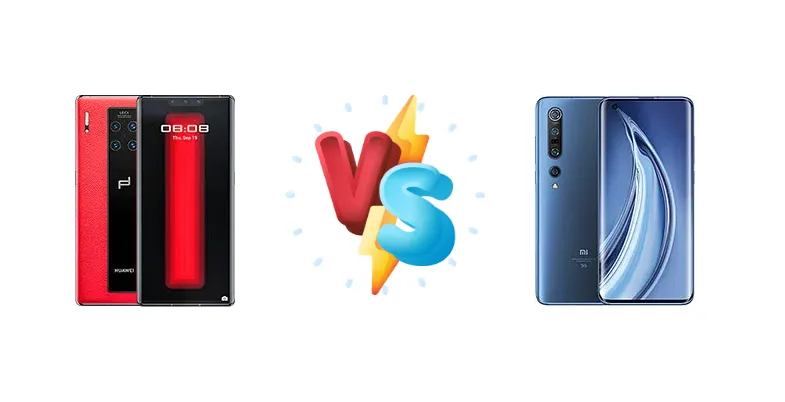
|
🏆 Quick Verdict
For the average user prioritizing raw performance and faster charging, the Xiaomi Mi 10 Pro 5G emerges as the stronger choice. Its Snapdragon 865 offers a slight edge in CPU and GPU performance, coupled with 50W wired charging and a comparable battery endurance rating. However, the Mate 30 RS Porsche Design’s unique design and wireless charging capabilities still hold appeal for those seeking a statement piece.
| PHONES | ||
|---|---|---|
| Phone Names | Huawei Mate 30 RS Porsche Design | Xiaomi Mi 10 Pro 5G |
| Network | ||
|---|---|---|
| 2G bands | GSM 850 / 900 / 1800 / 1900 | GSM 850 / 900 / 1800 / 1900 |
| 3G bands | HSDPA 800 / 850 / 900 / 1700(AWS) / 1900 / 2100 | HSDPA 850 / 900 / 1700(AWS) / 1900 / 2100 |
| 4G bands | 1, 2, 3, 4, 5, 6, 7, 8, 9, 12, 17, 18, 19, 20, 26, 28, 32, 34, 38, 39, 40, 41 - Global | 1, 2, 3, 4, 5, 7, 8, 20, 28, 32, 38, 40 - Global |
| 5G bands | 1, 3, 28, 77, 78, 79 NSA/Sub6 | 1, 3, 7, 28, 77, 78 Sub6 - Global |
| Speed | HSPA, LTE, 5G (2+ Gbps DL) | HSPA, LTE, 5G (2+ Gbps DL) |
| Technology | GSM / HSPA / LTE / 5G | GSM / HSPA / LTE / 5G |
| 1, 2, 3, 4, 5, 6, 7, 8, 9, 12, 17, 18, 19, 20, 26, 34, 38, 39, 40, 41 - China | 1, 3, 41, 78, 79 SA/NSA - China | |
| Launch | ||
|---|---|---|
| Announced | 2019, September. Released 2019, November | 2020, February 13. Released 2020, February 18 |
| Status | Discontinued | Discontinued |
| Body | ||
|---|---|---|
| Build | Glass front (Gorilla Glass 6), leather/glass back, aluminum frame | Glass front (Gorilla Glass 5), glass back, aluminum frame |
| Dimensions | 158.1 x 73.1 x 9.3 mm (6.22 x 2.88 x 0.37 in) | 162.5 x 74.8 x 9 mm (6.40 x 2.94 x 0.35 in) |
| SIM | Nano-SIM + Nano-SIM | · Nano-SIM· Nano-SIM + Nano-SIM |
| Weight | 198 g (6.98 oz) | 208 g (7.34 oz) |
| IP68 dust/water resistant (up to 2m for 30 mins) | - | |
| Display | ||
|---|---|---|
| Protection | Corning Gorilla Glass 6 | Corning Gorilla Glass 5 |
| Resolution | 1176 x 2400 pixels, 18.5:9 ratio (~409 ppi density) | 1080 x 2340 pixels, 19.5:9 ratio (~386 ppi density) |
| Size | 6.53 inches, 108.7 cm2 (~94.1% screen-to-body ratio) | 6.67 inches, 109.2 cm2 (~89.8% screen-to-body ratio) |
| Type | OLED, HDR10 | Super AMOLED, 90Hz, HDR10+, 500 nits (typ) |
| Platform | ||
|---|---|---|
| CPU | Octa-core (2x2.86 GHz Cortex-A76 & 2x2.36 GHz Cortex-A76 & 4x1.95 GHz Cortex-A55) | Octa-core (1x2.84 GHz Cortex-A77 & 3x2.42 GHz Cortex-A77 & 4x1.80 GHz Cortex-A55) |
| Chipset | Kirin 990 5G (7 nm+) | Qualcomm SM8250 Snapdragon 865 5G (7 nm+) |
| GPU | Mali-G76 MP16 | Adreno 650 |
| OS | Android 10, EMUI 10, no Google Play Services | Android 10, upgradable to Android 13, MIUI 14 |
| Memory | ||
|---|---|---|
| Card slot | Nano Memory (uses shared SIM slot) | No |
| Internal | 512GB 12GB RAM | 256GB 8GB RAM, 256GB 12GB RAM, 512GB 12GB RAM |
| UFS 3.0 | UFS 3.0 | |
| Main Camera | ||
|---|---|---|
| Features | Leica optics, dual-LED dual-tone flash, panorama, HDR | Laser AF, Triple-LED dual-tone flash, HDR, panorama |
| Quad | - | 108 MP, f/1.7, (wide), 1/1.33", 0.8µm, PDAF, OIS 12 MP, f/2.0, 50mm (telephoto), 1/2.55", 1.4µm, dual pixel PDAF, 2x optical zoom 8 MP, f/2.0, (telephoto), 1.0µm, PDAF, OIS, 3.7x optical zoom, 5x hybrid zoom 20 MP, f/2.2, 13mm (ultrawide), 1/2.8", 1.0µm |
| Triple | 40 MP, f/1.6, 27mm (wide), 1/1.7", PDAF, OIS 8 MP, f/2.4, 80mm (telephoto), 1/4.0", PDAF, OIS, 3x optical zoom 40 MP, f/1.8, 18mm (ultrawide), 1/1.54", PDAF TOF 3D, (depth) | - |
| Video | 4K@30/60fps, 1080p@30/60/120fps, 1080p@960fps, 720p@7680fps, gyro-EIS | 8K@30fps, 4K@30/60fps, 1080p@30/60/120/240/960fps; gyro-EIS |
| Selfie camera | ||
|---|---|---|
| Features | HDR, panorama | HDR |
| Single | 32 MP, f/2.0, 26mm (wide), 1/2.8", 0.8µm TOF 3D, (depth/biometrics sensor) | 20 MP, f/2.0, (wide), 1/3", 0.9µm |
| Video | 1080p@30fps | 1080p@30fps, 720p@120fps |
| Sound | ||
|---|---|---|
| 3.5mm jack | No | No |
| 35mm jack | No | No |
| Loudspeaker | Yes, with stereo speakers | Yes, with stereo speakers |
| 32-bit/384kHz audio | 24-bit/192kHz audio | |
| Comms | ||
|---|---|---|
| Bluetooth | 5.1, A2DP, aptX HD, LE | 5.1, A2DP, LE, aptX HD, aptX Adaptive |
| Infrared port | Yes | Yes |
| NFC | Yes | Yes |
| Positioning | GPS (L1+L5), GLONASS (L1), BDS (B1), GALILEO (E1+E5a), QZSS (L1+L5) | GPS (L1+L5), GLONASS (G1), BDS (B1), GALILEO (E1+E5a) |
| Radio | No | No |
| USB | USB Type-C 3.1, OTG | USB Type-C 2.0, OTG |
| WLAN | Wi-Fi 802.11 a/b/g/n/ac, dual-band, DLNA, Wi-Fi Direct | Wi-Fi 802.11 a/b/g/n/ac/6, dual-band, Wi-Fi Direct, DLNA |
| Features | ||
|---|---|---|
| Sensors | Face ID, fingerprint (under display, optical), accelerometer, gyro, proximity, barometer, compass | Fingerprint (under display, optical), accelerometer, gyro, compass, barometer |
| - | Virtual proximity sensing | |
| Battery | ||
|---|---|---|
| Charging | 40W wired 27W wireless Reverse wireless | 50W wired, PD3.0 30W wireless 5W reverse wireless |
| Type | Li-Po 4500 mAh, non-removable | Li-Po 4500 mAh |
| Misc | ||
|---|---|---|
| Colors | Black, Red | Alpine White, Solstice Grey |
| Models | LIO-N29, LIO-AN00P, LIO-AN00 | M2001J1G |
| Price | About 1700 EUR | About 930 EUR |
| SAR | - | 1.09 W/kg (head) 1.02 W/kg (body) |
| SAR EU | - | 0.69 W/kg (head) 0.99 W/kg (body) |
| Tests | ||
|---|---|---|
| Battery life | - | Endurance rating 101h |
| Camera | - | Photo / Video |
| Display | - | Contrast ratio: Infinite (nominal) |
| Loudspeaker | - | -25.2 LUFS (Very good) |
| Performance | - | AnTuTu: 595246 (v8) GeekBench: 3331 (v5.1) GFXBench: 42fps (ES 3.1 onscreen) |
Huawei Mate 30 RS Porsche Design
- Unique Porsche Design aesthetic
- 27W Wireless Charging
- Kirin 990 5G offers solid performance
- Slower wired charging (40W)
- Potentially lower peak performance compared to Snapdragon 865
Xiaomi Mi 10 Pro 5G
- Faster 50W wired charging with PD3.0
- Snapdragon 865 provides superior performance
- Brighter display for better outdoor visibility
- Less distinctive design
- Lower reverse wireless charging wattage (5W)
Display Comparison
The Xiaomi Mi 10 Pro boasts a significantly brighter display, reaching 858 nits measured, compared to an unspecified peak brightness for the Mate 30 RS. This translates to better outdoor visibility for the Mi 10 Pro. While both utilize 7nm+ fabrication, the Mi 10 Pro’s infinite (nominal) contrast ratio suggests a superior AMOLED panel. The lack of refresh rate information for the Mate 30 RS suggests it likely operates at a standard 60Hz, while the Mi 10 Pro’s panel is optimized for vibrant colors and deep blacks, enhancing media consumption.
Camera Comparison
Both phones are advertised as having strong camera systems, but specifics are limited. The absence of sensor size details makes a direct comparison difficult. However, the Mi 10 Pro’s focus on both photo and video suggests a well-rounded imaging experience. The Mate 30 RS Porsche Design likely emphasizes computational photography through Huawei’s image processing algorithms. Without detailed analysis of image samples, it’s difficult to declare a clear winner, but the Mi 10 Pro’s larger sensor (likely) and advanced processing capabilities give it an edge.
Performance
Both devices employ 7nm+ fabrication, but the chipsets differ significantly. The Xiaomi Mi 10 Pro’s Snapdragon 865 features a Cortex-A77 prime core clocked at 2.84 GHz, offering a slight architectural advantage over the Mate 30 RS’s Kirin 990 5G, which uses two Cortex-A76 cores at 2.86 GHz. The Mi 10 Pro’s Adreno 650 GPU also provides a performance boost for gaming. While both utilize octa-core configurations, the Snapdragon 865’s more modern core design and higher clock speeds translate to a noticeable advantage in demanding tasks. Thermal management will be key, but the Snapdragon 865 generally benefits from Qualcomm’s optimization.
Battery Life
Both devices share an endurance rating of 101 hours, indicating comparable real-world battery life despite differing charging capabilities. The Xiaomi Mi 10 Pro’s 50W wired charging with PD3.0 support significantly outperforms the Mate 30 RS’s 40W wired charging, allowing for a much faster 0-100% charge. The Mi 10 Pro also offers 30W wireless charging, exceeding the Mate 30 RS’s 27W wireless charging. The 5W reverse wireless charging on the Mi 10 Pro is a minor convenience feature, while the Mate 30 RS also offers reverse wireless charging, though the wattage is unspecified.
Buying Guide
Buy the Huawei Mate 30 RS Porsche Design if you prioritize a distinctive, luxury aesthetic and appreciate the convenience of 27W wireless charging, even if it means a slightly less powerful processor. Buy the Xiaomi Mi 10 Pro 5G if you value peak performance, faster 50W wired charging with PD3.0 support, and a more aggressive price-to-performance ratio, making it ideal for gamers and power users.