
Huawei Mate 30 RS Porsche Design vs. Samsung Galaxy S20 Ultra: A Detailed Comparison
| Phones Images | |||||
|---|---|---|---|---|---|
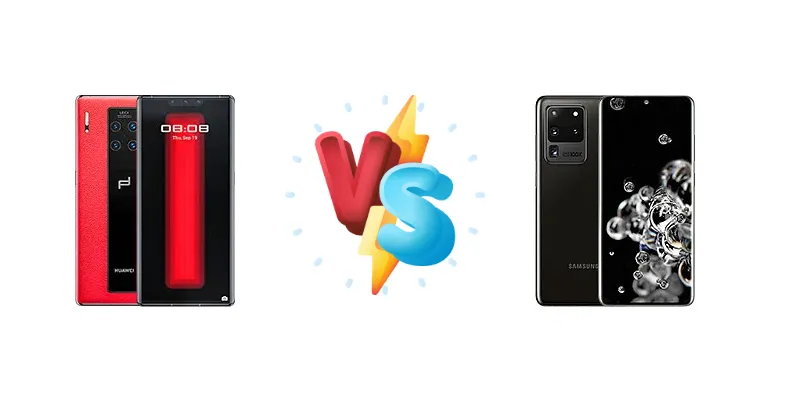
|
🏆 Quick Verdict
For the average user prioritizing camera versatility and readily available software updates, the Samsung Galaxy S20 Ultra is the better choice. However, the Huawei Mate 30 RS Porsche Design offers a unique aesthetic and a potentially smoother experience for users within the Huawei ecosystem, despite software limitations.
| PHONES | ||
|---|---|---|
| Phone Names | Huawei Mate 30 RS Porsche Design | Samsung Galaxy S20 Ultra |
| Network | ||
|---|---|---|
| 2G bands | GSM 850 / 900 / 1800 / 1900 | GSM 850 / 900 / 1800 / 1900 |
| 3G bands | HSDPA 800 / 850 / 900 / 1700(AWS) / 1900 / 2100 | HSDPA 850 / 900 / 1700(AWS) / 1900 / 2100 |
| 4G bands | 1, 2, 3, 4, 5, 6, 7, 8, 9, 12, 17, 18, 19, 20, 26, 28, 32, 34, 38, 39, 40, 41 - Global | 1, 2, 3, 4, 5, 7, 8, 12, 13, 17, 18, 19, 20, 25, 26, 28, 32, 38, 39, 40, 41, 66 |
| 5G bands | 1, 3, 28, 77, 78, 79 NSA/Sub6 | - |
| Speed | HSPA, LTE, 5G (2+ Gbps DL) | HSPA 42.2/5.76 Mbps, LTE (7CA) Cat20 2000/200 Mbps |
| Technology | GSM / HSPA / LTE / 5G | GSM / CDMA / HSPA / EVDO / LTE |
| 1, 2, 3, 4, 5, 6, 7, 8, 9, 12, 17, 18, 19, 20, 26, 34, 38, 39, 40, 41 - China | CDMA2000 1xEV-DO | |
| Launch | ||
|---|---|---|
| Announced | 2019, September. Released 2019, November | 2020, February 11 |
| Status | Discontinued | Available. Released 2020, March 15 |
| Body | ||
|---|---|---|
| Build | Glass front (Gorilla Glass 6), leather/glass back, aluminum frame | Glass front (Gorilla Glass 6), glass back (Gorilla Glass 6), aluminum frame |
| Dimensions | 158.1 x 73.1 x 9.3 mm (6.22 x 2.88 x 0.37 in) | 166.9 x 76 x 8.8 mm (6.57 x 2.99 x 0.35 in) |
| SIM | Nano-SIM + Nano-SIM | · Nano-SIM + eSIM· Nano-SIM + Nano-SIM |
| Weight | 198 g (6.98 oz) | 220 g (7.76 oz) |
| IP68 dust/water resistant (up to 2m for 30 mins) | IP68 dust/water resistant (up to 1.5m for 30 min) | |
| Display | ||
|---|---|---|
| Protection | Corning Gorilla Glass 6 | Corning Gorilla Glass 6 |
| Resolution | 1176 x 2400 pixels, 18.5:9 ratio (~409 ppi density) | 1440 x 3200 pixels, 20:9 ratio (~511 ppi density) |
| Size | 6.53 inches, 108.7 cm2 (~94.1% screen-to-body ratio) | 6.9 inches, 114.0 cm2 (~89.9% screen-to-body ratio) |
| Type | OLED, HDR10 | Dynamic AMOLED 2X, 120Hz, HDR10+, 1400 nits (peak) |
| - | Always-on display 120Hz@FHD/60Hz@QHD refresh rate | |
| Platform | ||
|---|---|---|
| CPU | Octa-core (2x2.86 GHz Cortex-A76 & 2x2.36 GHz Cortex-A76 & 4x1.95 GHz Cortex-A55) | Octa-core (2x2.73 GHz Mongoose M5 & 2x2.50 GHz Cortex-A76 & 4x2.0 GHz Cortex-A55)Octa-core (1x2.84 GHz Cortex-A77 & 3x2.42 GHz Cortex-A77 & 4x1.80 GHz Cortex-A55) |
| Chipset | Kirin 990 5G (7 nm+) | Exynos 990 (7 nm+)Qualcomm SM8250 Snapdragon 865 5G (7 nm+) |
| GPU | Mali-G76 MP16 | Mali-G77 MP11Adreno 650 |
| OS | Android 10, EMUI 10, no Google Play Services | Android 10, upgradable to Android 13, One UI 5 |
| Memory | ||
|---|---|---|
| Card slot | Nano Memory (uses shared SIM slot) | microSDXC (uses shared SIM slot) |
| Internal | 512GB 12GB RAM | 128GB 12GB RAM, 512GB 16GB RAM |
| UFS 3.0 | UFS 3.0 | |
| Main Camera | ||
|---|---|---|
| Features | Leica optics, dual-LED dual-tone flash, panorama, HDR | LED flash, auto-HDR, panorama |
| Triple | 40 MP, f/1.6, 27mm (wide), 1/1.7", PDAF, OIS 8 MP, f/2.4, 80mm (telephoto), 1/4.0", PDAF, OIS, 3x optical zoom 40 MP, f/1.8, 18mm (ultrawide), 1/1.54", PDAF TOF 3D, (depth) | 108 MP, f/1.8, 26mm (wide), 1/1.33", 0.8µm, PDAF, OIS 48 MP, f/3.5, 103mm (periscope telephoto), 1/2.0", 0.8µm, PDAF, OIS, 4x optical zoom, 10x hybrid zoom 12 MP, f/2.2, 13mm, 120˚ (ultrawide), 1/2.55" 1.4µm, Super Steady video 0.3 MP, TOF 3D, f/1.0, (depth) |
| Video | 4K@30/60fps, 1080p@30/60/120fps, 1080p@960fps, 720p@7680fps, gyro-EIS | 8K@24fps, 4K@30/60fps, 1080p@30/60/240fps, 720p@960fps, HDR10+, stereo sound rec., gyro-EIS & OIS |
| Selfie camera | ||
|---|---|---|
| Features | HDR, panorama | HDR |
| Single | 32 MP, f/2.0, 26mm (wide), 1/2.8", 0.8µm TOF 3D, (depth/biometrics sensor) | 40 MP, f/2.2, 26mm (wide), 1/2.8", 0.7µm, PDAF |
| Video | 1080p@30fps | 4K@30/60fps, 1080p@30fps |
| Sound | ||
|---|---|---|
| 3.5mm jack | No | No |
| 35mm jack | No | No |
| Loudspeaker | Yes, with stereo speakers | Yes, with stereo speakers |
| 32-bit/384kHz audio | 32-bit/384kHz audio Tuned by AKG | |
| Comms | ||
|---|---|---|
| Bluetooth | 5.1, A2DP, aptX HD, LE | 5.0, A2DP, LE |
| Infrared port | Yes | - |
| NFC | Yes | Yes |
| Positioning | GPS (L1+L5), GLONASS (L1), BDS (B1), GALILEO (E1+E5a), QZSS (L1+L5) | GPS, GLONASS, BDS, GALILEO |
| Radio | No | FM radio (USA & Canada only) |
| USB | USB Type-C 3.1, OTG | USB Type-C 3.2, OTG |
| WLAN | Wi-Fi 802.11 a/b/g/n/ac, dual-band, DLNA, Wi-Fi Direct | Wi-Fi 802.11 a/b/g/n/ac/6, dual-band, Wi-Fi Direct |
| Features | ||
|---|---|---|
| Sensors | Face ID, fingerprint (under display, optical), accelerometer, gyro, proximity, barometer, compass | Fingerprint (under display, ultrasonic), accelerometer, gyro, proximity, compass, barometer |
| - | Samsung DeX, Samsung Wireless DeX (desktop experience support) ANT+ Bixby natural language commands and dictation Samsung Pay (Visa, MasterCard certified) | |
| Battery | ||
|---|---|---|
| Charging | 40W wired 27W wireless Reverse wireless | 45W wired, PD3.0 15W wireless (Qi) 4.5W reverse wireless |
| Type | Li-Po 4500 mAh, non-removable | Li-Ion 5000 mAh |
| Misc | ||
|---|---|---|
| Colors | Black, Red | Cosmic Grey, Cosmic Black, Cloud White |
| Models | LIO-N29, LIO-AN00P, LIO-AN00 | SM-G988B/DS |
| Price | About 1700 EUR | About 690 EUR |
| SAR | - | 0.94 W/kg (head) 0.95 W/kg (body) |
| SAR EU | - | 0.32 W/kg (head) 1.56 W/kg (body) |
Huawei Mate 30 RS Porsche Design
- Unique and luxurious Porsche Design aesthetic
- Excellent low-light camera performance
- Fast 40W wired and 27W wireless charging
- Integrated 5G modem
- Lack of Google Mobile Services (GMS)
- Limited app availability
- Potential software update delays
- Less versatile camera system compared to S20 Ultra
Samsung Galaxy S20 Ultra
- Versatile camera system with 100x Space Zoom
- 120Hz display for smoother scrolling
- Access to Google Mobile Services and a vast app ecosystem
- Faster 45W wired charging
- Exynos 990 variant can suffer from thermal throttling
- Larger and heavier design
- Higher price at launch
- Software bloatware
Display Comparison
Both devices utilize 7nm+ fabrication processes, but the display differences are notable. While specific nit brightness figures aren't provided, the S20 Ultra’s larger 6.9-inch Dynamic AMOLED 2X display likely achieves higher peak brightness than the Mate 30 RS’s 6.39-inch OLED panel. The S20 Ultra’s 120Hz refresh rate, absent on the Mate 30 RS, provides a smoother scrolling experience, though it impacts battery life. The S20 Ultra’s larger size and higher resolution (3200 x 1440) result in a sharper image, while the Mate 30 RS’s curved waterfall display offers a unique aesthetic.
Camera Comparison
The S20 Ultra’s camera system is significantly more versatile. Its 108MP main sensor, combined with a periscope telephoto lens offering 100x Space Zoom, surpasses the Mate 30 RS’s 40MP main sensor and 8MP telephoto lens. While the Mate 30 RS excels in low-light photography due to its larger sensor size and Leica co-engineering, the S20 Ultra’s zoom capabilities and overall flexibility are unmatched. The S20 Ultra’s 8K video recording is also a feature absent on the Mate 30 RS. The 2MP macro lens on both devices is largely a marketing gimmick, offering limited practical benefit.
Performance
The chipset battle is complex. The Huawei Mate 30 RS features the Kirin 990 5G, built on a 7nm+ process, with a tri-cluster CPU configuration. The Galaxy S20 Ultra comes in two variants: the Exynos 990 (also 7nm+) and the Qualcomm Snapdragon 865 (7nm+). The Snapdragon 865, with its Cortex-A77 cores, generally outperforms the Kirin 990 and Exynos 990 in sustained workloads due to superior thermal management and a more efficient architecture. The Exynos 990 has been known to throttle under heavy load, potentially impacting gaming performance. Both phones feature ample RAM, but the S20 Ultra’s LPDDR5 RAM offers a slight speed advantage. The Kirin 990’s integrated 5G modem provides a potential edge in 5G connectivity, but the Snapdragon 865’s external modem is equally capable.
Battery Life
The Galaxy S20 Ultra packs a larger 5000mAh battery compared to the Mate 30 RS’s 4500mAh battery. However, the S20 Ultra’s higher refresh rate and more demanding processor can offset this capacity advantage. The S20 Ultra supports 45W wired charging with PD3.0, enabling a faster 0-100% charge time than the Mate 30 RS’s 40W charging. Wireless charging is also faster on the S20 Ultra (15W vs 27W), but the Mate 30 RS offers reverse wireless charging, a feature also present on the S20 Ultra, albeit at a lower wattage (4.5W vs. the Mate 30 RS's unspecified wattage).
Buying Guide
Buy the Huawei Mate 30 RS Porsche Design if you value a distinctive, luxurious design, appreciate Huawei’s EMUI software (and can navigate the lack of Google Mobile Services), and prioritize a potentially more stable, albeit closed, software experience. Buy the Samsung Galaxy S20 Ultra if you demand a versatile camera system with extreme zoom capabilities, prefer the openness of the Android ecosystem with Google services, and require the latest software updates and security patches.