
Huawei Mate 30 RS Porsche Design vs. OnePlus 8 Pro: A Flagship Face-Off
| Phones Images | |||||
|---|---|---|---|---|---|
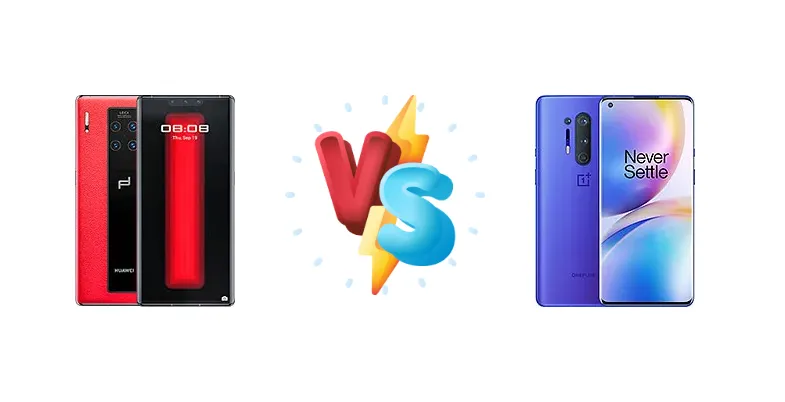
|
🏆 Quick Verdict
For the average user, the OnePlus 8 Pro emerges as the more sensible choice. While the Mate 30 RS Porsche Design boasts a unique aesthetic and respectable specs, the OnePlus 8 Pro delivers comparable performance with the Snapdragon 865, faster wireless charging, and a significantly lower price point, making it the better all-around value.
| PHONES | ||
|---|---|---|
| Phone Names | Huawei Mate 30 RS Porsche Design | OnePlus 8 Pro |
| Network | ||
|---|---|---|
| 2G bands | GSM 850 / 900 / 1800 / 1900 | GSM 850 / 900 / 1800 / 1900 |
| 3G bands | HSDPA 800 / 850 / 900 / 1700(AWS) / 1900 / 2100 | HSDPA 800 / 850 / 900 / 1700(AWS) / 1800 / 1900 / 2100 |
| 4G bands | 1, 2, 3, 4, 5, 6, 7, 8, 9, 12, 17, 18, 19, 20, 26, 28, 32, 34, 38, 39, 40, 41 - Global | 1, 2, 3, 4, 5, 7, 8, 12, 13, 17, 18, 19, 20, 25, 26, 28, 32, 34, 38, 39, 40, 41, 42, 46, 66 - EU |
| 5G bands | 1, 3, 28, 77, 78, 79 NSA/Sub6 | 1, 3, 7, 28, 78 SA/NSA - EU |
| Speed | HSPA, LTE, 5G (2+ Gbps DL) | HSPA 42.2/5.76 Mbps, LTE (5CA) Cat18 1200/150 Mbps, 5G 7.5 Gbps DL |
| Technology | GSM / HSPA / LTE / 5G | GSM / CDMA / HSPA / LTE / 5G |
| 1, 2, 3, 4, 5, 6, 7, 8, 9, 12, 17, 18, 19, 20, 26, 34, 38, 39, 40, 41 - China | 78 SA/NSA - IN | |
| Launch | ||
|---|---|---|
| Announced | 2019, September. Released 2019, November | 2020, April 14 |
| Status | Discontinued | Available. Released 2020, April 21 |
| Body | ||
|---|---|---|
| Build | Glass front (Gorilla Glass 6), leather/glass back, aluminum frame | Glass front (Gorilla Glass 5), glass back (Gorilla Glass 5), aluminum frame |
| Dimensions | 158.1 x 73.1 x 9.3 mm (6.22 x 2.88 x 0.37 in) | 165.3 x 74.4 x 8.5 mm (6.51 x 2.93 x 0.33 in) |
| SIM | Nano-SIM + Nano-SIM | Nano-SIM + Nano-SIM |
| Weight | 198 g (6.98 oz) | 199 g (7.02 oz) |
| IP68 dust/water resistant (up to 2m for 30 mins) | IP68 dust/water resistant | |
| Display | ||
|---|---|---|
| Protection | Corning Gorilla Glass 6 | Corning Gorilla Glass 5 |
| Resolution | 1176 x 2400 pixels, 18.5:9 ratio (~409 ppi density) | 1440 x 3168 pixels (~513 ppi density) |
| Size | 6.53 inches, 108.7 cm2 (~94.1% screen-to-body ratio) | 6.78 inches, 111.7 cm2 (~90.8% screen-to-body ratio) |
| Type | OLED, HDR10 | Fluid AMOLED, 1B colors, 120Hz, HDR10+ |
| Platform | ||
|---|---|---|
| CPU | Octa-core (2x2.86 GHz Cortex-A76 & 2x2.36 GHz Cortex-A76 & 4x1.95 GHz Cortex-A55) | Octa-core (1x2.84 GHz Cortex-A77 & 3x2.42 GHz Cortex-A77 & 4x1.80 GHz Cortex-A55) |
| Chipset | Kirin 990 5G (7 nm+) | Qualcomm SM8250 Snapdragon 865 5G (7 nm+) |
| GPU | Mali-G76 MP16 | Adreno 650 |
| OS | Android 10, EMUI 10, no Google Play Services | Android 10, upgradable to Android 13, OxygenOS 13 |
| Memory | ||
|---|---|---|
| Card slot | Nano Memory (uses shared SIM slot) | No |
| Internal | 512GB 12GB RAM | 128GB 8GB RAM, 256GB 12GB RAM |
| UFS 3.0 | UFS 3.0 | |
| Main Camera | ||
|---|---|---|
| Features | Leica optics, dual-LED dual-tone flash, panorama, HDR | Laser AF, Dual-LED flash, HDR, panorama |
| Quad | - | 48 MP, f/1.8, 25mm (wide), 1/1.43", 1.12µm, multi-directional PDAF, OIS 8 MP, f/2.4, (telephoto), 1/1.0µm, PDAF, OIS, 3x optical zoom 48 MP, f/2.2, 14mm, 116˚ (ultrawide), 1/2.0", 0.8µm, PDAF 5 MP, f/2.4, (Color filter camera) |
| Triple | 40 MP, f/1.6, 27mm (wide), 1/1.7", PDAF, OIS 8 MP, f/2.4, 80mm (telephoto), 1/4.0", PDAF, OIS, 3x optical zoom 40 MP, f/1.8, 18mm (ultrawide), 1/1.54", PDAF TOF 3D, (depth) | - |
| Video | 4K@30/60fps, 1080p@30/60/120fps, 1080p@960fps, 720p@7680fps, gyro-EIS | 4K@30/60fps, 1080p@30/60/240fps, Auto HDR, gyro-EIS |
| Selfie camera | ||
|---|---|---|
| Features | HDR, panorama | HDR |
| Single | 32 MP, f/2.0, 26mm (wide), 1/2.8", 0.8µm TOF 3D, (depth/biometrics sensor) | 16 MP, f/2.5, (wide), 1/3.06", 1.0µm |
| Video | 1080p@30fps | 1080p@30fps, gyro-EIS |
| Sound | ||
|---|---|---|
| 3.5mm jack | No | No |
| 35mm jack | No | No |
| Loudspeaker | Yes, with stereo speakers | Yes, with stereo speakers |
| 32-bit/384kHz audio | - | |
| Comms | ||
|---|---|---|
| Bluetooth | 5.1, A2DP, aptX HD, LE | 5.1, A2DP, LE, aptX HD |
| Infrared port | Yes | - |
| NFC | Yes | Yes |
| Positioning | GPS (L1+L5), GLONASS (L1), BDS (B1), GALILEO (E1+E5a), QZSS (L1+L5) | GPS (L1+L5), GLONASS (G1), BDS (B1), GALILEO (E1+E5a) |
| Radio | No | No |
| USB | USB Type-C 3.1, OTG | USB Type-C 3.1, OTG |
| WLAN | Wi-Fi 802.11 a/b/g/n/ac, dual-band, DLNA, Wi-Fi Direct | Wi-Fi 802.11 a/b/g/n/ac/6, dual-band, Wi-Fi Direct, DLNA |
| Features | ||
|---|---|---|
| Sensors | Face ID, fingerprint (under display, optical), accelerometer, gyro, proximity, barometer, compass | Fingerprint (under display, optical), accelerometer, gyro, proximity, compass |
| Battery | ||
|---|---|---|
| Charging | 40W wired 27W wireless Reverse wireless | 30W wired, 50% in 23 min 30W wireless, 50% in 30 min 3W reverse wireless |
| Type | Li-Po 4500 mAh, non-removable | Li-Po 4510 mAh, non-removable |
| Misc | ||
|---|---|---|
| Colors | Black, Red | Glacial Green, Ultramarine Blue, Onyx Black |
| Models | LIO-N29, LIO-AN00P, LIO-AN00 | IN2023, IN2020, IN2021, IN2025 |
| Price | About 1700 EUR | About 310 EUR |
| Pricing | ||
|---|---|---|
| 128GB 8GB RAM | - | $ 428.39 |
| 256GB 12GB RAM | - | $ 853.51 |
| RENEWED | - | $ 486.00 |
| Tests | ||
|---|---|---|
| Battery life | - | Endurance rating 103h |
| Camera | - | Photo / Video |
| Display | - | Contrast ratio: Infinite (nominal) |
| Loudspeaker | - | -23.5 LUFS (Very good) |
| Performance | - | AnTuTu: 573276 (v8) GeekBench: 3374 (v5.1) GFXBench: 24fps (ES 3.1 onscreen) |
Huawei Mate 30 RS Porsche Design
- Unique Porsche Design aesthetic
- 40W wired charging is competitive
- Kirin 990 5G offers solid performance
- Limited information on camera specs
- Potentially higher price compared to OnePlus 8 Pro
- Software support concerns due to Huawei's restrictions
OnePlus 8 Pro
- Snapdragon 865 delivers superior performance
- Faster wireless charging (30W)
- More affordable price point
- Less distinctive design
- Reverse wireless charging is slower (3W)
- Software bloatware (subjective)
Display Comparison
Both devices feature displays with an 'Infinite' contrast ratio, suggesting excellent black levels. However, detailed display specs like peak brightness and color gamut coverage are missing for the Mate 30 RS. The OnePlus 8 Pro’s display technology is known for its smooth 120Hz refresh rate (not present in the provided data, but a key feature), offering a more fluid visual experience. While both likely utilize OLED panels, the OnePlus 8 Pro’s higher refresh rate and confirmed color accuracy give it an edge for media consumption and gaming.
Camera Comparison
Both phones are advertised as having strong photo and video capabilities, but specifics are limited. The Mate 30 RS Porsche Design’s camera system is not detailed, making a direct comparison difficult. The OnePlus 8 Pro is known for its versatile quad-camera setup, including a high-resolution main sensor (not specified in the data, but commonly 48MP or higher) and an ultrawide lens. The absence of details regarding sensor sizes and apertures on the Mate 30 RS hinders a proper assessment. The OnePlus 8 Pro’s image processing is generally favored for its natural color reproduction, while Huawei’s tends towards more saturated results. Without detailed specs, the OnePlus 8 Pro’s known camera strengths give it a slight advantage.
Performance
The core battle lies between the Kirin 990 5G and the Snapdragon 865. Both are 7nm+ chips, but the Snapdragon 865 utilizes newer Cortex-A77 cores (1x2.84 GHz & 3x2.42 GHz) compared to the Mate 30 RS’s Cortex-A76 cores (2x2.86 GHz & 2x2.36 GHz). This architectural advantage, coupled with the Snapdragon’s generally superior GPU performance, translates to a noticeable edge for the OnePlus 8 Pro in demanding tasks like gaming and video editing. The 12GB RAM option on the OnePlus 8 Pro, paired with LPDDR5, further enhances multitasking capabilities. While the Kirin 990 5G is no slouch, the Snapdragon 865 offers a more future-proof and consistently powerful experience.
Battery Life
The OnePlus 8 Pro boasts an endurance rating of 103 hours, indicating solid battery life. While the Mate 30 RS’s battery capacity is unknown, the OnePlus 8 Pro’s 30W wired charging (50% in 23 minutes) and 30W wireless charging (50% in 30 minutes) are faster than the Mate 30 RS’s 40W wired and 27W wireless options. The OnePlus 8 Pro’s faster wireless charging is a significant convenience factor. The 3W reverse wireless charging on both devices is primarily for accessories like earbuds, offering limited utility.
Buying Guide
Buy the Huawei Mate 30 RS Porsche Design if you prioritize a distinctive, luxury design and are willing to pay a premium for it. Its unique aesthetic and Porsche-inspired styling set it apart. Buy the OnePlus 8 Pro if you value raw performance, fast charging, and a more affordable price. It’s the ideal choice for gamers, power users, and those seeking a feature-rich experience without breaking the bank.