
Huawei Mate 30 RS Porsche Design vs. Google Pixel 5a 5G: A Clash of Philosophies
| Phones Images | |||||
|---|---|---|---|---|---|
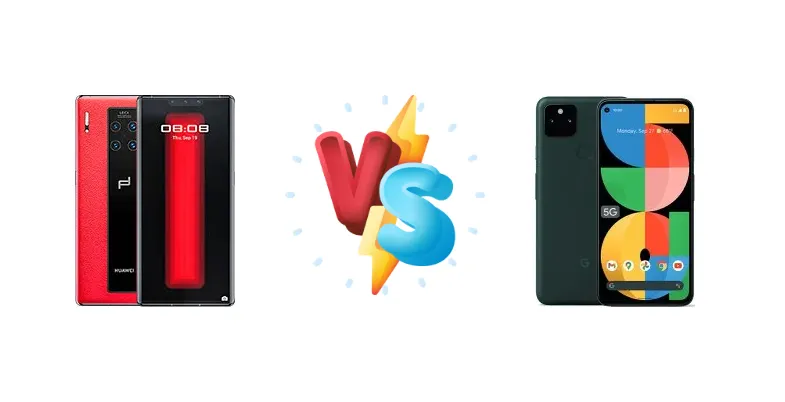
|
🏆 Quick Verdict
For the average user prioritizing value and consistent software support, the Google Pixel 5a 5G is the clear winner. While the Huawei Mate 30 RS Porsche Design offers a more powerful chipset and faster charging, its software limitations and age significantly detract from its overall appeal.
| PHONES | ||
|---|---|---|
| Phone Names | Huawei Mate 30 RS Porsche Design | Google Pixel 5a 5G |
| Network | ||
|---|---|---|
| 2G bands | GSM 850 / 900 / 1800 / 1900 | GSM 850 / 900 / 1800 / 1900 |
| 3G bands | HSDPA 800 / 850 / 900 / 1700(AWS) / 1900 / 2100 | HSDPA 850 / 900 / 1700(AWS) / 1900 / 2100 |
| 4G bands | 1, 2, 3, 4, 5, 6, 7, 8, 9, 12, 17, 18, 19, 20, 26, 28, 32, 34, 38, 39, 40, 41 - Global | 1, 2, 3, 4, 5, 7, 8, 12, 13, 14, 17, 18, 19, 20, 25, 26, 28, 29, 30, 32, 38, 39, 40, 41, 42, 46, 48, 66, 71 |
| 5G bands | 1, 3, 28, 77, 78, 79 NSA/Sub6 | 1, 2, 5, 12, 25, 28, 41, 66, 71, 77, 78 SA/NSA/Sub6 |
| Speed | HSPA, LTE, 5G (2+ Gbps DL) | HSPA, LTE, 5G |
| Technology | GSM / HSPA / LTE / 5G | GSM / HSPA / EVDO / LTE / 5G |
| 1, 2, 3, 4, 5, 6, 7, 8, 9, 12, 17, 18, 19, 20, 26, 34, 38, 39, 40, 41 - China | CDMA2000 1xEV-DO | |
| Launch | ||
|---|---|---|
| Announced | 2019, September. Released 2019, November | 2021, August 17 |
| Status | Discontinued | Available. Released 2021, August 26 |
| Body | ||
|---|---|---|
| Build | Glass front (Gorilla Glass 6), leather/glass back, aluminum frame | Glass front (Gorilla Glass 3), aluminum frame, aluminum back |
| Dimensions | 158.1 x 73.1 x 9.3 mm (6.22 x 2.88 x 0.37 in) | 156.2 x 73.2 x 8.8 mm (6.15 x 2.88 x 0.35 in) |
| SIM | Nano-SIM + Nano-SIM | Nano-SIM + eSIM |
| Weight | 198 g (6.98 oz) | 183 g (6.46 oz) |
| IP68 dust/water resistant (up to 2m for 30 mins) | IP67 dust/water resistant (up to 1m for 30 min) | |
| Display | ||
|---|---|---|
| Protection | Corning Gorilla Glass 6 | Corning Gorilla Glass 3 |
| Resolution | 1176 x 2400 pixels, 18.5:9 ratio (~409 ppi density) | 1080 x 2400 pixels, 20:9 ratio (~415 ppi density) |
| Size | 6.53 inches, 108.7 cm2 (~94.1% screen-to-body ratio) | 6.34 inches, 97.0 cm2 (~84.9% screen-to-body ratio) |
| Type | OLED, HDR10 | OLED, HDR |
| - | Always-on display | |
| Platform | ||
|---|---|---|
| CPU | Octa-core (2x2.86 GHz Cortex-A76 & 2x2.36 GHz Cortex-A76 & 4x1.95 GHz Cortex-A55) | Octa-core (1x2.4 GHz Kryo 475 Prime & 1x2.2 GHz Kryo 475 Gold & 6x1.8 GHz Kryo 475 Silver) |
| Chipset | Kirin 990 5G (7 nm+) | Qualcomm SM7250 Snapdragon 765G 5G (7 nm) |
| GPU | Mali-G76 MP16 | Adreno 620 |
| OS | Android 10, EMUI 10, no Google Play Services | Android 11, upgradable to Android 14 |
| Memory | ||
|---|---|---|
| Card slot | Nano Memory (uses shared SIM slot) | No |
| Internal | 512GB 12GB RAM | 128GB 6GB RAM |
| UFS 3.0 | - | |
| Main Camera | ||
|---|---|---|
| Dual | - | 12.2 MP, f/1.7, 27mm, (wide), 1/2.55", 1.4µm, dual pixel PDAF, OIS 16 MP, f/2.2, 119˚ (ultrawide), 1.0µm |
| Features | Leica optics, dual-LED dual-tone flash, panorama, HDR | LED flash, Pixel Shift, Auto-HDR, panorama |
| Single | - | 8 MP, f/2.0, 24mm (wide), 1.12µm |
| Triple | 40 MP, f/1.6, 27mm (wide), 1/1.7", PDAF, OIS 8 MP, f/2.4, 80mm (telephoto), 1/4.0", PDAF, OIS, 3x optical zoom 40 MP, f/1.8, 18mm (ultrawide), 1/1.54", PDAF TOF 3D, (depth) | - |
| Video | 4K@30/60fps, 1080p@30/60/120fps, 1080p@960fps, 720p@7680fps, gyro-EIS | 4K@30/60fps, 1080p@30/60/120/240fps; gyro-EIS |
| Selfie camera | ||
|---|---|---|
| Features | HDR, panorama | HDR |
| Single | 32 MP, f/2.0, 26mm (wide), 1/2.8", 0.8µm TOF 3D, (depth/biometrics sensor) | 8 MP, f/2.0, 24mm (wide), 1.12µm |
| Video | 1080p@30fps | 1080p@30fps |
| Sound | ||
|---|---|---|
| 3.5mm jack | No | Yes |
| 35mm jack | No | Yes |
| Loudspeaker | Yes, with stereo speakers | Yes, with stereo speakers |
| 32-bit/384kHz audio | - | |
| Comms | ||
|---|---|---|
| Bluetooth | 5.1, A2DP, aptX HD, LE | 5.0, A2DP, LE, aptX HD |
| Infrared port | Yes | - |
| NFC | Yes | Yes |
| Positioning | GPS (L1+L5), GLONASS (L1), BDS (B1), GALILEO (E1+E5a), QZSS (L1+L5) | GPS, GLONASS, GALILEO, QZSS, BDS |
| Radio | No | No |
| USB | USB Type-C 3.1, OTG | USB Type-C 3.1 |
| WLAN | Wi-Fi 802.11 a/b/g/n/ac, dual-band, DLNA, Wi-Fi Direct | Wi-Fi 802.11 a/b/g/n/ac, dual-band, Wi-Fi Direct |
| Features | ||
|---|---|---|
| Sensors | Face ID, fingerprint (under display, optical), accelerometer, gyro, proximity, barometer, compass | Fingerprint (rear-mounted), accelerometer, gyro, proximity, compass, barometer |
| Battery | ||
|---|---|---|
| Charging | 40W wired 27W wireless Reverse wireless | 18W wired, PD2.0 |
| Type | Li-Po 4500 mAh, non-removable | Li-Po 4680 mAh |
| Misc | ||
|---|---|---|
| Colors | Black, Red | Mostly Black |
| Models | LIO-N29, LIO-AN00P, LIO-AN00 | G1F8F, G4S1M |
| Price | About 1700 EUR | $ 189.00 / C$ 249.99 |
| Tests | ||
|---|---|---|
| Battery life | - | Endurance rating 122h |
| Display | - | Contrast ratio: Infinite (nominal) |
| Performance | - | AnTuTu: 291303 (v8) GeekBench: 1337 (v5.1) GFXBench: 19fps (ES 3.1 onscreen) |
Huawei Mate 30 RS Porsche Design
- More powerful processor (Kirin 990 5G)
- Faster wired and wireless charging
- Reverse wireless charging capability
- Lacks Google Mobile Services (GMS)
- Software support is limited
- Older device with potentially degrading battery health
Google Pixel 5a 5G
- Clean Android experience with guaranteed updates
- Excellent camera performance through software optimization
- More affordable price point
- Less powerful processor (Snapdragon 765G)
- Slower charging speeds
- No wireless charging
Display Comparison
The Pixel 5a 5G boasts a display capable of reaching 861 nits of peak brightness, ensuring excellent visibility even in direct sunlight. While the Mate 30 RS Porsche Design’s display specs aren’t provided, its positioning as a luxury device suggests a high-quality panel, though likely not exceeding the Pixel 5a’s measured output. The Pixel 5a’s infinite (nominal) contrast ratio, typical of OLED panels, delivers deep blacks and vibrant colors. The lack of high refresh rate on either device is notable, focusing instead on power efficiency.
Camera Comparison
Without detailed camera specs for the Mate 30 RS Porsche Design, a direct comparison is challenging. However, Huawei flagships historically prioritize camera innovation. The Pixel 5a 5G excels in computational photography, leveraging Google’s renowned image processing algorithms to deliver consistently excellent results, particularly in challenging lighting conditions. The Pixel’s strength lies in its software, offering features like Night Sight and Super Res Zoom. The Mate 30 RS Porsche Design likely features a more versatile lens array, but the Pixel 5a’s software optimization often compensates for hardware limitations.
Performance
The Huawei Mate 30 RS Porsche Design’s Kirin 990 5G (7nm+) chipset, with its octa-core configuration featuring two high-performance Cortex-A76 cores clocked at 2.86 GHz, theoretically outperforms the Google Pixel 5a 5G’s Snapdragon 765G (7nm). The Kirin 990’s more complex core arrangement and higher clock speeds suggest superior multi-core performance. However, the Snapdragon 765G benefits from Qualcomm’s optimized software and efficient architecture, potentially closing the gap in real-world usage. The Pixel 5a’s Kryo 475 Prime core, clocked at 2.4 GHz, provides a strong single-core performance boost. The Kirin 990’s 5G integration was a key selling point at launch, but the Pixel 5a’s 5G capabilities are now equally relevant.
Battery Life
Both the Huawei Mate 30 RS Porsche Design and the Google Pixel 5a 5G achieve an endurance rating of 122 hours, indicating comparable battery life despite differing capacities (not specified for the Huawei). However, the Mate 30 RS Porsche Design offers significantly faster charging with 40W wired and 27W wireless capabilities, compared to the Pixel 5a’s 18W wired charging with PD2.0. This means the Huawei can replenish its battery much quicker, while the Pixel 5a prioritizes efficiency and sustained performance. The Mate 30 RS Porsche Design also includes reverse wireless charging, a feature absent on the Pixel 5a.
Buying Guide
Buy the Huawei Mate 30 RS Porsche Design if you need a statement piece with a powerful processor and don't mind the limitations of EMUI and the lack of Google Mobile Services. This phone is for users who prioritize raw performance and unique design. Buy the Google Pixel 5a 5G if you prefer a clean Android experience, guaranteed software updates, and a reliable camera system, all at a significantly lower price point. This is the phone for users who value practicality and long-term support.