
Huawei Mate 30 Pro vs. iPhone 11 Pro Max: A Detailed Comparison of Flagship Power
| Phones Images | |||||
|---|---|---|---|---|---|
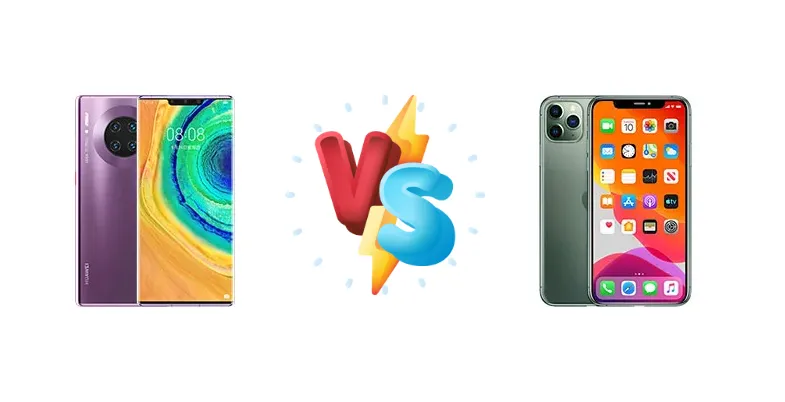
|
🏆 Quick Verdict
For the average user, the iPhone 11 Pro Max remains a more straightforward choice due to its established ecosystem and long-term software support. However, the Huawei Mate 30 Pro edges ahead in battery endurance and offers significantly faster charging, making it ideal for power users and photography enthusiasts.
| PHONES | ||
|---|---|---|
| Phone Names | Huawei Mate 30 Pro | Apple iPhone 11 Pro Max |
| Network | ||
|---|---|---|
| 2G bands | GSM 850 / 900 / 1800 / 1900 | GSM 850 / 900 / 1800 / 1900 |
| 3G bands | HSDPA 800 / 850 / 900 / 1700(AWS) / 1900 / 2100 | HSDPA 850 / 900 / 1700(AWS) / 1900 / 2100 |
| 4G bands | 1, 2, 3, 4, 5, 6, 7, 8, 9, 12, 17, 18, 19, 20, 26, 28, 32, 34, 38, 39, 40, 41 - Global | 1, 2, 3, 4, 5, 7, 8, 11, 12, 13, 17, 18, 19, 20, 21, 25, 26, 28, 29, 30, 32, 34, 38, 39, 40, 41, 42, 46, 48, 66 - A2218 |
| Speed | HSPA, LTE | HSPA, LTE 1.6 Gbps DL, EV-DO Rev.A 3.1 Mbps |
| Technology | GSM / HSPA / LTE | GSM / CDMA / HSPA / EVDO / LTE |
| 1, 2, 3, 4, 5, 6, 7, 8, 9, 12, 17, 18, 19, 20, 26, 34, 38, 39, 40, 41 - China | 1, 2, 3, 4, 5, 7, 8, 12, 13, 14, 17, 18, 19, 20, 25, 26, 29, 30, 34, 38, 39, 40, 41, 42, 46, 48, 66, 71 - A2161, A2220 | |
| Launch | ||
|---|---|---|
| Announced | 2019, September 19. Released 2019, September 26 | 2019, September 10 |
| Status | Discontinued | Available. Released 2019, September 20 |
| Body | ||
|---|---|---|
| Build | Glass front (Gorilla Glass 6), glass back (Gorilla Glass 6), aluminum frame | Glass front (Corning-made glass), glass back (Corning-made glass), stainless steel frame |
| Dimensions | 158.1 x 73.1 x 8.8 mm (6.22 x 2.88 x 0.35 in) | 158 x 77.8 x 8.1 mm (6.22 x 3.06 x 0.32 in) |
| SIM | · Nano-SIM· Nano-SIM + Nano-SIM | · Nano-SIM + eSIM· Nano-SIM + Nano-SIM (China) |
| Weight | 198 g (6.98 oz) | 226 g (7.97 oz) |
| IP68 dust/water resistant (up to 2m for 30 min) | IP68 dust/water resistant (up to 4m for 30 min) Apple Pay (Visa, MasterCard, AMEX certified) | |
| Display | ||
|---|---|---|
| Protection | Corning Gorilla Glass 6 | Scratch-resistant glass |
| Resolution | 1176 x 2400 pixels, 18.5:9 ratio (~409 ppi density) | 1242 x 2688 pixels, 19.5:9 ratio (~458 ppi density) |
| Size | 6.53 inches, 108.7 cm2 (~94.1% screen-to-body ratio) | 6.5 inches, 102.9 cm2 (~83.7% screen-to-body ratio) |
| Type | OLED, HDR10 | Super Retina XDR OLED, HDR10, Dolby Vision, 800 nits (HBM), 1200 nits (peak) |
| Platform | ||
|---|---|---|
| CPU | Octa-core (2x2.86 GHz Cortex-A76 & 2x2.09 GHz Cortex-A76 & 4x1.86 GHz Cortex-A55) | Hexa-core (2x2.65 GHz Lightning + 4x1.8 GHz Thunder) |
| Chipset | Kirin 990 (7 nm) | Apple A13 Bionic (7 nm+) |
| GPU | Mali-G76 MP16 | Apple GPU (4-core graphics) |
| OS | Android 10, EMUI 11, no Google Play Services | iOS 13, upgradable to iOS 26.1 |
| Memory | ||
|---|---|---|
| Card slot | Nano Memory (uses shared SIM slot) | No |
| Internal | 128GB 8GB RAM, 256GB 8GB RAM | 64GB 4GB RAM, 256GB 4GB RAM, 512GB 4GB RAM |
| UFS 3.0 | NVMe | |
| Main Camera | ||
|---|---|---|
| Features | Leica optics, dual-LED dual-tone flash, panorama, HDR | Dual-LED dual-tone flash, HDR (photo/panorama) |
| Single | - | 13 MP, f/2.2, PDAF |
| Triple | 40 MP, f/1.6, 27mm (wide), 1/1.7", PDAF, OIS 8 MP, f/2.4, 80mm (telephoto), 1/4.0", PDAF, OIS, 3x optical zoom 40 MP, f/1.8, 18mm (ultrawide), 1/1.54", PDAF TOF 3D, (depth) | 12 MP, f/1.8, 26mm (wide), 1/2.55", 1.4µm, dual pixel PDAF, OIS 12 MP, f/2.0, 52mm (telephoto), 1/3.4", 1.0µm, PDAF, OIS, 2x optical zoom 12 MP, f/2.4, 120˚, 13mm (ultrawide), 1/3.6" |
| Video | 4K@30/60fps, 1080p@30/60/120fps, 1080p@960fps, 720p@7680fps, gyro-EIS | 4K@24/25/30/60fps, 1080p@25/30/60/120/240fps, HDR, stereo sound rec. |
| Selfie camera | ||
|---|---|---|
| Features | HDR, panorama | HDR |
| Single | 32 MP, f/2.0, 26mm (wide), 1/2.8", 0.8µm TOF 3D, (depth/biometrics sensor) | 12 MP, f/2.2, 23mm (wide), 1/3.6", 1.0µm SL 3D, (depth/biometrics sensor) |
| Video | 1080p@30fps | 4K@24/25/30/60fps, 1080p@25/30/60/120fps, gyro-EIS |
| Sound | ||
|---|---|---|
| 3.5mm jack | No | No |
| 35mm jack | No | No |
| Loudspeaker | Yes | Yes, with stereo speakers |
| 32-bit/384kHz audio | - | |
| Comms | ||
|---|---|---|
| Bluetooth | 5.1, A2DP, aptX HD, LE | 5.0, A2DP, LE |
| Infrared port | Yes | - |
| NFC | Yes | Yes |
| Positioning | GPS (L1+L5), GLONASS (L1), BDS (B1), GALILEO (E1+E5a), QZSS (L1+L5) | GPS, GLONASS, GALILEO, QZSS |
| Radio | No | No |
| USB | USB Type-C 3.1, OTG | Lightning, USB 2.0 |
| WLAN | Wi-Fi 802.11 a/b/g/n/ac, dual-band, DLNA, Wi-Fi Direct | Wi-Fi 802.11 a/b/g/n/ac/6, dual-band, hotspot |
| Features | ||
|---|---|---|
| Sensors | Face ID, fingerprint (under display, optical), accelerometer, gyro, proximity, barometer, compass | Face ID, accelerometer, gyro, proximity, compass, barometer |
| - | Ultra Wideband (UWB) support | |
| Battery | ||
|---|---|---|
| Charging | 40W wired 27W wireless Reverse wireless | Wired, PD2.0, 50% in 30 min Wireless (Qi) |
| Type | Li-Po 4500 mAh, non-removable | Li-Ion 3969 mAh, non-removable (15.04 Wh) |
| Misc | ||
|---|---|---|
| Colors | Black, Space Silver, Cosmic Purple, Emerald Green | Matte Space Gray, Matte Silver, Matte Gold, Matte Midnight Green |
| Models | LIO-L09, LIO-L29, LIO-AL00, LIO-TL00 | A2218, A2161, A2220, iPhone12,5 |
| Price | About 1290 EUR | $ 233.00 / C$ 369.75 / £ 226.95 / € 249.00 |
| SAR | - | 1.16 W/kg (head) 1.17 W/kg (body) |
| SAR EU | - | 0.95 W/kg (head) 0.99 W/kg (body) |
| Pricing | ||
|---|---|---|
| 256GB 4GB RAM | - | $ 874.46 |
| 512GB 4GB RAM | - | $ 1,004.31 |
| 64GB 4GB RAM | - | $ 435.00 |
| RENEWED | - | $ 485.00 |
| Tests | ||
|---|---|---|
| Audio quality | - | Noise -94.3dB / Crosstalk -81.5dB |
| Battery life | Endurance rating 103h | Endurance rating 102h |
| Camera | Photo / Video | Photo / Video |
| Display | Contrast ratio: Infinite (nominal) | Contrast ratio: Infinite (nominal) |
| Loudspeaker | -29.3 LUFS (Average) | -25.6 LUFS (Very good) |
| Performance | AnTuTu: 378950 (v7), 484529 (v8) GeekBench: 11936 (v4.4), 3038 (v5.1) GFXBench: 34fps (ES 3.1 onscreen) | AnTuTu: 459713 (v7), 536883 (v8) GeekBench: 13870 (v4.4), 3503 (v5.1) GFXBench: 57fps (ES 3.1 onscreen) |
Huawei Mate 30 Pro
- Significantly faster wired and wireless charging (40W/27W)
- Slightly better battery endurance (103h rating)
- More versatile camera system with 5x optical zoom
- Reverse wireless charging capability
- Lack of Google Mobile Services (GMS) – potential app compatibility issues
- Software updates may be less frequent and consistent
Apple iPhone 11 Pro Max
- Seamless iOS ecosystem and long-term software support
- Excellent video recording capabilities
- Strong app compatibility and wider accessory availability
- Generally more efficient memory management
- Slower charging speeds (wired and wireless)
- Slightly lower battery endurance (102h rating)
- Less versatile zoom capabilities compared to Mate 30 Pro
Display Comparison
Both devices feature 'infinite' contrast ratios, typical of OLED panels. However, the iPhone 11 Pro Max boasts a significantly brighter display at 820 nits compared to the Mate 30 Pro’s 686 nits. This translates to better visibility under direct sunlight for the iPhone. While both offer excellent color accuracy, the higher peak brightness of the iPhone provides a more vibrant and readable experience in bright outdoor conditions. The Mate 30 Pro’s display technology isn’t specified beyond OLED, while Apple’s Super Retina XDR display is known for its color calibration.
Camera Comparison
Both phones excel in photography and videography, but approach it differently. The context data doesn’t specify sensor sizes, but the Mate 30 Pro is known for its innovative camera system, including a large 1/1.7-inch sensor and a telephoto lens with 5x optical zoom. The iPhone 11 Pro Max features a triple-camera system with a wider field of view and excels in video recording, offering cinematic mode and excellent dynamic range. The Mate 30 Pro’s image processing tends to be more saturated and contrasty, while the iPhone aims for a more natural look. Both offer excellent low-light performance, but the Mate 30 Pro’s larger sensor and advanced night mode give it a slight edge in extremely dark conditions.
Performance
The core difference lies in the chipsets: Huawei’s Kirin 990 (7nm) versus Apple’s A13 Bionic (7nm+). While both are 7nm chips, Apple’s A13 Bionic benefits from a more refined architecture and process node, resulting in superior single-core performance. The Kirin 990 utilizes an octa-core configuration (2x2.86 GHz Cortex-A76, 2x2.09 GHz Cortex-A76, 4x1.86 GHz Cortex-A55), while the A13 Bionic employs a hexa-core setup (2x2.65 GHz Lightning + 4x1.8 GHz Thunder). The A13’s Neural Engine also provides a significant advantage in machine learning tasks. Both phones have 4GB of RAM, but iOS generally manages memory more efficiently, mitigating the impact of the lower RAM capacity.
Battery Life
The Huawei Mate 30 Pro boasts an endurance rating of 103 hours, slightly surpassing the iPhone 11 Pro Max’s 102 hours. This difference, while small, is noticeable in real-world usage. More significantly, the Mate 30 Pro supports 40W wired charging, allowing for a full charge in under an hour, and 27W wireless charging, a substantial advantage over the iPhone’s slower wired charging (PD2.0, 50% in 30 min) and 7.5W Qi wireless charging. The Mate 30 Pro also includes reverse wireless charging, a feature absent on the iPhone.
Buying Guide
Buy the Huawei Mate 30 Pro if you need exceptional battery life, prioritize fast wired and wireless charging, and value a versatile camera system with strong zoom capabilities. Buy the Apple iPhone 11 Pro Max if you prefer a seamless iOS experience, prioritize long-term software updates, and are deeply integrated into the Apple ecosystem. The iPhone also offers a more consistent app experience and wider accessory availability.