
Huawei Mate 30 Pro 5G vs Huawei P40 Pro+: A Clash of Flagships
| Phones Images | |||||
|---|---|---|---|---|---|
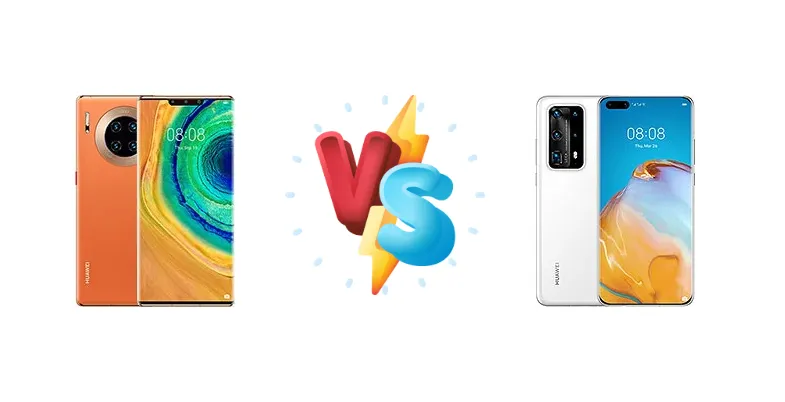
|
🏆 Quick Verdict
The P40 Pro+ edges out the Mate 30 Pro 5G thanks to its superior camera system, faster wireless charging, and slightly improved display. However, the Mate 30 Pro 5G remains a strong contender, especially if 5G connectivity is a priority and you can find it at a better price.
| PHONES | ||
|---|---|---|
| Phone Names | Huawei Mate 30 Pro 5G | Huawei P40 Pro+ |
| Network | ||
|---|---|---|
| 2G bands | GSM 850 / 900 / 1800 / 1900 | GSM 850 / 900 / 1800 / 1900 |
| 3G bands | HSDPA 800 / 850 / 900 / 1700(AWS) / 1900 / 2100 | HSDPA 800 / 850 / 900 / 1700(AWS) / 1900 / 2100 |
| 4G bands | 1, 2, 3, 4, 5, 6, 7, 8, 9, 12, 17, 18, 19, 20, 26, 28, 32, 34, 38, 39, 40, 41 - Global | 1, 2, 3, 4, 5, 6, 7, 8, 9, 12, 17, 18, 19, 20, 26, 28, 34, 38, 39, 40, 41 |
| 5G bands | 1, 3, 28, 38, 41, 77, 78, 79 NSA/Sub6 | 1, 3, 28, 38, 41, 77, 78, 79 SA/NSA |
| Speed | HSPA, LTE, 5G (2+ Gbps DL) | HSPA, LTE, 5G |
| Technology | GSM / HSPA / LTE / 5G | GSM / HSPA / LTE / 5G |
| 1, 2, 3, 4, 5, 6, 7, 8, 9, 12, 17, 18, 19, 20, 26, 34, 38, 39, 40, 41 - China | - | |
| Launch | ||
|---|---|---|
| Announced | 2019, September 19. Released 2019, October 23 | 2020, March 26 |
| Status | Discontinued | Available. Released 2020, June 06 |
| Body | ||
|---|---|---|
| Build | Glass front (Gorilla Glass 6), glass back (Gorilla Glass 6), aluminum frame | Glass front, ceramic back, ceramic frame |
| Dimensions | 158.1 x 73.1 x 8.8 mm (6.22 x 2.88 x 0.35 in) | 158.2 x 72.6 x 9 mm (6.23 x 2.86 x 0.35 in) |
| SIM | Nano-SIM + Nano-SIM | · Nano-SIM· Nano-SIM + Nano-SIM |
| Weight | 198 g (6.98 oz) | 226 g (7.97 oz) |
| IP68 dust/water resistant (up to 2m for 30 mins) | IP68 dust/water resistant (up to 1.5m for 30 mins) | |
| Display | ||
|---|---|---|
| Protection | Corning Gorilla Glass 6 | - |
| Resolution | 1176 x 2400 pixels, 18.5:9 ratio (~409 ppi density) | 1200 x 2640 pixels (~441 ppi density) |
| Size | 6.53 inches, 108.7 cm2 (~94.1% screen-to-body ratio) | 6.58 inches, 105.2 cm2 (~91.6% screen-to-body ratio) |
| Type | OLED, HDR10 | OLED, 90Hz, HDR10 |
| Platform | ||
|---|---|---|
| CPU | Octa-core (2x2.86 GHz Cortex-A76 & 2x2.36 GHz Cortex-A76 & 4x1.95 GHz Cortex-A55) | Octa-core (2x2.86 GHz Cortex-A76 & 2x2.36 GHz Cortex-A76 & 4x1.95 GHz Cortex-A55) |
| Chipset | Kirin 990 5G (7 nm+) | Kirin 990 5G (7 nm+) |
| GPU | Mali-G76 MP16 | Mali-G76 MP16 |
| OS | Android 10, EMUI 10, no Google Play Services | Android 10, EMUI 10.1, no Google Play Services |
| Memory | ||
|---|---|---|
| Card slot | Nano Memory (uses shared SIM slot) | Nano Memory (uses shared SIM slot) |
| Internal | 128GB 8GB RAM, 256GB 8GB RAM, 512GB 8GB RAM | 256GB 8GB RAM, 512GB 8GB RAM |
| UFS 3.0 | UFS 3.0 | |
| Main Camera | ||
|---|---|---|
| Features | Leica optics, color spectrum sensor, dual-LED dual-tone flash, panorama, HDR | Leica optics, color spectrum sensor, LED flash, panorama, HDR |
| Quad | - | 50 MP, f/1.9, 23mm (wide), 1/1.28", 1.22µm, dual pixel PDAF, OIS 8 MP, f/4.4, 240mm (periscope telephoto), PDAF, OIS, 10x optical zoom 8 MP, f/2.4, 80mm (telephoto), PDAF, OIS, 3x optical zoom 40 MP, f/1.8, 18mm (ultrawide), 1/1.54", PDAF TOF 3D, (depth) |
| Triple | 40 MP, f/1.6, 27mm (wide), 1/1.7", PDAF, OIS 8 MP, f/2.4, 80mm (telephoto), 1/4.0", PDAF, OIS, 3x optical zoom 40 MP, f/1.8, 18mm (ultrawide), 1/1.54", PDAF TOF 3D, (depth) | - |
| Video | 4K@30/60fps, 1080p@30/60/120fps, 1080p@960fps, 720p@7680fps, gyro-EIS | 4K@30/60fps, 1080p@30/60fps, 720@7680fps, 1080p@960fps, HDR; gyro-EIS |
| Selfie camera | ||
|---|---|---|
| Features | HDR, panorama | HDR |
| Single | 32 MP, f/2.0, 26mm (wide), 1/2.8", 0.8µm TOF 3D, (depth/biometrics sensor) | 32 MP, f/2.2, 26mm (wide), 1/2.8", 0.8µm, AF IR TOF 3D, (depth/biometrics sensor) |
| Video | 1080p@30fps | 4K@30/60fps, 1080p@30/60fps |
| Sound | ||
|---|---|---|
| 3.5mm jack | No | No |
| 35mm jack | No | No |
| Loudspeaker | Yes | Yes |
| 32-bit/384kHz audio | 32-bit/384kHz audio | |
| Comms | ||
|---|---|---|
| Bluetooth | 5.1, A2DP, aptX HD, LE | 5.1, A2DP, LE |
| Infrared port | Yes | Yes |
| NFC | Yes | Yes |
| Positioning | GPS (L1+L5), GLONASS (L1), BDS (B1), GALILEO (E1+E5a), QZSS (L1+L5) | GPS (L1+L5), GLONASS (L1), BDS (B1I+B1c+B2a), GALILEO (E1+E5a), QZSS (L1+L5), NavIC |
| Radio | No | No |
| USB | USB Type-C 3.1, OTG | USB Type-C 3.1, OTG |
| WLAN | Wi-Fi 802.11 a/b/g/n/ac, dual-band, DLNA, Wi-Fi Direct | Wi-Fi 802.11 a/b/g/n/ac/6, dual-band, Wi-Fi Direct |
| Features | ||
|---|---|---|
| Sensors | Face ID, fingerprint (under display, optical), accelerometer, gyro, proximity, barometer, compass | Infrared Face ID, fingerprint (under display, optical), accelerometer, gyro, proximity, compass |
| Battery | ||
|---|---|---|
| Charging | 40W wired 27W wireless Reverse wireless | 40W wired 40W wireless 27W reverse wireless |
| Type | Li-Po 4500 mAh, non-removable | Li-Po 4200 mAh |
| Misc | ||
|---|---|---|
| Colors | Black, Space Silver, Cosmic Purple, Emerald Green, Orange, Forest Green | White Ceramic, Black Ceramic |
| Models | LIO-N29, LIO-AL10, LIO-TL10 | ELS-N39, ELS-AN10 |
| Price | About 1440 EUR | About 1000 EUR |
| Tests | ||
|---|---|---|
| Battery life | - | Endurance rating 95h |
| Camera | - | Photo / Video |
| Display | - | Contrast ratio: Infinite (nominal) |
| Loudspeaker | - | -27.4 LUFS (Good) |
| Performance | - | AnTuTu: 529687 (v8) GeekBench: 3203 (v5.1) GFXBench: 31fps (ES 3.1 onscreen) |
Huawei Mate 30 Pro 5G
- Excellent performance
- 5G connectivity
- Good camera system
- Fast wired charging
- Reverse wireless charging
- Slower wireless charging than P40 Pro+
- Camera zoom less impressive than P40 Pro+
Huawei P40 Pro+
- Exceptional camera system (especially zoom)
- Faster wireless charging
- Bright and vibrant display
- Excellent battery life
- Premium design
- Potentially higher price
- No Google Play Services (requires workarounds)
Display Comparison
Both phones feature OLED displays with vibrant colors and excellent contrast. The P40 Pro+ boasts a slightly higher peak brightness (760 nits vs Mate 30 Pro 5G's estimated 650 nits) and a theoretically infinite contrast ratio, resulting in marginally better image quality. Both have a 90Hz refresh rate for smoother scrolling.
Camera Comparison
This is where the P40 Pro+ truly shines. It features a periscope telephoto lens with 10x optical zoom, significantly exceeding the Mate 30 Pro 5G's capabilities. While both offer excellent image quality, the P40 Pro+'s versatility and zoom prowess make it the clear winner for photography enthusiasts. Both have excellent night mode capabilities.
Performance
Powered by the same Kirin 990 5G chipset, both phones deliver flagship-level performance. Expect smooth multitasking, responsive gaming, and effortless handling of demanding applications. Real-world performance differences will be minimal.
Battery Life
The P40 Pro+ boasts an impressive endurance rating of 95 hours, suggesting slightly better battery optimization. Both phones support 40W wired charging, but the P40 Pro+ offers faster 40W wireless charging compared to the Mate 30 Pro 5G's 27W wireless charging.
Buying Guide
The Huawei Mate 30 Pro 5G is ideal for users prioritizing 5G connectivity and a slightly more affordable flagship experience. The Huawei P40 Pro+ is best suited for photography enthusiasts and those who value the fastest wireless charging speeds and a premium display.