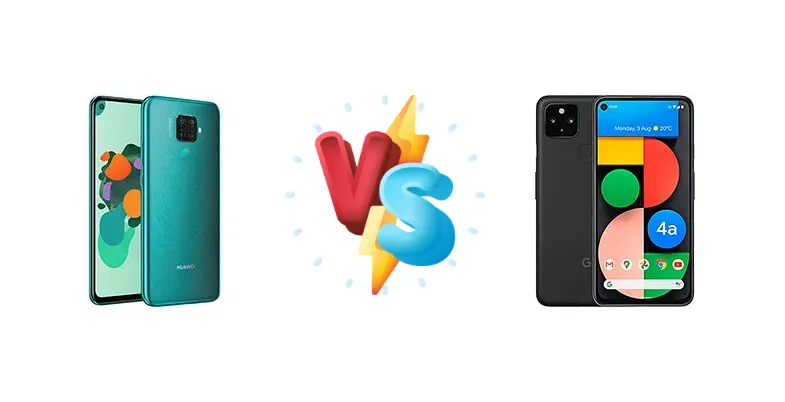
The Huawei Mate 30 Lite and Google Pixel 4a 5G represent compelling options in the increasingly crowded mid-range 5G smartphone market. While both aim to deliver 5G connectivity at a reasonable price, they take distinctly different approaches to achieving this, primarily through their chipset choices and software philosophies. This comparison dissects these differences to determine which device offers the best overall experience.
🏆 Quick Verdict
For the average user prioritizing consistent performance, software support, and camera quality, the Google Pixel 4a 5G is the better choice. Its Snapdragon 765G chipset and Google's computational photography provide a smoother, more reliable experience, despite the Mate 30 Lite's slightly faster charging.
| Network |
|---|
| 2G bands | GSM 850 / 900 / 1800 / 1900 | GSM 850 / 900 / 1800 / 1900 |
| 3G bands | HSDPA 800 / 850 / 900 / 1700(AWS) / 2100 | HSDPA 850 / 900 / 1700(AWS) / 1900 / 2100 |
| 4G bands | LTE | 1, 2, 3, 4, 5, 7, 8, 12, 13, 14, 17, 18, 19, 20, 25, 26, 28, 29, 30, 32, 38, 39, 40, 41, 42, 46, 48, 66, 71 |
| 5G bands | - | 1, 2, 3, 5, 7, 8, 12, 28, 41, 66, 71, 77, 78 Sub6, mmWave (market dependant) |
| Speed | HSPA, LTE | HSPA, LTE, 5G |
| Technology | GSM / HSPA / LTE | GSM / HSPA / LTE / 5G |
| Launch |
|---|
| Announced | Not announced yet | 2020, September 30 |
| Status | Cancelled | Available. Released 2020, November 05 |
| Body |
|---|
| Build | - | Glass front (Gorilla Glass 3), plastic back, plastic frame |
| Dimensions | 156.1 x 73.9 x 8.3 mm (6.15 x 2.91 x 0.33 in) | 153.9 x 74 x 8.2 mm (Sub-6) or 8.5 mm (Sub-6 and mmWave) |
| SIM | · Nano-SIM· Nano-SIM + Nano-SIM | Nano-SIM + eSIM |
| Weight | 178 g (6.28 oz) | 168 g (5G Sub-6); 171 g ( 5G Sub-6 and mmWave) (5.93 oz) |
| Display |
|---|
| Protection | - | Corning Gorilla Glass 3 |
| Resolution | 1080 x 2340 pixels, 19.5:9 ratio (~412 ppi density) | 1080 x 2340 pixels, 19.5:9 ratio (~413 ppi density) |
| Size | 6.26 inches, 96.2 cm2 (~83.4% screen-to-body ratio) | 6.2 inches, 95.7 cm2 (~84.1% screen-to-body ratio) |
| Type | IPS LCD | OLED, HDR |
| | - | Always-on display |
| Platform |
|---|
| CPU | Octa-core (2x2.27 GHz Cortex-A76 & 6x1.88 GHz Cortex-A55) | Octa-core (1x2.4 GHz Kryo 475 Prime & 1x2.2 GHz Kryo 475 Gold & 6x1.8 GHz Kryo 475 Silver) |
| Chipset | Kirin 810 (7 nm) | Qualcomm SM7250 Snapdragon 765G 5G (7 nm) |
| GPU | Mali-G52 MP6 | Adreno 620 |
| OS | Android 9.0 (Pie), EMUI 9.1 | Android 11, upgradable to Android 14 |
| Memory |
|---|
| Card slot | Nano Memory (uses shared SIM slot) | No |
| Internal | 128GB 6GB RAM | 128GB 6GB RAM |
| | - | UFS 2.1 |
| Main Camera |
|---|
| Dual | - | 12.2 MP, f/1.7, 27mm (wide), 1/2.55", 1.4µm, dual pixel PDAF, OIS
16 MP, f/2.2, 107˚ (ultrawide), 1.0µm |
| Features | LED flash, HDR, panorama | LED flash, Pixel Shift, Auto-HDR, panorama |
| Quad | 48 MP, f/1.8, 26mm (wide), 1/2.0", 0.8µm, PDAF
8 MP, f/2.2, 13mm (ultrawide)
2 MP (macro)
Auxiliary lens | - |
| Video | 4K@30fps, 1080p@30fps | 4K@30/60fps, 1080p@30/60/120/240fps; gyro-EIS |
| Selfie camera |
|---|
| Features | HDR | HDR |
| Single | 32 MP, f/2.0, 26mm (wide), 1/2.8", 0.8µm | 8 MP, f/2.0, 24mm (wide), 1/4.0", 1.12µm |
| Video | 1080p@30fps | 1080p@30fps |
| Sound |
|---|
| 3.5mm jack | Yes | Yes |
| 35mm jack | Yes | Yes |
| Loudspeaker | Yes | Yes, with stereo speakers |
| Comms |
|---|
| Bluetooth | 5.0, A2DP, LE | 5.0, A2DP, LE, aptX HD |
| NFC | No | Yes |
| Positioning | GPS, GLONASS, GALILEO, QZSS, BDS | GPS, GLONASS, GALILEO, QZSS, BDS |
| Radio | FM radio | No |
| USB | USB Type-C 2.0, OTG | USB Type-C 3.1 |
| WLAN | Wi-Fi 802.11 a/b/g/n/ac, dual-band, Wi-Fi Direct | Wi-Fi 802.11 a/b/g/n/ac, dual-band, Wi-Fi Direct |
| Features |
|---|
| Sensors | Fingerprint (rear-mounted), accelerometer, gyro, proximity, compass | Fingerprint (rear-mounted), accelerometer, gyro, proximity, compass, barometer |
| Battery |
|---|
| Charging | 20W wired | 18W wired, PD2.0 |
| Type | Li-Po 4000 mAh, non-removable | Li-Po 3885 mAh |
| Misc |
|---|
| Colors | Black, Aurora, Emerald Green | Just Black, Clearly White |
| Models | SPL-AL00, SPL-TL00 | GD1YQ, G025I, G025E, G025H, G6QU3 |
| Price | About 400 EUR | About 140 EUR |
Huawei Mate 30 Lite
- Faster 20W wired charging
- Potentially lower price point (depending on region)
- Huawei’s EMUI offers customization options
- Less consistent performance compared to Snapdragon
- Software updates are less frequent and reliable
- Lacks Google Mobile Services (GMS) in some regions
Google Pixel 4a 5G
- Superior performance with Snapdragon 765G
- Clean Android experience with guaranteed updates
- Excellent camera quality thanks to Google’s software
- Slower 18W charging
- Potentially higher price point
- May lack expandable storage
Display Comparison
Neither device boasts a particularly standout display. While specific panel details (like OLED vs. LCD) aren't provided, both target the mid-range segment. The core difference lies in processing power impacting display responsiveness. The Snapdragon 765G’s image signal processor (ISP) likely contributes to slightly more accurate color reproduction on the Pixel 4a 5G. Bezels are expected to be comparable, typical of this price bracket. Without specific brightness data, it’s difficult to declare a clear winner, but Google’s software optimizations often yield better viewing experiences even on similar hardware.
Camera Comparison
The Pixel 4a 5G leverages Google’s renowned computational photography prowess. While sensor sizes aren’t specified, the Pixel’s strength lies in its software algorithms, which excel at dynamic range, noise reduction, and detail preservation. The Kirin 810’s ISP is capable, but lacks the same level of refinement. Huawei often relies on megapixel count for marketing, but the Pixel’s image processing consistently outperforms competitors with similar or even higher megapixel sensors. The Pixel 4a 5G’s 5G connectivity also enables faster uploads for sharing photos and videos. We can assume both phones have a standard wide and ultrawide lens setup, but the Pixel's processing will likely be the deciding factor.
Performance
The chipset battle is central here. The Google Pixel 4a 5G’s Qualcomm Snapdragon 765G (7nm) features a Kryo 475 Prime core clocked at 2.4GHz, designed for peak performance, alongside a Kryo 475 Gold and six Silver cores for efficiency. This contrasts with the Huawei Mate 30 Lite’s Kirin 810 (7nm) which utilizes a dual-cluster approach with two Cortex-A76 cores at 2.27GHz and six Cortex-A55 cores at 1.88GHz. While both are 7nm chips, Qualcomm’s architecture generally delivers superior sustained performance and GPU capabilities. The Pixel 4a 5G benefits from Qualcomm’s Adreno 620 GPU, likely providing a smoother gaming experience than the Kirin 810’s Mali-G52 MP6. The Snapdragon’s more efficient core design also suggests better thermal management under sustained load.
Battery Life
The Huawei Mate 30 Lite’s 20W wired charging offers a slight advantage in terms of raw charging speed over the Pixel 4a 5G’s 18W charging with PD2.0. However, the Pixel’s more efficient Snapdragon 765G chipset likely translates to better overall battery life. While mAh capacities aren’t provided, the combination of hardware and software optimization on the Pixel 4a 5G should result in comparable, if not slightly longer, real-world usage times. The inclusion of PD2.0 on the Pixel also allows for faster charging with compatible chargers.
Buying Guide
Buy the Huawei Mate 30 Lite if you prioritize fast charging and are comfortable with Huawei’s EMUI software ecosystem, and don't rely heavily on Google services. Buy the Google Pixel 4a 5G if you value a clean Android experience, superior camera performance driven by Google’s image processing, and guaranteed software updates, even if it means slightly slower charging speeds.
Frequently Asked Questions
❓ Does the Kirin 810 in the Mate 30 Lite struggle with demanding games like PUBG or Call of Duty?
The Kirin 810 is capable of running these games, but you may need to lower graphics settings to maintain a stable frame rate. The Snapdragon 765G in the Pixel 4a 5G offers a smoother experience at higher settings due to its more powerful GPU and optimized thermal management.
❓ How does the lack of Google Mobile Services (GMS) on some Mate 30 Lite models affect usability?
Without GMS, you won't have access to popular apps like Gmail, YouTube, and Google Maps directly from the Play Store. Huawei provides its own AppGallery and workarounds, but the experience isn't as seamless, and some apps may not be available or function correctly.
❓ Is the 5G connectivity on both phones equally reliable?
Both phones support 5G, but the Snapdragon 765G in the Pixel 4a 5G generally offers broader 5G band support, potentially leading to better connectivity in more regions. Qualcomm’s modem technology is also known for its efficiency.
❓ How long will the Pixel 4a 5G receive software and security updates?
Google typically provides at least three years of Android OS updates and five years of security updates for its Pixel phones, ensuring long-term software support and security for the Pixel 4a 5G.