
Huawei Mate 30 5G vs Samsung Galaxy S20 5G UW: A Head-to-Head Flagship Battle
| Phones Images | |||||
|---|---|---|---|---|---|
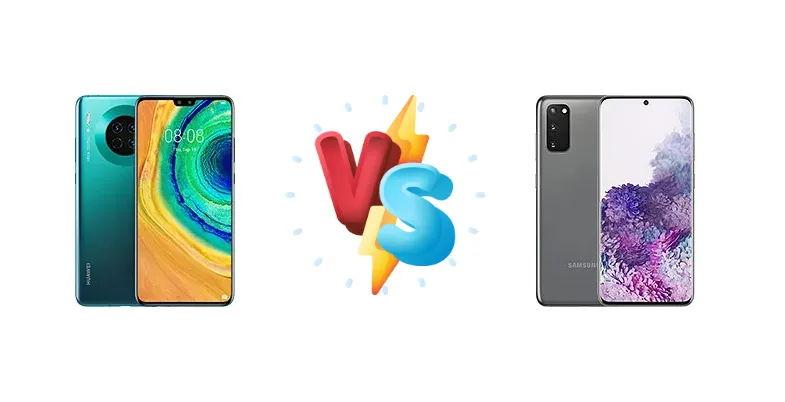
|
🏆 Quick Verdict
For the average user prioritizing raw performance and a more established software ecosystem, the Samsung Galaxy S20 5G UW emerges as the stronger choice. Its Snapdragon 865 offers a slight edge in CPU and GPU performance, coupled with wider 5G band support. However, the Mate 30 5G’s faster charging and potentially superior camera processing remain compelling advantages.
| PHONES | ||
|---|---|---|
| Phone Names | Huawei Mate 30 5G | Samsung Galaxy S20 5G UW |
| Network | ||
|---|---|---|
| 2G bands | GSM 850 / 900 / 1800 / 1900 | GSM 850 / 900 / 1800 / 1900 |
| 3G bands | HSDPA 800 / 850 / 900 / 1700(AWS) / 1900 / 2100 | HSDPA 850 / 900 / 1700(AWS) / 1900 / 2100 |
| 4G bands | 1, 2, 3, 4, 5, 6, 7, 8, 9, 12, 17, 18, 19, 20, 26, 34, 38, 39, 40, 41 | 2, 3, 4, 5, 7, 8, 13, 18, 19, 20, 26, 28, 48, 66 |
| 5G bands | 41, 77, 78, 79 NSA/Sub6 | 260, 261 mmWave |
| Speed | HSPA, LTE, 5G (2+ Gbps DL) | HSPA 42.2/5.76 Mbps, LTE (7CA) Cat20 2000/200 Mbps, 5G (5+ Gbps DL) |
| Technology | GSM / HSPA / LTE / 5G | GSM / CDMA / HSPA / EVDO / LTE / 5G |
| - | CDMA2000 1xEV-DO | |
| Launch | ||
|---|---|---|
| Announced | 2019, September. Released 2019, October | 2020, May 20 |
| Status | Discontinued | Available. Released 2020, June 04 |
| Body | ||
|---|---|---|
| Build | Glass front, glass back, aluminum frame | Glass front (Gorilla Glass 6), glass back (Gorilla Glass 6), aluminum frame |
| Dimensions | 160.8 x 76.1 x 8.4 mm (6.33 x 3.00 x 0.33 in) | 151.7 x 69.1 x 8.1 mm (5.97 x 2.72 x 0.32 in) |
| SIM | Nano-SIM + Nano-SIM | Nano-SIM (pre-installed) |
| Weight | 196 g (6.91 oz) | 168.1 g (5.93 oz) |
| IP53, dust and splash resistant | IP68 dust/water resistant (up to 1.5m for 30 min) | |
| Display | ||
|---|---|---|
| Protection | - | Corning Gorilla Glass 6 |
| Resolution | 1080 x 2340 pixels, 19.5:9 ratio (~389 ppi density) | 1440 x 3200 pixels, 20:9 ratio (~566 ppi density) |
| Size | 6.62 inches, 107.6 cm2 (~87.9% screen-to-body ratio) | 6.2 inches, 92.8 cm2 (~88.5% screen-to-body ratio) |
| Type | OLED, HDR10 | Dynamic AMOLED 2X, 120Hz, HDR10+, 1200 nits (peak) |
| - | Always-on display 120Hz@FHD/60Hz@QHD refresh rate | |
| Platform | ||
|---|---|---|
| CPU | Octa-core (2x2.86 GHz Cortex-A76 & 2x2.36 GHz Cortex-A76 & 4x1.95 GHz Cortex-A55) | Octa-core (1x2.84 GHz Cortex-A77 & 3x2.42 GHz Cortex-A77 & 4x1.80 GHz Cortex-A55) |
| Chipset | Kirin 990 5G (7 nm+) | Qualcomm SM8250 Snapdragon 865 5G (7 nm+) |
| GPU | Mali-G76 MP16 | Adreno 650 |
| OS | Android 10, EMUI 10, no Google Play Services | Android 10, One UI 2.5 |
| Memory | ||
|---|---|---|
| Card slot | Nano Memory (uses shared SIM slot) | No |
| Internal | 128GB 6GB RAM, 128GB 8GB RAM, 256GB 8GB RAM | 128GB 8GB RAM |
| UFS 3.0 | UFS 3.0 | |
| Main Camera | ||
|---|---|---|
| Features | Laser AF, Leica optics, dual-LED dual-tone flash, panorama, HDR | LED flash, auto-HDR, panorama |
| Triple | 40 MP, f/1.8, 27mm (wide), 1/1.54", PDAF 8 MP, f/2.4, 80mm (telephoto), 1/4.0", PDAF, OIS, 3x optical zoom 16 MP, f/2.2, 17mm (ultrawide) | 12 MP, f/1.8, 26mm (wide), 1/1.76", 1.8µm, dual pixel PDAF, OIS 64 MP, f/2.0, 29mm (telephoto), 1/1.72", 0.8µm, PDAF, OIS, 1.1x optical zoom, 3x hybrid zoom 12 MP, f/2.2, 13mm, 120˚ (ultrawide), 1/2.55" 1.4µm, Super Steady video |
| Video | 4K@30/60fps, 1080p@30/60/120fps, 720p@960fps, gyro-EIS | 8K@24fps, 4K@30/60fps, 1080p@30/60/240fps, 720p@960fps, HDR10+, stereo sound rec., gyro-EIS & OIS |
| Selfie camera | ||
|---|---|---|
| Features | HDR | HDR |
| Single | 24 MP, f/2.0, 26mm (wide), 1/2.8", 0.9µm TOF 3D, (depth/biometrics sensor) | 10 MP, f/2.2, 26mm (wide), 1/3.24", 1.22µm, dual pixel PDAF |
| Video | 1080p@30fps | 4K@30/60fps, 1080p@30fps |
| Sound | ||
|---|---|---|
| 3.5mm jack | Yes | No |
| 35mm jack | Yes | No |
| Loudspeaker | Yes, with stereo speakers | Yes, with stereo speakers |
| 32-bit/384kHz audio | 32-bit/384kHz audio Tuned by AKG | |
| Comms | ||
|---|---|---|
| Bluetooth | 5.1, A2DP, aptX HD, LE | 5.0, A2DP, LE |
| Infrared port | Yes | - |
| NFC | Yes | Yes |
| Positioning | GPS (L1+L5), GLONASS (L1), BDS (B1), GALILEO (E1+E5a), QZSS (L1+L5) | GPS, GLONASS, BDS, GALILEO |
| Radio | No | FM radio |
| USB | USB Type-C 3.1, OTG | USB Type-C 3.2, OTG |
| WLAN | Wi-Fi 802.11 a/b/g/n/ac, dual-band, DLNA, Wi-Fi Direct | Wi-Fi 802.11 a/b/g/n/ac/6, dual-band, Wi-Fi Direct |
| Features | ||
|---|---|---|
| Sensors | Face ID, fingerprint (under display, optical), accelerometer, gyro, proximity, barometer, compass | Fingerprint (under display, ultrasonic), accelerometer, gyro, proximity, compass, barometer |
| - | Samsung DeX, Samsung Wireless DeX (desktop experience support) ANT+ Bixby natural language commands and dictation Samsung Pay (Visa, MasterCard certified) | |
| Battery | ||
|---|---|---|
| Charging | 40W wired 27W wireless Reverse wireless | 25W wired, PD3.0 15W wireless (Qi) 4.5W reverse wireless |
| Type | Li-Po 4200 mAh, non-removable | Li-Ion 4000 mAh |
| Misc | ||
|---|---|---|
| Colors | Black, Space Silver, Cosmic Purple, Emerald Green, Orange, Forest Green | Cloud Pink, Cosmic Grey, Cloud White |
| Models | TAS-AN00, TAS-TN00 | SM-G981V |
| Price | About 650 EUR | About 880 EUR |
| SAR | - | 0.91 W/kg (head) 1.05 W/kg (body) |
Huawei Mate 30 5G
- Significantly faster 40W wired charging
- Superior wireless and reverse wireless charging capabilities
- Potentially more advanced camera processing due to Kirin 990 5G’s NPU
- EMUI software may not appeal to all users
- Potential 5G band limitations depending on region
Samsung Galaxy S20 5G UW
- Stronger CPU and GPU performance with Snapdragon 865
- Wider 5G band support for greater compatibility
- More refined and widely adopted One UI software experience
- Slower 25W wired charging
- Lower wireless charging speed (15W)
Display Comparison
While both devices feature OLED panels, specific details like resolution and refresh rate aren't provided. However, the focus here is on processing power. The Samsung S20 5G UW likely benefits from the Snapdragon 865’s image signal processor (ISP) for potentially more accurate color reproduction and faster image processing from the display. The lack of detailed display specs makes a direct comparison difficult, but Samsung historically excels in display technology.
Camera Comparison
Without detailed sensor specifications, a direct camera comparison is challenging. However, Huawei historically prioritizes computational photography, and the Kirin 990 5G’s dedicated Neural Processing Unit (NPU) likely plays a significant role in image processing. The Snapdragon 865 also has a powerful ISP, but Samsung’s image processing tends to be more natural, while Huawei often aims for more vibrant, saturated results. The absence of information on sensor sizes and lens apertures prevents a definitive judgment, but Huawei’s reputation for camera innovation suggests a strong contender.
Performance
The core of the difference lies in the chipsets. The Samsung Galaxy S20 5G UW’s Snapdragon 865 (7nm+) boasts a Cortex-A77 prime core clocked at 2.84 GHz, while the Huawei Mate 30 5G utilizes the Kirin 990 5G (7nm+) with a slightly higher clocked Cortex-A76 (2.86 GHz). However, the Snapdragon 865’s architecture, particularly its Adreno 650 GPU, generally delivers superior graphics performance. The Kirin 990 5G’s CPU configuration, with two A76 cores, is balanced, but the Snapdragon’s single, faster A77 core and three additional A77 cores provide a performance advantage in multi-threaded tasks. Both utilize LPDDR4X RAM, but the Snapdragon’s optimized memory controller contributes to overall system responsiveness.
Battery Life
The Huawei Mate 30 5G’s 40W wired charging is a clear advantage over the Samsung Galaxy S20 5G UW’s 25W charging, promising significantly faster top-ups. The Mate 30 5G also offers 27W wireless charging and reverse wireless charging, while the S20 5G UW is limited to 15W wireless (Qi) and 4.5W reverse wireless. While battery capacity isn’t specified, the faster charging speeds of the Mate 30 5G mitigate any potential capacity disadvantage, offering more convenient power management for users on the go.
Buying Guide
Buy the Huawei Mate 30 5G if you prioritize exceptionally fast charging (40W wired, 27W wireless) and are comfortable with Huawei’s EMUI software, potentially benefiting from their advanced camera algorithms. Buy the Samsung Galaxy S20 5G UW if you value a more universally compatible 5G experience, a smoother software experience with One UI, and a slightly more powerful processor for demanding tasks like gaming and video editing.