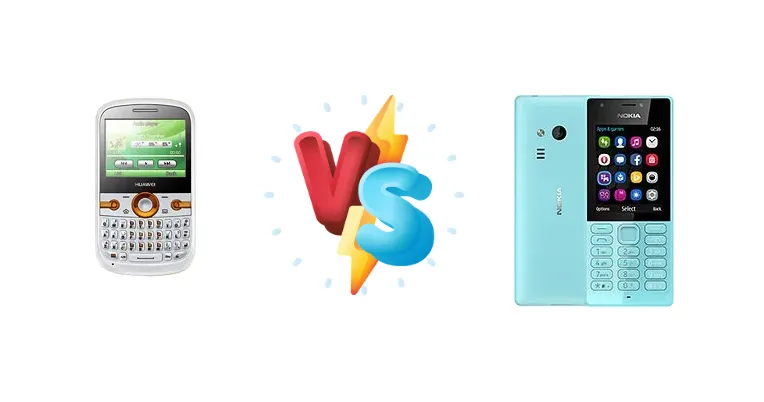
In a world dominated by smartphones, the feature phone remains a vital tool for those prioritizing simplicity, reliability, and extended battery life. We pit the Huawei G6620 against the Nokia 216, two representatives of this enduring segment, to determine which offers the best blend of functionality and value for users seeking essential communication.
🏆 Quick Verdict
For the average user needing a dependable, long-lasting phone for calls and texts, the Nokia 216 emerges as the slightly stronger choice. Nokia’s established reputation for durability and user-friendly interface, combined with its typically robust build quality, provides a more reassuring experience than the relatively unknown Huawei G6620.
| Network |
|---|
| 2G bands | GSM 850 / 900 / 1800 / 1900 - SIM 1 | GSM 900 / 1800 - SIM 1 & SIM 2 (dual-SIM model only) |
| EDGE | No | Up to 236.8 kbps |
| GPRS | Class 12 | Up to 85.6 kbps |
| Technology | GSM | GSM |
| | GSM 850 / 900 / 1800 / 1900 - SIM 2 | - |
| Launch |
|---|
| Announced | 2011, July | 2016, September. Released 2016, October |
| Status | Discontinued | Discontinued |
| Body |
|---|
| Build | - | Glass front, plastic back, plastic frame |
| Dimensions | 108 x 59 x 12 mm (4.25 x 2.32 x 0.47 in) | 118 x 50.2 x 13.5 mm, 71.7 cc (4.65 x 1.98 x 0.53 in) |
| Keyboard | QWERTY | - |
| SIM | Dual SIM (Mini-SIM) | Single SIM (Mini-SIM) or Dual SIM (Mini-SIM, dual stand-by) |
| Weight | - | 82.6 (2.93 oz) |
| | - | Flashlight |
| Display |
|---|
| Resolution | 320 x 240 pixels, 4:3 ratio (~167 ppi density) | 240 x 320 pixels, 4:3 ratio (~167 ppi density) |
| Size | 2.4 inches, 17.8 cm2 (~28.0% screen-to-body ratio) | 2.4 inches, 17.8 cm2 (~30.1% screen-to-body ratio) |
| Type | TFT, 256K colors | TFT |
| Memory |
|---|
| Call records | Yes | Yes |
| Card slot | microSDHC (dedicated slot) | microSDHC (dedicated slot) |
| Internal | - | 16MB RAM |
| Phonebook | Yes, Photocall | 2000 entries |
| Main Camera |
|---|
| Features | - | LED flash |
| Single | 1.3 MP | VGA |
| Video | - | 240p@15fps |
| Selfie camera |
|---|
| Single | - | VGA, LED flash |
| | No | - |
| Sound |
|---|
| 3.5mm jack | Yes | Yes |
| 35mm jack | Yes | Yes |
| Loudspeaker | Yes | Yes |
| | SRS audio | - |
| Comms |
|---|
| Bluetooth | 2.0, A2DP | 3.0, A2DP |
| NFC | - | No |
| Positioning | No | No |
| Radio | FM radio | Stereo FM radio |
| USB | microUSB 2.0 | microUSB 1.1 |
| WLAN | No | No |
| Features |
|---|
| Games | Yes | Yes |
| Java | Yes | - |
| Messaging | SMS, MMS, Email, IM | SMS, MMS |
| | Facebook, Twitter, MSN applications
MP3/AAC player
MP4/H.263 player
Organizer
Voice memo | SNS applications
MP4/H.264 player
MP3/WAV/AAC player
Organizer
Voice memo |
| Battery |
|---|
| Music play | - | Up to 47 h |
| Stand-by | - | Up to 456 h |
| Talk time | - | Up to 18 h |
| Type | Removable Li-Ion 800 mAh battery | Li-Ion 1020 mAh, removable |
| Misc |
|---|
| Colors | Gray, Blue, Orange | Black, Gray, Mint |
| Price | About 70 EUR | About 40 EUR |
| SAR EU | - | 1.01 W/kg (head) 1.07 W/kg (body) |
Huawei G6620
- Potential for lower price point.
- Dual SIM capability for cost savings or travel.
- Huawei's telecommunications expertise.
- Limited brand recognition in feature phones.
- Uncertain build quality and long-term support.
Nokia 216
- Nokia's reputation for durability and reliability.
- Simple and intuitive Series 30+ interface.
- Excellent battery life and standby time.
- Basic feature set with limited functionality.
- Lower camera quality compared to even entry-level smartphones.
Display Comparison
Given the lack of specific display data, we can infer both devices utilize basic color LCD screens, likely with resolutions around QVGA (240x320). The Nokia 216, historically, has focused on readability in direct sunlight, suggesting a potentially brighter panel than the G6620. However, without concrete nit measurements, this remains speculative. Both screens will prioritize power efficiency over visual fidelity.
Camera Comparison
Both the Huawei G6620 and Nokia 216 are likely equipped with very basic cameras, probably VGA resolution. Image quality will be limited to simple snapshots in good lighting conditions. The primary function of these cameras is not photography, but rather providing a convenient way to capture quick visual references. Focusing on megapixel counts is irrelevant; image processing and sensor size (both likely very small) are the limiting factors.
Performance
Neither device features a traditional 'processor' in the smartphone sense. Performance is dictated by the efficiency of the baseband modem and the responsiveness of the feature phone operating system. Huawei, as a telecommunications giant, likely employs a competent modem in the G6620, but Nokia’s optimization of its Series 30+ platform for low-power operation could translate to a smoother user experience, particularly in areas with weaker signal strength. RAM is minimal on both, sufficient only for basic call handling and SMS.
Battery Life
This is where feature phones truly shine. Both the G6620 and 216 boast exceptional battery life, potentially lasting several days on a single charge with moderate use. The Nokia 216 is renowned for its long standby time, often exceeding a week. While the G6620 may offer a slightly larger capacity, Nokia’s software optimization likely provides comparable, if not superior, endurance. Charging times will be slow, utilizing micro-USB on both devices.
Buying Guide
Buy the Huawei G6620 if you need a secondary phone for travel or emergencies, prioritizing a potentially lower price point and dual SIM capability. Buy the Nokia 216 if you prefer a brand with a proven track record of reliability, a simple and intuitive interface, and a focus on core functionality like call quality and battery endurance. The Nokia 216 is ideal for users who want a phone that 'just works' without the complexities of a smartphone.
Frequently Asked Questions
❓ Is the Nokia 216 a good phone for elderly users?
Yes, the Nokia 216 is an excellent choice for elderly users. Its simple interface, large buttons, and clear call quality make it easy to use. The long battery life also reduces the need for frequent charging, and the FM radio provides entertainment without requiring data.
❓ Can the Huawei G6620 be used as a backup phone while traveling?
The Huawei G6620 is well-suited as a travel backup phone, particularly if you need dual SIM functionality to use a local SIM card. Its compact size and long battery life make it convenient to carry, and it can handle essential communication tasks without draining your smartphone's battery.
❓ Do either of these phones support internet access?
Both phones offer limited internet access via 2G connectivity. However, browsing will be extremely slow and data-intensive tasks are impractical. They are primarily designed for voice calls and SMS messaging, not web browsing.
❓ What type of charger do these phones use?
Both the Huawei G6620 and Nokia 216 utilize a micro-USB port for charging. They typically come with a basic micro-USB charger in the box, but charging speeds are slow compared to modern smartphones.