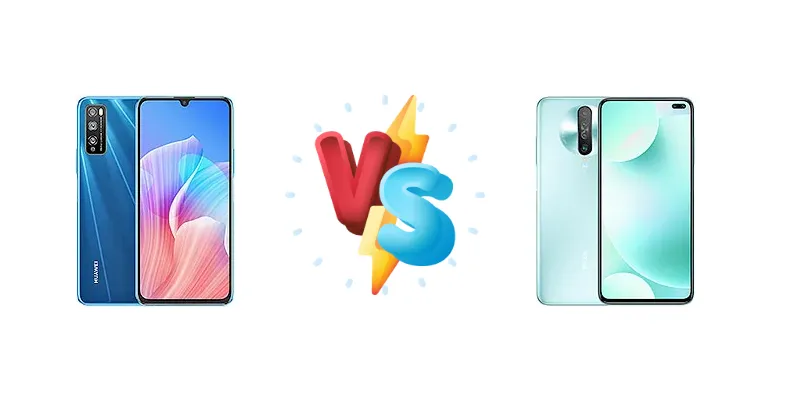
Both the Huawei Enjoy Z 5G and Xiaomi Redmi K30 5G Racing represent compelling options in the increasingly competitive mid-range 5G smartphone market. While both aim to deliver 5G connectivity at an accessible price point, they diverge significantly in their core hardware choices – specifically, their chipsets and charging capabilities. This comparison will dissect these differences to determine which device best suits your needs.
🏆 Quick Verdict
For the average user prioritizing faster charging and potentially more sustained gaming performance, the Xiaomi Redmi K30 5G Racing emerges as the stronger choice. Its Snapdragon 768G and 30W charging offer a tangible advantage over the Enjoy Z 5G’s Dimensity 800 and 22.5W charging, despite the Huawei’s potentially better software experience.
| Network |
|---|
| 2G bands | GSM 900 / 1800 / 1900 | GSM 850 / 900 / 1800 / 1900 |
| 3G bands | HSDPA 850 / 900 / 1700(AWS) / 1900 / 2100 | HSDPA 850 / 900 / 1900 / 2100 |
| 4G bands | LTE | 1, 3, 5, 7, 8, 34, 38, 39, 40, 41 |
| 5G bands | 1, 38, 41, 77, 78, 79 SA/NSA | 41, 78 SA/NSA/Sub6 |
| Speed | HSPA, LTE, 5G | HSPA, LTE, 5G (2+ Gbps DL) |
| Technology | GSM / HSPA / LTE / 5G | GSM / HSPA / LTE / 5G |
| Launch |
|---|
| Announced | 2020, May 24. Released 2020, June 03 | 2020, May 11. Released 2020, May 14 |
| Status | Discontinued | Discontinued |
| Body |
|---|
| Build | - | Glass front (Gorilla Glass 5), glass back (Gorilla Glass 5), aluminum frame |
| Dimensions | 160 x 75.3 x 8.4 mm (6.30 x 2.96 x 0.33 in) | 165.3 x 76.6 x 8.8 mm (6.51 x 3.02 x 0.35 in) |
| SIM | Nano-SIM + Nano-SIM | Nano-SIM + Nano-SIM |
| Weight | 182 g (6.42 oz) | 208 g (7.34 oz) |
| Display |
|---|
| Protection | - | Corning Gorilla Glass 5 |
| Resolution | 1080 x 2400 pixels, 20:9 ratio (~405 ppi density) | 1080 x 2400 pixels, 20:9 ratio (~395 ppi density) |
| Size | 6.5 inches, 102.0 cm2 (~84.7% screen-to-body ratio) | 6.67 inches, 107.4 cm2 (~84.8% screen-to-body ratio) |
| Type | IPS LCD, 90Hz | IPS LCD, 120Hz, HDR10 |
| Platform |
|---|
| CPU | Octa-core (4x2.0 GHz Cortex-A76 & 4x2.0 GHz Cortex-A55) | Octa-core (1x2.8 GHz Kryo 475 Prime & 1x2.2 GHz Kryo 475 Gold & 6x1.8 GHz Kryo 475 Silver) |
| Chipset | Mediatek Dimensity 800 (7 nm) | Qualcomm SDM768 Snapdragon 768G 5G (7 nm) |
| GPU | Mali-G57MP4 | Adreno 620 |
| OS | Android 10, EMUI 10.1, no Google Play Services | Android 10, MIUI 11 |
| Memory |
|---|
| Card slot | Nano Memory (uses shared SIM slot) | No |
| Internal | 64GB 6GB RAM, 128GB 6GB RAM, 128GB 8GB RAM | 128GB 6GB RAM |
| | - | UFS 2.1
|
| Main Camera |
|---|
| Features | LED flash, HDR, panorama | Dual-LED flash, HDR, panorama |
| Quad | - | 64 MP, f/1.9, 26mm (wide), 1/1.72", 0.8µm, PDAF
8 MP, f/2.2, 116˚ (ultrawide), 1/4.0", 1.12µm
5 MP (macro)
Auxiliary lens |
| Triple | 48 MP, f/1.8, 26mm (wide), 1/2.0", 0.8µm, PDAF
8 MP, f/2.4, 120˚ (ultrawide)
2 MP (macro) | - |
| Video | 4K@30fps, 1080p@30fps | 4K@30fps, 1080p@30/120fps, 720p@960fps; gyro-EIS |
| Selfie camera |
|---|
| Dual | - | 20 MP, f/2.2, 27mm (wide), 1/3.4", 0.8µm
2 MP, f/2.4, 1/5.0", 1.75µm, depth sensor |
| Features | HDR | HDR |
| Single | 16 MP, f/2.0 | - |
| Video | 1080p@30fps | 1080p@30fps |
| Sound |
|---|
| 3.5mm jack | Yes | Yes |
| 35mm jack | Yes | Yes |
| Loudspeaker | Yes | Yes |
| | - | 24-bit/192kHz audio
|
| Comms |
|---|
| Bluetooth | 5.1, A2DP, LE | 5.1, A2DP, LE, aptX HD |
| Infrared port | - | Yes |
| NFC | No | Yes |
| Positioning | GPS, GLONASS, BDS | GPS |
| Radio | No | FM radio |
| USB | USB Type-C 2.0, OTG | USB Type-C 2.0, OTG |
| WLAN | Wi-Fi 802.11 a/b/g/n/ac, dual-band, Wi-Fi Direct | Wi-Fi 802.11 a/b/g/n/ac, dual-band, Wi-Fi Direct |
| Features |
|---|
| Sensors | Fingerprint (side-mounted), accelerometer, gyro, proximity, compass | Fingerprint (side-mounted), accelerometer, gyro, proximity, compass |
| Battery |
|---|
| Charging | 22.5W wired | 30W wired, 100% in 57 min |
| Type | Li-Po 4000 mAh | Li-Po 4500 mAh |
| Misc |
|---|
| Colors | Breathing Crystal, Midnight Black, Dark Blue | Mint, Blue, Red, Purple, White |
| Models | DVC-AN00 | - |
| Price | About 220 EUR | About 260 EUR |
Huawei Enjoy Z 5G
- Potentially cleaner software experience (EMUI)
- Mediatek Dimensity 800 offers solid everyday performance
- Competitive 5G connectivity
- Slower 22.5W charging
- Less powerful GPU compared to Snapdragon 768G
- Potential for more thermal throttling under sustained load
Xiaomi Redmi K30 5G Racing
- Faster 30W charging (0-100% in 57 minutes)
- More powerful Snapdragon 768G chipset
- Superior GPU performance for gaming
- MIUI software can be resource-intensive
- Potential for bloatware
- May not have the same software polish as Huawei
Display Comparison
Neither device’s display specifications are provided, so a direct comparison is limited. However, given their market positioning, both likely feature LCD panels with 60Hz refresh rates. The Redmi K30 5G Racing, being slightly more premium, *may* have a marginally higher peak brightness. Color accuracy will likely be similar, leaning towards the saturated side typical of Chinese smartphone manufacturers. Bezels are expected to be moderate on both devices.
Camera Comparison
Without detailed camera specs, analysis is limited. Both phones likely feature multi-camera setups, but the quality will depend heavily on sensor size and image processing. Given the Redmi K30 5G Racing’s slightly higher market positioning, it *may* have a larger main sensor, resulting in better low-light performance. Image processing styles will differ – Huawei typically aims for vibrant, saturated colors, while Xiaomi often leans towards a more natural look. The presence of OIS (Optical Image Stabilization) is unknown for both, but would be a significant advantage if present.
Performance
The core difference lies in the chipsets. The Xiaomi Redmi K30 5G Racing’s Qualcomm Snapdragon 768G (7nm) boasts a Kryo 475 Prime core clocked at 2.8GHz, offering a significant single-core performance advantage over the Huawei Enjoy Z 5G’s Mediatek Dimensity 800 (7nm). The Dimensity 800 utilizes a more traditional Cortex-A76/A55 configuration with a peak clock of 2.0GHz. While both are 7nm chips, Qualcomm’s architecture generally provides better sustained performance and GPU capabilities. The 768G’s Adreno 620 GPU will outperform the Dimensity 800’s Mali-G52 MC4 in graphically intensive tasks like gaming. The Redmi K30 5G Racing is likely to exhibit less thermal throttling during prolonged gaming sessions.
Battery Life
Battery capacity isn’t specified, but both likely fall in the 4500-5000mAh range. However, the Redmi K30 5G Racing’s 30W wired charging is a clear advantage over the Enjoy Z 5G’s 22.5W charging. Xiaomi claims a 0-100% charge in 57 minutes, while the Enjoy Z 5G will likely take considerably longer. This faster charging is a significant convenience factor for users who frequently need to top up their battery quickly. Even with a slightly smaller battery, the Redmi K30 5G Racing’s faster charging could result in more usable uptime throughout the day.
Buying Guide
Buy the Huawei Enjoy Z 5G if you prioritize a potentially cleaner software experience (depending on your region and preference for EMUI) and are less concerned with pushing the phone to its performance limits for extended periods. Buy the Xiaomi Redmi K30 5G Racing if you value faster charging speeds, a more powerful GPU for gaming, and a chipset known for its efficiency in handling demanding tasks, even if it means navigating Xiaomi’s MIUI.
Frequently Asked Questions
❓ Will the Snapdragon 768G in the Redmi K30 5G Racing handle demanding games like PUBG Mobile at high settings?
Yes, the Snapdragon 768G is well-equipped to handle PUBG Mobile at high settings. Its Adreno 620 GPU provides ample graphical power, and the chipset’s efficient thermal design should minimize throttling during extended gaming sessions. Expect smooth frame rates and a responsive gaming experience.
❓ How does the charging speed difference impact daily use? Is 30W charging *really* that much faster than 22.5W?
The 30W charging on the Redmi K30 5G Racing is noticeably faster. Xiaomi claims a full charge in 57 minutes, while the Enjoy Z 5G will likely take over an hour and fifteen minutes. This translates to a significant time saving, especially for users who frequently need to quickly top up their battery before leaving the house or during short breaks.
❓ Is the software experience on the Huawei Enjoy Z 5G affected by the US trade restrictions?
Potentially. The Huawei Enjoy Z 5G runs EMUI, which does not include Google Mobile Services (GMS). This means no pre-installed Google apps like Gmail, YouTube, or the Play Store. Users will need to rely on Huawei’s AppGallery and sideloading apps, which can be a less seamless experience for some.