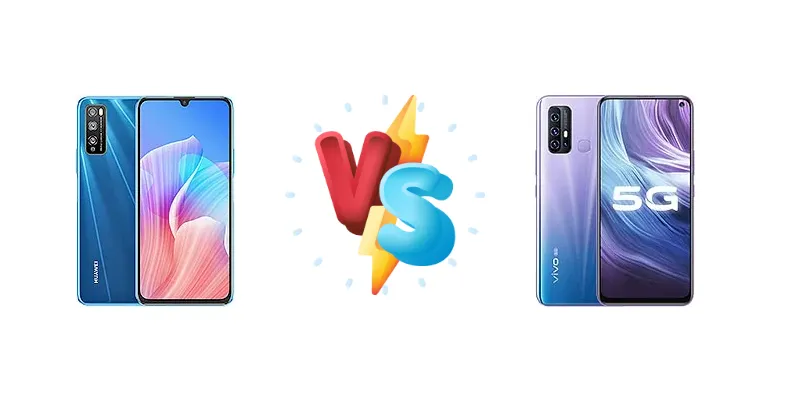
Both the Huawei Enjoy Z 5G and vivo Z6 5G represent compelling options in the increasingly competitive mid-range 5G smartphone market. While both aim to deliver 5G connectivity at an accessible price point, they diverge significantly in their core hardware choices – specifically, their chipsets and charging capabilities. This comparison will dissect these differences to determine which device best suits your needs.
🏆 Quick Verdict
For the average user prioritizing fast charging and potentially smoother gaming, the vivo Z6 5G emerges as the stronger contender. Its 44W charging significantly reduces downtime, and the Snapdragon 765G offers a slight edge in GPU performance. However, the Enjoy Z 5G remains a viable option for those heavily invested in the Huawei ecosystem.
| Network |
|---|
| 2G bands | GSM 900 / 1800 / 1900 | GSM 850 / 900 / 1800 / 1900 |
| 3G bands | HSDPA 850 / 900 / 1700(AWS) / 1900 / 2100 | HSDPA 850 / 900 / 1700(AWS) / 2100 |
| 4G bands | LTE | 1, 3, 4, 5, 8, 39, 40, 41 |
| 5G bands | 1, 38, 41, 77, 78, 79 SA/NSA | 1, 3, 41, 77, 78 SA/NSA |
| Speed | HSPA, LTE, 5G | HSPA, LTE, 5G |
| Technology | GSM / HSPA / LTE / 5G | GSM / CDMA / HSPA / EVDO / LTE / 5G |
| | - | CDMA2000 1xEV-DO |
| Launch |
|---|
| Announced | 2020, May 24. Released 2020, June 03 | 2020, February 28. Released 2020, February 29 |
| Status | Discontinued | Discontinued |
| Body |
|---|
| Dimensions | 160 x 75.3 x 8.4 mm (6.30 x 2.96 x 0.33 in) | 164 x 75.1 x 9.2 mm (6.46 x 2.96 x 0.36 in) |
| SIM | Nano-SIM + Nano-SIM | Nano-SIM + Nano-SIM |
| Weight | 182 g (6.42 oz) | 201 g (7.09 oz) |
| Display |
|---|
| Resolution | 1080 x 2400 pixels, 20:9 ratio (~405 ppi density) | 1080 x 2400 pixels, 20:9 ratio (~401 ppi density) |
| Size | 6.5 inches, 102.0 cm2 (~84.7% screen-to-body ratio) | 6.57 inches, 104.2 cm2 (~84.6% screen-to-body ratio) |
| Type | IPS LCD, 90Hz | IPS LCD |
| Platform |
|---|
| CPU | Octa-core (4x2.0 GHz Cortex-A76 & 4x2.0 GHz Cortex-A55) | Octa-core (1x2.4 GHz Kryo 475 Prime & 1x2.2 GHz Kryo 475 Gold & 6x1.8 GHz Kryo 475 Silver) |
| Chipset | Mediatek Dimensity 800 (7 nm) | Qualcomm SM7250 Snapdragon 765G 5G (7 nm) |
| GPU | Mali-G57MP4 | Adreno 620 |
| OS | Android 10, EMUI 10.1, no Google Play Services | Android 10, Funtouch 10.0 |
| Memory |
|---|
| Card slot | Nano Memory (uses shared SIM slot) | microSDXC (dedicated slot) |
| Internal | 64GB 6GB RAM, 128GB 6GB RAM, 128GB 8GB RAM | 128GB 6GB RAM, 128GB 8GB RAM |
| | - | UFS 2.1 |
| Main Camera |
|---|
| Features | LED flash, HDR, panorama | LED flash, HDR, panorama |
| Quad | - | 48 MP, f/1.8, (wide), 1/2.0", 0.8µm, PDAF
8 MP, f/2.2, 13mm (ultrawide), 1/4.0", 1.12µm
2 MP (macro)
Auxiliary lens |
| Triple | 48 MP, f/1.8, 26mm (wide), 1/2.0", 0.8µm, PDAF
8 MP, f/2.4, 120˚ (ultrawide)
2 MP (macro) | - |
| Video | 4K@30fps, 1080p@30fps | 4K@30fps, 1080p@30fps |
| Selfie camera |
|---|
| Features | HDR | HDR |
| Single | 16 MP, f/2.0 | 16 MP, f/2.5, (wide) |
| Video | 1080p@30fps | 1080p@30fps |
| Sound |
|---|
| 3.5mm jack | Yes | Yes |
| 35mm jack | Yes | Yes |
| Loudspeaker | Yes | Yes |
| Comms |
|---|
| Bluetooth | 5.1, A2DP, LE | 5.1, A2DP, LE, aptX HD |
| NFC | No | No |
| Positioning | GPS, GLONASS, BDS | - |
| Radio | No | FM radio |
| USB | USB Type-C 2.0, OTG | USB Type-C 2.0, OTG |
| WLAN | Wi-Fi 802.11 a/b/g/n/ac, dual-band, Wi-Fi Direct | Wi-Fi 802.11 a/b/g/n/ac/6, dual-band, Wi-Fi Direct |
| Features |
|---|
| Sensors | Fingerprint (side-mounted), accelerometer, gyro, proximity, compass | Fingerprint (rear-mounted), accelerometer, gyro, proximity, compass |
| Battery |
|---|
| Charging | 22.5W wired | 44W wired, 70% in 35 min |
| Type | Li-Po 4000 mAh | 5000 mAh |
| Misc |
|---|
| Colors | Breathing Crystal, Midnight Black, Dark Blue | Ice Age, Interstellar Silver, Aurora Black |
| Models | DVC-AN00 | V1963A |
| Price | About 220 EUR | About 300 EUR |
Huawei Enjoy Z 5G
- Potentially better Huawei ecosystem integration
- Reliable Mediatek Dimensity 800 performance
- Competitive price point
- Significantly slower 22.5W charging
- Potentially less optimized gaming performance
- Software restrictions due to Huawei's situation
vivo Z6 5G
- Faster 44W charging with quick top-up times
- Slightly more powerful Snapdragon 765G GPU
- More open software environment
- May lack the same level of Huawei ecosystem integration
- Potential for slightly higher price
- Qualcomm's software support timeline can be shorter than MediaTek's
Display Comparison
Neither device boasts a standout display. Given the context data focuses on internal components, we can infer both likely utilize LCD panels common in this price bracket. The absence of specifications like refresh rate or peak brightness suggests neither prioritizes display quality as a key selling point. Bezels are likely comparable, aiming for maximizing screen real estate within the budget constraints. Color accuracy will likely be standard for the segment, leaning towards vibrant rather than color-accurate.
Camera Comparison
Without detailed camera specifications, a direct comparison is limited. However, the market segment suggests both phones likely feature a multi-camera setup with a primary sensor around 48MP. The Snapdragon 765G’s image signal processor (ISP) generally offers superior image processing capabilities, potentially resulting in better dynamic range and low-light performance on the vivo Z6 5G. The absence of OIS information suggests neither phone prioritizes optical image stabilization, relying instead on software-based stabilization. Any secondary cameras (ultrawide, macro, depth) are likely to be of similar quality on both devices.
Performance
The core difference lies in the chipsets: the Huawei Enjoy Z 5G features the Mediatek Dimensity 800 (7nm), while the vivo Z6 5G utilizes the Qualcomm Snapdragon 765G (7nm). The Snapdragon 765G’s CPU configuration – a 1x2.4 GHz Kryo 475 Prime core, 1x2.2 GHz Kryo 475 Gold core, and 6x1.8 GHz Kryo 475 Silver cores – suggests a focus on burst performance and efficient multi-tasking. The Dimensity 800’s octa-core setup (4x2.0 GHz Cortex-A76 & 4x2.0 GHz Cortex-A55) offers consistent performance across all cores. While both are 7nm chips, the Snapdragon 765G generally exhibits a slight advantage in GPU performance, benefiting users who engage in mobile gaming. The vivo Z6 5G’s potential for higher sustained performance is further enhanced by Qualcomm’s established thermal management solutions.
Battery Life
The vivo Z6 5G’s 44W wired charging is a significant advantage over the Huawei Enjoy Z 5G’s 22.5W charging. The vivo Z6 5G claims a 70% charge in just 35 minutes, drastically reducing downtime. While battery capacity isn’t specified, the faster charging speed effectively mitigates any potential capacity difference. The Enjoy Z 5G will require considerably longer to fully charge, impacting usability for power users. This difference in charging speed is a key differentiator for users who frequently top up their phones throughout the day.
Buying Guide
Buy the Huawei Enjoy Z 5G if you prioritize a streamlined Huawei software experience and are comfortable with potentially slower charging speeds. Buy the vivo Z6 5G if you value faster charging, a slightly more powerful GPU for gaming, and a more open software environment. Both phones are excellent choices for users entering the 5G space on a budget, but their strengths cater to different priorities.
Frequently Asked Questions
❓ Will the Snapdragon 765G in the vivo Z6 5G handle demanding games like PUBG Mobile at high settings?
The Snapdragon 765G is capable of running PUBG Mobile at high settings with reasonably stable frame rates. While it won't match the performance of flagship chipsets, it provides a smooth gaming experience for most users. The Adreno 620 GPU offers a noticeable advantage over the Mali-G52 MC3 in the Dimensity 800 for graphically intensive titles.
❓ How much faster is the 44W charging on the vivo Z6 5G compared to the 22.5W charging on the Huawei Enjoy Z 5G in real-world use?
The vivo Z6 5G’s 44W charging can take a phone from 0% to 70% in approximately 35 minutes, while the Huawei Enjoy Z 5G’s 22.5W charging will likely take over 90 minutes to reach the same charge level. This difference is substantial for users who need a quick power boost throughout the day.
❓ Does the Huawei Enjoy Z 5G support Huawei’s SuperCharge protocol, and will it work with existing Huawei chargers?
While the Enjoy Z 5G supports 22.5W charging, it doesn't necessarily utilize the full SuperCharge protocol found in Huawei's flagship devices. It will work with standard USB-PD chargers, but using a Huawei 22.5W charger will likely provide optimal charging performance.