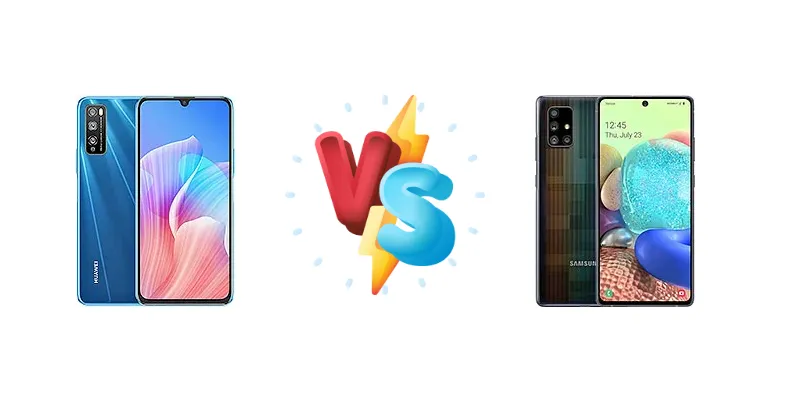
Both the Huawei Enjoy Z 5G and the Samsung Galaxy A71 5G UW represent attempts to bring 5G connectivity to a more accessible price point. However, they achieve this with different chipsets and design philosophies. This comparison dissects the core differences between the Mediatek Dimensity 800-powered Huawei and the Qualcomm Snapdragon 765G-equipped Samsung, focusing on real-world performance implications.
🏆 Quick Verdict
For the average user prioritizing consistent performance and a more established software ecosystem, the Samsung Galaxy A71 5G UW is the better choice. While the Huawei Enjoy Z 5G offers competitive specs, the Snapdragon 765G provides a slight edge in CPU and GPU performance, translating to smoother multitasking and gaming.
| Network |
|---|
| 2G bands | GSM 900 / 1800 / 1900 | GSM 850 / 900 / 1800 / 1900 |
| 3G bands | HSDPA 850 / 900 / 1700(AWS) / 1900 / 2100 | HSDPA 850 / 900 / 1900 / 2100 |
| 4G bands | LTE | 2, 3, 4, 5, 7, 12, 13, 20, 28, 66 |
| 5G bands | 1, 38, 41, 77, 78, 79 SA/NSA | 260, 261 SA/NSA/mmWave |
| Speed | HSPA, LTE, 5G | HSPA, LTE, 5G |
| Technology | GSM / HSPA / LTE / 5G | GSM / HSPA / LTE / 5G |
| Launch |
|---|
| Announced | 2020, May 24. Released 2020, June 03 | 2020, July 07 |
| Status | Discontinued | Available. Released 2020, July 16 |
| Body |
|---|
| Build | - | Glass front (Gorilla Glass 3), plastic back, aluminum frame |
| Dimensions | 160 x 75.3 x 8.4 mm (6.30 x 2.96 x 0.33 in) | 162.8 x 75.7 x 8.4 mm (6.41 x 2.98 x 0.33 in) |
| SIM | Nano-SIM + Nano-SIM | Nano-SIM (pre-installed) |
| Weight | 182 g (6.42 oz) | 188 g (6.63 oz) |
| Display |
|---|
| Protection | - | Corning Gorilla Glass 3 |
| Resolution | 1080 x 2400 pixels, 20:9 ratio (~405 ppi density) | 1080 x 2400 pixels, 20:9 ratio (~393 ppi density) |
| Size | 6.5 inches, 102.0 cm2 (~84.7% screen-to-body ratio) | 6.7 inches, 108.4 cm2 (~87.9% screen-to-body ratio) |
| Type | IPS LCD, 90Hz | Super AMOLED Plus |
| Platform |
|---|
| CPU | Octa-core (4x2.0 GHz Cortex-A76 & 4x2.0 GHz Cortex-A55) | Octa-core (1x2.4 GHz Kryo 475 Prime & 1x2.2 GHz Kryo 475 Gold & 6x1.8 GHz Kryo 475 Silver) |
| Chipset | Mediatek Dimensity 800 (7 nm) | Qualcomm SM7250 Snapdragon 765G 5G (7 nm) |
| GPU | Mali-G57MP4 | Adreno 620 |
| OS | Android 10, EMUI 10.1, no Google Play Services | Android 10, One UI 2.1 |
| Memory |
|---|
| Card slot | Nano Memory (uses shared SIM slot) | microSDXC (dedicated slot) |
| Internal | 64GB 6GB RAM, 128GB 6GB RAM, 128GB 8GB RAM | 128GB 8GB RAM |
| | - | UFS 2.1 |
| Main Camera |
|---|
| Features | LED flash, HDR, panorama | LED flash, panorama, HDR |
| Quad | - | 64 MP, f/1.8, 26mm (wide), 1/1.72", 0.8µm, PDAF
12 MP, f/2.2, 123˚ (ultrawide)
5 MP (macro)
Auxiliary lens |
| Triple | 48 MP, f/1.8, 26mm (wide), 1/2.0", 0.8µm, PDAF
8 MP, f/2.4, 120˚ (ultrawide)
2 MP (macro) | - |
| Video | 4K@30fps, 1080p@30fps | 4K@30fps, 1080p@30/240fps, 1080p@960fps; gyro-EIS |
| Selfie camera |
|---|
| Features | HDR | HDR |
| Single | 16 MP, f/2.0 | 32 MP, f/2.2, 26mm (wide), 1/2.8", 0.8µm |
| Video | 1080p@30fps | 4K@30fps, 1080p@30fps |
| Sound |
|---|
| 3.5mm jack | Yes | Yes |
| 35mm jack | Yes | Yes |
| Loudspeaker | Yes | Yes |
| Comms |
|---|
| Bluetooth | 5.1, A2DP, LE | 5.0, A2DP, LE |
| NFC | No | No |
| Positioning | GPS, GLONASS, BDS | GPS, GLONASS, GALILEO, BDS |
| Radio | No | No |
| USB | USB Type-C 2.0, OTG | USB Type-C 2.0, OTG |
| WLAN | Wi-Fi 802.11 a/b/g/n/ac, dual-band, Wi-Fi Direct | Wi-Fi 802.11 a/b/g/n/ac, dual-band, Wi-Fi Direct |
| Features |
|---|
| Sensors | Fingerprint (side-mounted), accelerometer, gyro, proximity, compass | Fingerprint (under display, optical), accelerometer, gyro, proximity, compass |
| | - | ANT+ |
| Battery |
|---|
| Charging | 22.5W wired | 25W wired |
| Type | Li-Po 4000 mAh | Li-Po 4500 mAh |
| Misc |
|---|
| Colors | Breathing Crystal, Midnight Black, Dark Blue | Prism Bricks Black |
| Models | DVC-AN00 | SM-A716V |
| Price | About 220 EUR | - |
| SAR | - | 0.50 W/kg (head) 0.78 W/kg (body) |
Huawei Enjoy Z 5G
- Potentially lower price point
- Mediatek Dimensity 800 offers solid 5G performance
- 22.5W fast charging
- EMUI software may not appeal to all users
- Snapdragon 765G offers superior CPU/GPU performance
Samsung Galaxy A71 5G UW
- Qualcomm Snapdragon 765G provides better performance
- More refined software experience with One UI
- 25W fast charging
- May be more expensive than the Huawei Enjoy Z 5G
- Potential for carrier bloatware (depending on the variant)
Display Comparison
Neither device boasts a particularly standout display. While specific panel details (like OLED vs LCD) are missing, the focus here is on performance. The lack of high refresh rate panels on either device means the chipset differences won't be leveraged for smoother scrolling. The real difference will come down to color calibration and brightness, which are not specified in the provided data, but Samsung generally excels in display quality within this price bracket.
Camera Comparison
Without detailed sensor information beyond the presence of cameras, a direct comparison is difficult. However, the Snapdragon 765G’s ISP (Image Signal Processor) is generally regarded as more advanced, offering better image processing capabilities, particularly in low-light conditions. Samsung’s image processing algorithms are also well-refined. The Enjoy Z 5G’s camera performance will likely be adequate, but the A71 5G UW is expected to deliver more consistent and detailed images. The absence of information on OIS (Optical Image Stabilization) is a significant omission, as its presence would heavily favor one device.
Performance
The core of the difference lies in the chipsets. The Qualcomm Snapdragon 765G (7nm) in the A71 5G UW features a Kryo 475 Prime core clocked at 2.4GHz, designed for peak performance, alongside Gold and Silver cores for efficiency. This contrasts with the Huawei Enjoy Z 5G’s Mediatek Dimensity 800 (7nm) which utilizes a more homogenous octa-core setup with four Cortex-A76 cores at 2.0GHz and four Cortex-A55 cores also at 2.0GHz. The Snapdragon’s architectural advantage, particularly the Prime core, gives it an edge in single-core tasks and burst performance. While both are 7nm chips, Qualcomm’s optimizations generally lead to better sustained performance and thermal management. This translates to less throttling during extended gaming sessions.
Battery Life
Both devices offer relatively fast charging – 25W for the Samsung and 22.5W for the Huawei. The difference in charging speed is minimal. Battery capacity is not provided, but the Snapdragon 765G’s efficiency advantage may offset a potentially larger battery in the Enjoy Z 5G. The 25W charging on the A71 5G UW will likely result in slightly faster 0-100% charge times, but real-world battery life will depend heavily on usage patterns and software optimization.
Buying Guide
Buy the Huawei Enjoy Z 5G if you prioritize a potentially lower price point and are comfortable with Huawei’s EMUI software. It’s a solid option for everyday tasks and moderate 5G usage. Buy the Samsung Galaxy A71 5G UW if you prefer a more refined software experience, slightly better overall performance for demanding apps, and the broader compatibility of the Qualcomm ecosystem. It’s ideal for users who frequently game or multitask.
Frequently Asked Questions
❓ Will the Dimensity 800 in the Huawei Enjoy Z 5G struggle with graphically intensive games like PUBG or Call of Duty?
While the Dimensity 800 is capable, the Snapdragon 765G in the A71 5G UW offers a more consistent gaming experience. The Snapdragon’s GPU and thermal management are better suited for sustained high frame rates, potentially requiring lower graphics settings on the Enjoy Z 5G to avoid significant frame drops.
❓ How does Huawei’s EMUI software compare to Samsung’s One UI in terms of updates and features?
Samsung’s One UI generally receives more frequent software updates and security patches compared to Huawei’s EMUI, particularly due to ongoing geopolitical factors impacting Huawei’s access to Google Mobile Services. One UI also offers a wider range of features and customization options, while EMUI prioritizes a different aesthetic and set of functionalities.
❓ Does the Samsung Galaxy A71 5G UW support carrier aggregation for faster 5G speeds?
The 'UW' designation in the Samsung Galaxy A71 5G UW specifically indicates support for Verizon’s Ultra Wideband 5G network, which relies heavily on carrier aggregation to combine multiple frequency bands for significantly faster speeds. The Huawei Enjoy Z 5G’s 5G capabilities may be more limited depending on the specific bands supported.