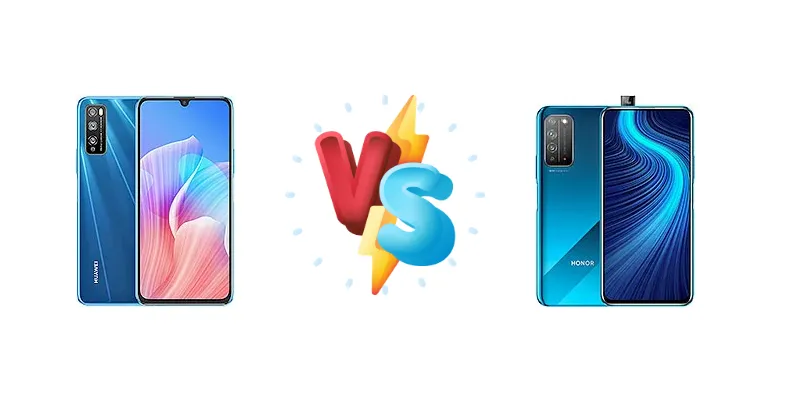
Both the Huawei Enjoy Z 5G and the Honor X10 5G represent compelling options in the increasingly competitive mid-range 5G smartphone market. While both aim to deliver 5G connectivity at an accessible price point, they diverge significantly in their core processing power, stemming from the choice between MediaTek’s Dimensity 800 and Huawei’s Kirin 820 5G. This comparison will dissect these differences to determine which device offers the best value for your needs.
🏆 Quick Verdict
For the average user prioritizing sustained performance and a slightly more refined feature set, the Honor X10 5G emerges as the stronger contender. Its Kirin 820 chipset, with its more powerful Cortex-A76 configuration, provides a noticeable edge in demanding tasks, despite both phones sharing the same 22.5W charging.
| Network |
|---|
| 2G bands | GSM 900 / 1800 / 1900 | GSM 850 / 900 / 1800 / 1900 |
| 3G bands | HSDPA 850 / 900 / 1700(AWS) / 1900 / 2100 | HSDPA 800 / 850 / 900 / 1700(AWS) / 1900 / 2100 |
| 4G bands | LTE | 1, 2, 3, 4, 5, 8, 18, 19, 26, 34, 38, 39, 40, 41 |
| 5G bands | 1, 38, 41, 77, 78, 79 SA/NSA | 1, 3, 38, 41, 77, 78, 79, 80, 84 SA/NSA |
| Speed | HSPA, LTE, 5G | HSPA 42.2/5.76 Mbps, LTE (4CA) Cat12 600/50 Mbps, 5G 2.3 Gbps DL |
| Technology | GSM / HSPA / LTE / 5G | GSM / CDMA / HSPA / EVDO / LTE / 5G |
| | - | CDMA2000 1xEV-DO |
| Launch |
|---|
| Announced | 2020, May 24. Released 2020, June 03 | 2020, May 20. Released 2020, May 26 |
| Status | Discontinued | Discontinued |
| Body |
|---|
| Build | - | Glass front (Aluminosilicate glass) |
| Dimensions | 160 x 75.3 x 8.4 mm (6.30 x 2.96 x 0.33 in) | 163.7 x 76.5 x 8.8 mm (6.44 x 3.01 x 0.35 in) |
| SIM | Nano-SIM + Nano-SIM | Nano-SIM + Nano-SIM |
| Weight | 182 g (6.42 oz) | 203 g (7.16 oz) |
| Display |
|---|
| Protection | - | Aluminosilicate glass |
| Resolution | 1080 x 2400 pixels, 20:9 ratio (~405 ppi density) | 1080 x 2400 pixels, 20:9 ratio (~397 ppi density) |
| Size | 6.5 inches, 102.0 cm2 (~84.7% screen-to-body ratio) | 6.63 inches, 106.1 cm2 (~84.7% screen-to-body ratio) |
| Type | IPS LCD, 90Hz | IPS LCD, 90Hz |
| Platform |
|---|
| CPU | Octa-core (4x2.0 GHz Cortex-A76 & 4x2.0 GHz Cortex-A55) | Octa-core (1x2.36 GHz Cortex-A76 & 3x2.22 GHz Cortex-A76 & 4x1.84 GHz Cortex-A55) |
| Chipset | Mediatek Dimensity 800 (7 nm) | Kirin 820 5G (7 nm) |
| GPU | Mali-G57MP4 | Mali-G57 (6-core) |
| OS | Android 10, EMUI 10.1, no Google Play Services | Android 10, Magic UI 3.1, no Google Play Services |
| Memory |
|---|
| Card slot | Nano Memory (uses shared SIM slot) | Nano Memory (uses shared SIM slot) |
| Internal | 64GB 6GB RAM, 128GB 6GB RAM, 128GB 8GB RAM | 64GB 6GB RAM, 128GB 6GB RAM, 128GB 8GB RAM |
| Main Camera |
|---|
| Features | LED flash, HDR, panorama | LED flash, panorama, HDR |
| Triple | 48 MP, f/1.8, 26mm (wide), 1/2.0", 0.8µm, PDAF
8 MP, f/2.4, 120˚ (ultrawide)
2 MP (macro) | 40 MP, f/1.8, 26mm (wide), 1/1.7", PDAF
8 MP, f/2.4, 17mm, 120˚ (ultrawide)
Auxiliary lens |
| Video | 4K@30fps, 1080p@30fps | 4K@30fps, 1080p@30fps, 720p@960fps, gyro-EIS |
| Selfie camera |
|---|
| Features | HDR | HDR |
| Single | 16 MP, f/2.0 | Motorized pop-up 16 MP, f/2.2, 24mm (wide), 1/3.06", 1.0µm |
| Video | 1080p@30fps | 1080p@30fps |
| Sound |
|---|
| 3.5mm jack | Yes | Yes |
| 35mm jack | Yes | Yes |
| Loudspeaker | Yes | Yes |
| Comms |
|---|
| Bluetooth | 5.1, A2DP, LE | 5.1, A2DP, LE |
| NFC | No | No |
| Positioning | GPS, GLONASS, BDS | GPS, GLONASS, BDS |
| Radio | No | No |
| USB | USB Type-C 2.0, OTG | USB Type-C 2.0, OTG |
| WLAN | Wi-Fi 802.11 a/b/g/n/ac, dual-band, Wi-Fi Direct | Wi-Fi 802.11 a/b/g/n/ac, dual-band, Wi-Fi Direct |
| Features |
|---|
| Sensors | Fingerprint (side-mounted), accelerometer, gyro, proximity, compass | Fingerprint (side-mounted), accelerometer, gyro, proximity, compass |
| Battery |
|---|
| Charging | 22.5W wired | 22.5W wired
5W reverse wired |
| Type | Li-Po 4000 mAh | Li-Po 4300 mAh |
| Misc |
|---|
| Colors | Breathing Crystal, Midnight Black, Dark Blue | Blue, Orange, Black, Silver |
| Models | DVC-AN00 | TEL-AN00, TEL-TN00, TEL-AN00a, TEL-AN10 |
| Price | About 220 EUR | About 250 EUR |
Huawei Enjoy Z 5G
- Potentially better battery efficiency due to Dimensity 800.
- More affordable price point (likely).
- Clean software experience (typical of Huawei).
- Less powerful processor compared to the Kirin 820.
- Lacks reverse wireless charging.
- Unknown display quality.
Honor X10 5G
- More powerful Kirin 820 chipset for better performance.
- 5W reverse wired charging for accessory top-ups.
- Potentially better image processing capabilities.
- Potentially lower battery life due to Kirin 820’s power draw.
- May be slightly more expensive.
- Unknown display quality.
Display Comparison
Neither Huawei nor Honor provided display specs in the context data. However, given the price bracket, both likely utilize LCD panels with a 60Hz refresh rate. The real differentiator will be color accuracy and peak brightness, which are unknown. Considering Honor’s historical focus on display quality, the X10 5G *may* have a slight advantage, but this is speculative without further information.
Camera Comparison
Without detailed camera specifications, a direct comparison is limited. However, the chipset plays a role in image signal processing (ISP) capabilities. The Kirin 820 generally offers more advanced ISP features than the Dimensity 800, potentially leading to better dynamic range and noise reduction in photos and videos. The absence of information regarding sensor sizes and lens apertures makes it difficult to assess the overall camera quality, but the Kirin 820’s processing power gives the X10 5G a theoretical edge.
Performance
The core difference lies in the chipsets. The Honor X10 5G’s Kirin 820 5G features a 1x2.36 GHz Cortex-A76 prime core, complemented by 3x2.22 GHz Cortex-A76 cores, and 4x1.84 GHz Cortex-A55 efficiency cores. This contrasts with the Huawei Enjoy Z 5G’s Dimensity 800, which uses 4x2.0 GHz Cortex-A76 cores and 4x2.0 GHz Cortex-A55 cores. The Kirin 820’s higher clock speeds and additional high-performance core translate to a clear advantage in CPU-intensive tasks and sustained performance. While both are 7nm chips, the Kirin 820’s architecture provides a more robust foundation for demanding applications. The GPU performance will also favor the Kirin 820, offering a smoother gaming experience.
Battery Life
Both devices support 22.5W wired charging, suggesting similar charging speeds – approximately 1 hour to fully charge. Battery capacity is not specified, but the Dimensity 800 is generally more power-efficient than the Kirin 820. This could translate to slightly longer battery life on the Enjoy Z 5G, despite the X10 5G’s reverse charging capability. The 5W reverse charging on the X10 5G is a useful feature for charging accessories like earbuds or smartwatches, a convenience the Enjoy Z 5G lacks.
Buying Guide
Buy the Huawei Enjoy Z 5G if you need a reliable 5G experience on a tighter budget and prioritize a clean, streamlined software experience. Buy the Honor X10 5G if you prefer a more powerful processor for gaming and multitasking, and appreciate the added convenience of 5W reverse wired charging for topping up accessories.
Frequently Asked Questions
❓ Will the Kirin 820 in the Honor X10 5G handle demanding games like PUBG Mobile at high settings?
Yes, the Kirin 820 is capable of running PUBG Mobile at high settings with stable frame rates. While it won't match flagship-level performance, it provides a significantly smoother gaming experience compared to the Dimensity 800, particularly during prolonged gaming sessions due to its more robust CPU architecture.
❓ Does the Huawei Enjoy Z 5G support carrier aggregation for faster 5G speeds?
While the context data doesn't explicitly state carrier aggregation support, the Dimensity 800 chipset *generally* supports carrier aggregation. However, the specific implementation and supported bands will vary depending on the region and carrier. It's best to check with your local carrier for compatibility details.
❓ Is the 22.5W charging on either phone considered fast charging in 2024?
22.5W charging is considered moderate in 2024. While it's not the fastest available, it's still reasonably quick and will fully charge both devices in around an hour. Many competitors now offer 65W or even 120W charging, but the difference in daily usage is often minimal.