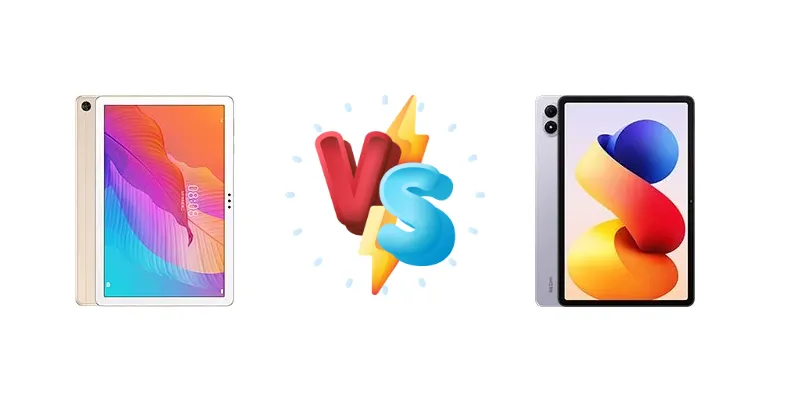
The tablet market is heating up with compelling options at various price points. We're pitting the Xiaomi Redmi Pad 2 Pro, boasting a modern Snapdragon 7s Gen 4 chipset and rapid charging, against the Huawei Enjoy Tablet 2, which relies on the older Kirin 710A. This comparison will dissect their strengths and weaknesses to help you determine which tablet best suits your needs.
🏆 Quick Verdict
For most users, the Xiaomi Redmi Pad 2 Pro is the clear winner. Its significantly more powerful Snapdragon 7s Gen 4 processor, coupled with 33W fast charging and impressive battery endurance, offers a superior experience. While the Enjoy Tablet 2 is likely more affordable, the performance gap is substantial.
| Network |
|---|
| 2G bands | N/A | N/A |
| 3G bands | N/A | N/A |
| 4G bands | N/A | - |
| EDGE | No | N/A |
| GPRS | No | N/A |
| Speed | No | - |
| Technology | No cellular connectivity | No cellular connectivity |
| Launch |
|---|
| Announced | 2020, July 30. Released 2020, August 16 | 2025, September 24 |
| Status | Discontinued | Available. Released 2025, September 24 |
| Body |
|---|
| Build | - | Glass front, aluminum frame, aluminum back |
| Dimensions | 240.2 x 159 x 7.9 mm (9.46 x 6.26 x 0.31 in) | 279.8 x 181.7 x 7.5 mm (11.02 x 7.15 x 0.30 in) |
| SIM | No | No |
| Weight | 450 g (0.99 lb) | 610 g (1.34 lb) |
| | Stylus support | - |
| Display |
|---|
| Protection | - | Mohs level 6 |
| Resolution | 1200 x 1920 pixels, 16:10 ratio (~224 ppi density) | 1600 x 2560 pixels, 16:10 ratio (~249 ppi density) |
| Size | 10.1 inches, 295.8 cm2 (~77.4% screen-to-body ratio) | 12.1 inches, 424.5 cm2 (~83.5% screen-to-body ratio) |
| Type | IPS LCD | IPS LCD, 1B colors, 120Hz, Dolby Vision, 600 nits (HBM) |
| Platform |
|---|
| CPU | Octa-core (4x2.0 GHz Cortex-A73 & 4x1.7 GHz Cortex-A53) | Octa-core (1x2.7 GHz Cortex-A720 & 3x2.4 GHz Cortex-A720 & 4x1.8 GHz Cortex-A520) |
| Chipset | Kirin 710A (14 nm) | Qualcomm SM7635-AC Snapdragon 7s Gen 4 (4 nm) |
| GPU | Mali-G51 MP4 | Adreno 810 |
| OS | Android 10, EMUI 10.1, no Google Play Services | Android 15, HyperOS 2 |
| Memory |
|---|
| Card slot | microSDXC | microSDXC (dedicated slot) |
| Internal | 64GB 4GB RAM, 128GB 4GB RAM | 128GB 6GB RAM, 256GB 8GB RAM |
| Main Camera |
|---|
| Features | HDR, panorama | Color spectrum sensor, LED flash, HDR |
| Single | 5 MP, f/2.2, PDAF | 8 MP, f/2.0, (wide), 1/4.0", 1.12µm |
| Video | 1080p@30fps | 1080p@30fps |
| Selfie camera |
|---|
| Single | 2 MP, f/2.4 | 8 MP, f/2.3, (wide), 1/4.0", 1.12µm |
| Video | - | 1080p@30fps |
| Sound |
|---|
| 3.5mm jack | Yes | - |
| 35mm jack | Yes | Yes |
| Loudspeaker | Yes, with stereo speakers | Yes, with stereo speakers, Dolby Atmos (4 speakers) |
| | Tuned by Harman Kardon | - |
| Comms |
|---|
| Bluetooth | 5.1, A2DP, LE | 5.4, A2DP, LE, aptX HD, aptX Adaptive |
| NFC | No | No |
| Positioning | GPS | No |
| Radio | No | No |
| USB | USB Type-C 2.0, OTG | USB Type-C 2.0, OTG |
| WLAN | Wi-Fi 802.11 a/b/g/n/ac, dual-band, Wi-Fi Direct | Wi-Fi 802.11 a/b/g/n/a/6, dual-band, Wi-Fi Direct |
| Features |
|---|
| Sensors | Accelerometer, proximity | Accelerometer, gyro, proximity (accessories only), compass |
| Battery |
|---|
| Charging | 10W wired | 33W wired, PD3.0, QC3+
27W reverse wired |
| Type | Li-Po 5100 mAh | 12000 mAh |
| Misc |
|---|
| Colors | Gold, Dark Blue | Graphite Gray, Silver, Lavender Purple, Matte Glass Version |
| Models | AGS3-W00D | 25099RP13G |
| Price | About 200 EUR | About 300 EUR |
| EU LABEL |
|---|
| Battery | - | 103:18h endurance, 1000 cycles |
| Energy | - | Class G |
| Free fall | - | Class A (208 falls) |
| Repairability | - | Class C |
Huawei Enjoy Tablet 2
- Likely more affordable price point
- Potentially lighter and more portable
- Simple and straightforward user experience
- Outdated Kirin 710A processor
- Slow 10W charging
- Limited performance for demanding tasks
Xiaomi Redmi Pad 2 Pro
- Powerful Snapdragon 7s Gen 4 processor
- Fast 33W charging with PD3.0/QC3+
- Excellent battery endurance (103:18h)
- Potentially higher price
- May be slightly heavier than the Enjoy Tablet 2
- Software experience may include Xiaomi's MIUI customizations
Display Comparison
Display specifications are not provided for the Huawei Enjoy Tablet 2, making a direct comparison difficult. However, the Redmi Pad 2 Pro’s battery endurance suggests a power-efficient display. The Redmi Pad 2 Pro’s charging capabilities (33W) indicate a likely larger display and higher resolution, demanding more power. The Redmi Pad 2 Pro’s support for PD3.0 and QC3+ also suggests a more advanced display controller.
Camera Comparison
Camera details are absent for both devices. Given the market segment, it’s reasonable to assume both tablets feature modest camera setups focused on video conferencing rather than photography. Without specific sensor information, it’s impossible to declare a winner, but the Redmi Pad 2 Pro’s more powerful processor could potentially enable better image processing algorithms.
Performance
The Xiaomi Redmi Pad 2 Pro’s Qualcomm SM7635-AC Snapdragon 7s Gen 4 (4nm) represents a significant leap in performance and efficiency over the Huawei Enjoy Tablet 2’s Kirin 710A (14nm). The Snapdragon 7s Gen 4 utilizes newer Cortex-A720 cores, offering a substantial improvement in both single-core and multi-core performance. The 4nm process node further enhances efficiency, leading to less heat generation and potentially sustained performance during demanding tasks. The Kirin 710A, while capable for basic tasks, will struggle with heavier applications and multitasking. The Redmi Pad 2 Pro is the clear winner for users who prioritize responsiveness and future-proofing.
Battery Life
The Xiaomi Redmi Pad 2 Pro boasts a compelling battery profile with a 103:18h endurance score and an active use score of 12:55h. This is significantly enhanced by its 33W wired charging, supporting PD3.0 and QC3+, and 27W reverse wired charging. The Huawei Enjoy Tablet 2’s 10W charging is comparatively slow, meaning longer downtime between uses. While the Enjoy Tablet 2’s battery capacity isn’t specified, the Redmi Pad 2 Pro’s superior charging speed and endurance make it the more convenient option for users who rely on their tablet throughout the day.
Buying Guide
Buy the Huawei Enjoy Tablet 2 if you prioritize absolute affordability and basic tablet functionality for light tasks like web browsing and video playback. It's a suitable option for users on a very tight budget. Buy the Xiaomi Redmi Pad 2 Pro if you demand smoother multitasking, better gaming performance, and faster charging, making it ideal for students, content consumers, and those who need a more versatile tablet experience.
Frequently Asked Questions
❓ Will the Snapdragon 7s Gen 4 in the Redmi Pad 2 Pro handle demanding games like Genshin Impact?
The Snapdragon 7s Gen 4 is a capable mid-range processor. While it won't deliver flagship-level performance, it should be able to run Genshin Impact at medium settings with reasonable frame rates. The Kirin 710A in the Enjoy Tablet 2 would likely struggle with this title.
❓ How long will it take to fully charge the Redmi Pad 2 Pro from 0%?
With its 33W fast charging support, the Redmi Pad 2 Pro should fully charge from 0% in approximately 1 hour and 45 minutes to 2 hours, depending on usage during charging. The Huawei Enjoy Tablet 2’s 10W charging will take considerably longer – likely over 5 hours.
❓ Does the Redmi Pad 2 Pro support expandable storage via microSD card?
Unfortunately, the Redmi Pad 2 Pro does not offer microSD card expansion. Users will need to rely on the internal storage options available at the time of purchase. The Enjoy Tablet 2's storage options are also unknown.
❓ Is the 27W reverse wired charging on the Redmi Pad 2 Pro useful?
The 27W reverse wired charging is a convenient feature for topping up other devices like smartphones or wireless earbuds using the tablet as a power bank. It's particularly useful when you're away from a power outlet.