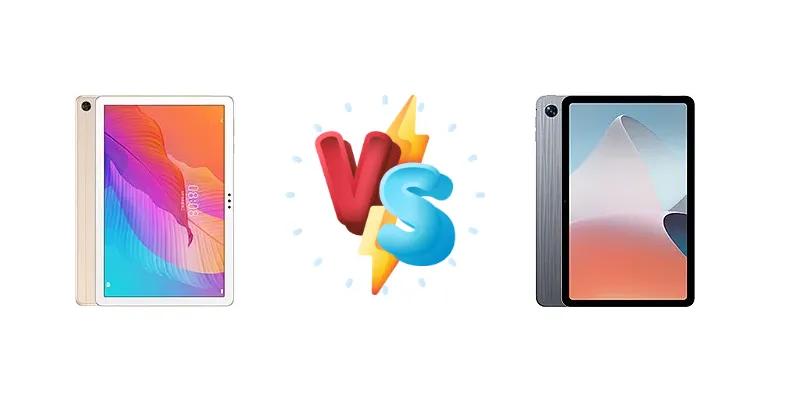
The tablet market is booming, and budget-friendly options are increasingly popular. Today, we're pitting two contenders against each other: the Huawei Enjoy Tablet 2 and the Oppo Pad Air. Both promise a decent experience without breaking the bank, but which one delivers the most value?
🏆 Quick Verdict
The Oppo Pad Air emerges as the winner thanks to its superior chipset, faster charging, and brighter display. While the Enjoy Tablet 2 is a solid budget option, the Pad Air's overall performance and features make it a more compelling choice for most users.
| Network |
|---|
| 2G bands | N/A | N/A |
| 3G bands | N/A | N/A |
| 4G bands | N/A | N/A |
| EDGE | No | No |
| GPRS | No | No |
| Speed | No | - |
| Technology | No cellular connectivity | No cellular connectivity |
| Launch |
|---|
| Announced | 2020, July 30. Released 2020, August 16 | 2022, May 23 |
| Status | Discontinued | Available. Released 2022, June 01 |
| Body |
|---|
| Dimensions | 240.2 x 159 x 7.9 mm (9.46 x 6.26 x 0.31 in) | 245.1 x 154.8 x 6.9 mm (9.65 x 6.09 x 0.27 in) |
| SIM | No | No |
| Weight | 450 g (0.99 lb) | 440 g (15.52 oz) |
| | Stylus support | Stylus support |
| Display |
|---|
| Resolution | 1200 x 1920 pixels, 16:10 ratio (~224 ppi density) | 1200 x 2000 pixels, 5:3 ratio (~225 ppi density) |
| Size | 10.1 inches, 295.8 cm2 (~77.4% screen-to-body ratio) | 10.36 inches, 305.5 cm2 (~80.5% screen-to-body ratio) |
| Type | IPS LCD | IPS LCD, 1B colors, 360 nits (typ) |
| Platform |
|---|
| CPU | Octa-core (4x2.0 GHz Cortex-A73 & 4x1.7 GHz Cortex-A53) | Octa-core (4x2.4 GHz Kryo 265 Gold & 4x1.9 GHz Kryo 265 Silver) |
| Chipset | Kirin 710A (14 nm) | Qualcomm SM6225 Snapdragon 680 4G (6 nm) |
| GPU | Mali-G51 MP4 | Adreno 610 |
| OS | Android 10, EMUI 10.1, no Google Play Services | Android 12, ColorOS 12 |
| Memory |
|---|
| Card slot | microSDXC | microSDXC |
| Internal | 64GB 4GB RAM, 128GB 4GB RAM | 64GB 4GB RAM, 128GB 4GB RAM, 128GB 6GB RAM |
| | - | UFS 2.2 |
| Main Camera |
|---|
| Features | HDR, panorama | Panorama |
| Single | 5 MP, f/2.2, PDAF | 8 MP, f/2.0, AF |
| Video | 1080p@30fps | 1080p@30fps |
| Selfie camera |
|---|
| Single | 2 MP, f/2.4 | 5 MP, f/2.2 |
| Video | - | 1080p@30fps |
| Sound |
|---|
| 3.5mm jack | Yes | No |
| 35mm jack | Yes | No |
| Loudspeaker | Yes, with stereo speakers | Yes, with stereo speakers (4 speakers) |
| | Tuned by Harman Kardon | - |
| Comms |
|---|
| Bluetooth | 5.1, A2DP, LE | 5.1, A2DP, LE, aptX HD |
| NFC | No | No |
| Positioning | GPS | No |
| Radio | No | No |
| USB | USB Type-C 2.0, OTG | USB Type-C 2.0, OTG |
| WLAN | Wi-Fi 802.11 a/b/g/n/ac, dual-band, Wi-Fi Direct | Wi-Fi 802.11 a/b/g/n/ac, dual-band, Wi-Fi Direct |
| Features |
|---|
| Sensors | Accelerometer, proximity | Accelerometer, gyro, compass |
| Battery |
|---|
| Charging | 10W wired | 18W wired, PD
5W reverse wired |
| Type | Li-Po 5100 mAh | Li-Po 7100 mAh |
| Misc |
|---|
| Colors | Gold, Dark Blue | Gray, Silver |
| Models | AGS3-W00D | OPD2102, X21N2 |
| Price | About 200 EUR | About 300 EUR |
| Tests |
|---|
| Display | - |
Contrast ratio: 1391:1 |
| Loudspeaker | - |
-28.3 LUFS (Average)
|
| Performance | - |
AnTuTu: 249272 (v9)
GeekBench: 1661 (v5.1)
GFXBench: 7.2fps (ES 3.1 onscreen) |
Huawei Enjoy Tablet 2
- Affordable
- Decent for basic media consumption
- Huawei ecosystem integration
- Weaker chipset
- Slower charging
- Limited camera details
- Likely lower display brightness
Oppo Pad Air
- Faster and more efficient chipset
- Faster charging (18W PD)
- Brighter display
- Better multitasking performance
- Potentially higher price than Enjoy Tablet 2
- Camera is not a primary strength
Display Comparison
The Oppo Pad Air boasts a noticeably brighter display (352 nits vs. likely lower on the Enjoy Tablet 2, though specific Enjoy Tablet 2 brightness data is unavailable). Both tablets share a high contrast ratio (1391:1), suggesting good image quality, but the Oppo Pad Air's brightness advantage gives it the edge for outdoor use and overall viewing comfort. The Oppo Pad Air also has a slightly larger screen size, enhancing the viewing experience.
Camera Comparison
Camera details for the Huawei Enjoy Tablet 2 are scarce. The Oppo Pad Air typically features a single rear camera, likely around 5MP. While neither tablet is a photography powerhouse, the Oppo Pad Air's camera is likely to offer slightly better image quality due to the more modern chipset and potentially better image processing.
Performance
Here, the Oppo Pad Air shines. Its Qualcomm Snapdragon 680 4G chipset (6nm) is significantly more powerful than the Huawei Kirin 710A (14nm). The Snapdragon 680's Kryo 265 cores offer better CPU performance, resulting in smoother app loading, faster multitasking, and improved gaming performance. The Enjoy Tablet 2's Kirin 710A is adequate for basic tasks, but struggles with more demanding applications.
Battery Life
The Oppo Pad Air's 18W wired charging with PD (Power Delivery) is a significant advantage over the Enjoy Tablet 2's 10W charging. This means faster charging times for the Oppo Pad Air. Battery capacity is likely similar (around 7000mAh for both), so real-world battery life should be comparable, but the Oppo Pad Air's faster charging makes it more convenient.
Buying Guide
The Huawei Enjoy Tablet 2 is ideal for users primarily seeking a basic tablet for media consumption and light tasks, especially those already invested in the Huawei ecosystem. The Oppo Pad Air is better suited for users who want a smoother, more responsive experience for gaming, multitasking, and general productivity, and appreciate faster charging.
Frequently Asked Questions
❓ What is the difference between the Kirin 710A and Snapdragon 680?
The Snapdragon 680 is a more modern and powerful chipset than the Kirin 710A, offering better performance and efficiency. It's built on a smaller manufacturing process (6nm vs 14nm), resulting in improved power efficiency and thermal performance.
❓ Is the Oppo Pad Air good for gaming?
Yes, the Oppo Pad Air's Snapdragon 680 chipset provides a smoother gaming experience compared to the Enjoy Tablet 2. While it's not a high-end gaming tablet, it can handle most popular mobile games at decent settings.