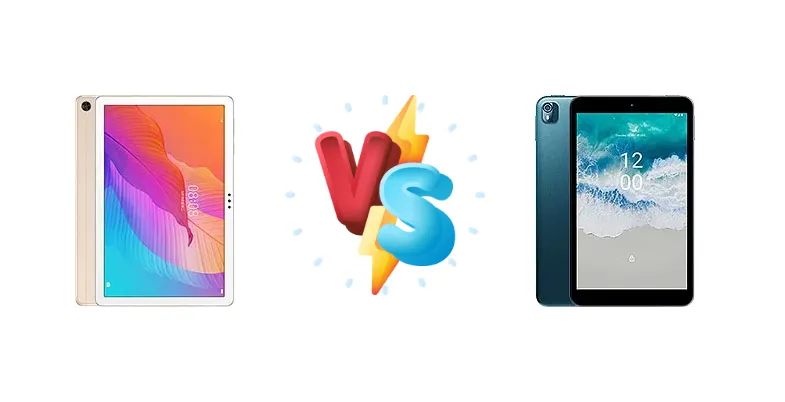
The budget tablet market is fiercely competitive, and the Huawei Enjoy Tablet 2 and Nokia T10 represent compelling options for users seeking affordable Android experiences. This comparison dissects their core components – from chipsets to charging – to determine which tablet delivers the most bang for your buck, focusing on real-world performance implications.
🏆 Quick Verdict
For most users, the Huawei Enjoy Tablet 2 edges out the Nokia T10 due to its more powerful Kirin 710A chipset. While both tablets offer similar 10W charging, the Enjoy Tablet 2’s CPU architecture provides a noticeable performance advantage in multitasking and demanding applications, making it the better choice for productivity and entertainment.
| Network |
|---|
| 2G bands | N/A | GSM 850 / 900 / 1800 / 1900 |
| 3G bands | N/A | HSDPA 850 / 900 / 2100 |
| 4G bands | N/A | 1, 3, 5, 7, 8, 20, 28, 38, 40, 41 |
| EDGE | No | - |
| GPRS | No | - |
| Speed | No | HSPA 42.2/5.76 Mbps, LTE Cat4 150/50 Mbps |
| Technology | No cellular connectivity | GSM / HSPA / LTE |
| Launch |
|---|
| Announced | 2020, July 30. Released 2020, August 16 | 2022, July 12 |
| Status | Discontinued | Available. Released 2022, August 20 |
| Body |
|---|
| Build | - | Glass front, plastic back, plastic frame |
| Dimensions | 240.2 x 159 x 7.9 mm (9.46 x 6.26 x 0.31 in) | 208 x 123.2 x 9 mm (8.19 x 4.85 x 0.35 in) |
| SIM | No | Nano-SIM |
| Weight | 450 g (0.99 lb) | 375 g (13.23 oz) |
| | Stylus support | Splash resistant |
| Display |
|---|
| Resolution | 1200 x 1920 pixels, 16:10 ratio (~224 ppi density) | 800 x 1280 pixels, 16:10 ratio (~189 ppi density) |
| Size | 10.1 inches, 295.8 cm2 (~77.4% screen-to-body ratio) | 8.0 inches, 185.6 cm2 (~72.4% screen-to-body ratio) |
| Type | IPS LCD | IPS LCD, 360 nits (typ), 450 nits (peak) |
| Platform |
|---|
| CPU | Octa-core (4x2.0 GHz Cortex-A73 & 4x1.7 GHz Cortex-A53) | Octa-core (2x1.6 GHz Cortex-A75 & 6x1.6 GHz Cortex-A55) |
| Chipset | Kirin 710A (14 nm) | Unisoc T606 (12 nm) |
| GPU | Mali-G51 MP4 | Mali-G57 MP1 |
| OS | Android 10, EMUI 10.1, no Google Play Services | Android 12, upgradable to Android 13 |
| Memory |
|---|
| Card slot | microSDXC | microSDXC |
| Internal | 64GB 4GB RAM, 128GB 4GB RAM | 32GB 3GB RAM, 64GB 4GB RAM |
| Main Camera |
|---|
| Features | HDR, panorama | LED flash |
| Single | 5 MP, f/2.2, PDAF | 8 MP, 1/4.0", 1.12µm, AF |
| Video | 1080p@30fps | 1080p |
| Selfie camera |
|---|
| Single | 2 MP, f/2.4 | 2 MP, 1/5.0", 1.65µm |
| Video | - | 720p |
| Sound |
|---|
| 3.5mm jack | Yes | Yes |
| 35mm jack | Yes | Yes |
| Loudspeaker | Yes, with stereo speakers | Yes, with stereo speakers |
| | Tuned by Harman Kardon | - |
| Comms |
|---|
| Bluetooth | 5.1, A2DP, LE | 5.0, A2DP, LE |
| NFC | No | No |
| Positioning | GPS | GPS, GLONASS, GALILEO |
| Radio | No | No |
| USB | USB Type-C 2.0, OTG | USB Type-C 2.0, OTG |
| WLAN | Wi-Fi 802.11 a/b/g/n/ac, dual-band, Wi-Fi Direct | Wi-Fi 802.11 a/b/g/n/ac, dual-band |
| Features |
|---|
| Sensors | Accelerometer, proximity | Accelerometer, proximity |
| Battery |
|---|
| Charging | 10W wired | 10W wired |
| Type | Li-Po 5100 mAh | Li-Po 5250 mAh |
| Misc |
|---|
| Colors | Gold, Dark Blue | Ocean Blue |
| Models | AGS3-W00D | TA-1503, TA-1472, TA-1462, TA-1457 |
| Price | About 200 EUR | About 160 EUR |
| SAR | - | 1.19 W/kg (body) |
| SAR EU | - | 0.27 W/kg (head) 1.57 W/kg (body) |
Huawei Enjoy Tablet 2
- More powerful Kirin 710A chipset for better performance.
- Potentially better image processing due to the Kirin 710A’s ISP.
- More responsive user experience for multitasking.
- Huawei’s software ecosystem can be restrictive.
- Long-term software support is uncertain.
Nokia T10
- Clean Android experience with potentially longer software support.
- Affordable price point.
- Reliable brand reputation for durability.
- Unisoc T606 chipset offers lower performance.
- May struggle with demanding applications.
- Less capable ISP for image processing.
Display Comparison
Neither Huawei nor Nokia provide display specifications beyond size. However, given the price point, both likely utilize IPS LCD panels. The key difference lies under the hood. The Enjoy Tablet 2’s Kirin 710A likely has a more capable ISP, potentially leading to slightly better image processing for display output. Without detailed brightness or color gamut data, it’s difficult to definitively declare a winner, but the Enjoy Tablet 2’s more powerful chipset suggests a slight edge in display quality.
Camera Comparison
Neither device is positioned as a photography powerhouse, and detailed camera specs are scarce. It’s safe to assume both feature basic camera setups. Without knowing sensor sizes or lens apertures, a direct comparison is impossible. However, the Kirin 710A’s more powerful ISP in the Enjoy Tablet 2 likely provides better image processing capabilities, potentially resulting in slightly improved image quality, particularly in low-light conditions. Focusing on the chipset’s processing power is more relevant than speculating about potentially similar sensor configurations.
Performance
The core of the difference between these tablets is the chipset. The Huawei Enjoy Tablet 2’s Kirin 710A (14nm) features a more sophisticated CPU architecture – four Cortex-A73 cores clocked at 2.0 GHz alongside four Cortex-A53 cores – compared to the Nokia T10’s Unisoc T606 (12nm) with its two Cortex-A75 cores at 1.6 GHz and six Cortex-A55 cores. While the Unisoc T606 benefits from a smaller manufacturing process (12nm vs 14nm), the architectural advantage of the A73 cores in the Kirin 710A translates to superior single-core and multi-core performance. This means faster app loading times, smoother multitasking, and a more responsive user experience on the Enjoy Tablet 2. The Unisoc T606 is adequate for basic tasks, but will struggle with more demanding applications.
Battery Life
Both tablets are equipped with 10W wired charging, indicating a similar charging experience – expect around 3-4 hours for a full charge. Without knowing the battery capacity of either device, it’s difficult to predict real-world battery life. However, the Kirin 710A’s more efficient CPU architecture *could* lead to slightly better power management, potentially offsetting a smaller battery capacity if present. The 12nm process of the Unisoc T606 also contributes to efficiency, but the architectural differences favor the Enjoy Tablet 2.
Buying Guide
Buy the Huawei Enjoy Tablet 2 if you prioritize performance for tasks like video editing, moderate gaming, or running multiple apps simultaneously. Its Kirin 710A chipset offers a tangible advantage. Buy the Nokia T10 if you value a clean Android experience and a potentially longer software support lifecycle, and your usage is primarily focused on basic tasks like web browsing, video streaming, and light document editing. The T10’s Unisoc T606 is sufficient for these scenarios.
Frequently Asked Questions
❓ Will the Huawei Enjoy Tablet 2 handle demanding games like PUBG Mobile?
While the Kirin 710A can run PUBG Mobile, expect to play at medium settings to maintain a stable frame rate. The chipset isn’t designed for high-end gaming, and prolonged sessions may result in some thermal throttling. The Nokia T10 would likely struggle to provide a playable experience at even medium settings.
❓ How does Huawei’s EMUI software compare to the stock Android experience on the Nokia T10?
Huawei’s EMUI is a heavily customized version of Android, offering features like gesture navigation and a different app drawer layout. It’s generally considered less streamlined than the stock Android experience on the Nokia T10, which prioritizes simplicity and minimal bloatware. EMUI also lacks full Google Mobile Services (GMS) support, requiring users to rely on Huawei’s AppGallery and workarounds for certain apps.
❓ Is the Unisoc T606 chipset in the Nokia T10 sufficient for everyday tasks like browsing and streaming?
Yes, the Unisoc T606 is perfectly adequate for everyday tasks such as web browsing, video streaming, and social media. It won’t excel at demanding applications, but it provides a smooth and responsive experience for basic usage scenarios. However, multitasking with several apps open simultaneously may lead to some slowdown.