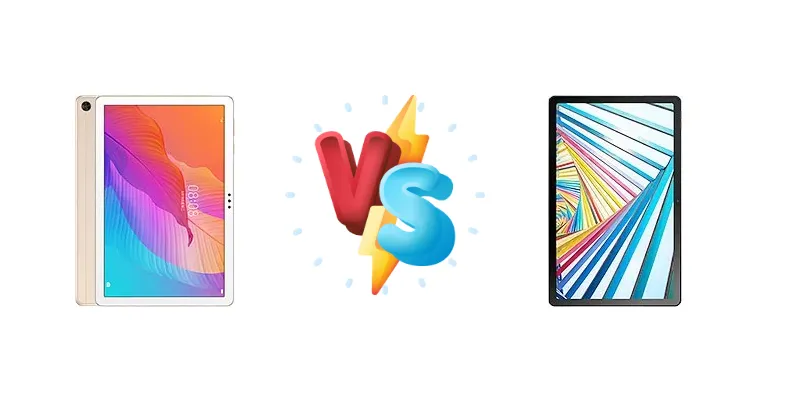
The budget tablet market is fiercely competitive, and the Huawei Enjoy Tablet 2 and Lenovo Tab M10 Plus (3rd Gen) represent compelling options for users seeking affordable entertainment and productivity. This comparison dives deep into their core specifications, focusing on chipset architecture, charging capabilities, and overall performance to determine which tablet delivers the most bang for your buck.
🏆 Quick Verdict
For the average user prioritizing faster charging and potentially better long-term performance, the Lenovo Tab M10 Plus (3rd Gen) with the Snapdragon 680 is the stronger choice. While the Huawei Enjoy Tablet 2 offers a functional experience, the Lenovo’s more modern chipset and 20W charging provide a noticeable advantage.
| Network |
|---|
| 2G bands | N/A | GSM 850 / 900 / 1800 / 1900 |
| 3G bands | N/A | HSDPA 800 / 850 / 900 / 1900 / 2100 |
| 4G bands | N/A | 1, 2, 3, 4, 5, 7, 8, 19, 20, 26, 28, 28, 38, 40, 41 |
| EDGE | No | - |
| GPRS | No | - |
| Speed | No | HSPA 42.2/5.76 Mbps, LTE Cat13 390/75 Mbps - cellular model only |
| Technology | No cellular connectivity | GSM / HSPA / LTE |
| Launch |
|---|
| Announced | 2020, July 30. Released 2020, August 16 | 2022, May |
| Status | Discontinued | Available. Released 2022, May |
| Body |
|---|
| Dimensions | 240.2 x 159 x 7.9 mm (9.46 x 6.26 x 0.31 in) | 251.2 x 158.8 x 7.5 mm (9.89 x 6.25 x 0.30 in) |
| SIM | No | Nano-SIM (cellular model only) |
| Weight | 450 g (0.99 lb) | 465 g (1.03 lb) |
| | Stylus support | Stylus support |
| Display |
|---|
| Resolution | 1200 x 1920 pixels, 16:10 ratio (~224 ppi density) | 1200 x 2000 pixels, 5:3 ratio (~220 ppi density) |
| Size | 10.1 inches, 295.8 cm2 (~77.4% screen-to-body ratio) | 10.61 inches, 320.4 cm2 (~80.3% screen-to-body ratio) |
| Type | IPS LCD | IPS LCD, 400 nits (typ) |
| Platform |
|---|
| CPU | Octa-core (4x2.0 GHz Cortex-A73 & 4x1.7 GHz Cortex-A53) | Octa-core (4x2.4 GHz Kryo 265 Gold & 4x1.9 GHz Kryo 265 Silver) - LTE model Octa-core (2x2.0 GHz Cortex-A75 & 6x1.8 GHz Cortex-A55) - Wi-Fi only model |
| Chipset | Kirin 710A (14 nm) | Qualcomm SM6225 Snapdragon 680 4G (6 nm) - LTE model Mediatek MT6769V/CU Helio G80 (12 nm) - Wi-Fi only model |
| GPU | Mali-G51 MP4 | Adreno 610 - LTE model Mali-G52 MC2 - Wi-Fi only model |
| OS | Android 10, EMUI 10.1, no Google Play Services | Android 12 |
| Memory |
|---|
| Card slot | microSDXC | microSDXC (dedicated slot) |
| Internal | 64GB 4GB RAM, 128GB 4GB RAM | 32GB 3GB RAM, 64GB 4GB RAM, 128GB 4GB RAM, 128GB 6GB RAM |
| | - | eMCP/uMCP |
| Main Camera |
|---|
| Features | HDR, panorama | - |
| Single | 5 MP, f/2.2, PDAF | 8 MP, AF |
| Video | 1080p@30fps | 1080p |
| Selfie camera |
|---|
| Single | 2 MP, f/2.4 | 8 MP |
| Sound |
|---|
| 3.5mm jack | Yes | Yes |
| 35mm jack | Yes | Yes |
| Loudspeaker | Yes, with stereo speakers | Yes, with stereo speakers (4 speakers) |
| | Tuned by Harman Kardon | - |
| Comms |
|---|
| Bluetooth | 5.1, A2DP, LE | 5.0, A2DP, LE |
| NFC | No | No |
| Positioning | GPS | GPS, GLONASS, BDS - cellular model only |
| Radio | No | FM Radio |
| USB | USB Type-C 2.0, OTG | USB Type-C 2.0 |
| WLAN | Wi-Fi 802.11 a/b/g/n/ac, dual-band, Wi-Fi Direct | Wi-Fi 802.11 a/b/g/n/ac, dual-band, Wi-Fi Direct |
| Features |
|---|
| Sensors | Accelerometer, proximity | Accelerometer, proximity, gyro |
| Battery |
|---|
| Charging | 10W wired | 20W wired |
| Type | Li-Po 5100 mAh | Li-Po 7700 mAh |
| Misc |
|---|
| Colors | Gold, Dark Blue | Storm Grey, Frost Blue |
| Models | AGS3-W00D | - |
| Price | About 200 EUR | About 260 EUR |
Huawei Enjoy Tablet 2
- Potentially lower price point.
- Functional for basic tasks.
- Huawei ecosystem integration (for existing users).
- Slower charging (10W).
- Older Kirin 710A chipset.
- Less efficient 14nm process.
Lenovo Tab M10 Plus (3rd Gen)
- Faster 20W charging.
- More efficient Snapdragon 680 (6nm) chipset.
- Potentially better multitasking and app performance.
- LTE connectivity option available.
- May be slightly more expensive.
- Wi-Fi only variant uses less powerful Helio G80.
Display Comparison
Neither Huawei nor Lenovo provide detailed display specifications beyond screen size. However, the core difference lies in the processing power driving the display. The more capable Snapdragon 680 in the Lenovo Tab M10 Plus (3rd Gen) can handle higher resolution content and potentially smoother animations. While both likely utilize IPS LCD panels, the Lenovo’s chipset offers a better foundation for a visually responsive experience. Bezels are expected to be similar on both devices, typical for this price segment.
Camera Comparison
Camera performance is unlikely to be a deciding factor for either tablet, given their target market. Detailed camera specs are unavailable, but both will likely feature basic rear and front-facing cameras suitable for video calls and casual snapshots. Focusing on the chipset, the Lenovo Tab M10 Plus (3rd Gen)'s Snapdragon 680 includes an improved Image Signal Processor (ISP) compared to the Kirin 710A, potentially resulting in slightly better image processing and low-light performance. However, expectations should remain modest.
Performance
The Lenovo Tab M10 Plus (3rd Gen) presents a significant architectural advantage. The Snapdragon 680 (6nm) utilizes Kryo 265 Gold and Silver cores, offering a performance uplift over the Huawei Enjoy Tablet 2’s Kirin 710A (14nm). The 6nm process node of the Snapdragon is more efficient, translating to better thermal management and potentially less throttling during sustained workloads. The Wi-Fi only variant of the Lenovo Tab M10 Plus (3rd Gen) uses the Mediatek Helio G80 (12nm), which still offers a performance edge over the Kirin 710A, though not as substantial as the Snapdragon 680. The Kirin 710A’s Cortex-A73 cores are older architecture, impacting multi-tasking and demanding applications.
Battery Life
While battery capacity isn’t specified, the Lenovo Tab M10 Plus (3rd Gen) gains a clear advantage with its 20W wired charging. This is double the 10W charging speed of the Huawei Enjoy Tablet 2. Faster charging significantly reduces downtime, allowing users to quickly top up their tablet between uses. The more efficient Snapdragon 680 (6nm) also contributes to potentially better battery life, even with a similar capacity battery to the Huawei Enjoy Tablet 2.
Buying Guide
Buy the Huawei Enjoy Tablet 2 if you need a basic tablet for light tasks like reading ebooks, browsing the web, and occasional video calls, and are comfortable with slower charging speeds. Buy the Lenovo Tab M10 Plus (3rd Gen) if you prioritize smoother multitasking, faster app loading times, and quicker charging, especially if you opt for the 4G LTE model with the Snapdragon 680 chipset.
Frequently Asked Questions
❓ Does the Snapdragon 680 in the Lenovo Tab M10 Plus (3rd Gen) offer a noticeable performance improvement over the Kirin 710A for gaming?
Yes, the Snapdragon 680, particularly the 4G LTE variant, provides a significant performance boost for gaming. Its newer architecture and more efficient process node allow for higher frame rates and smoother gameplay in demanding titles compared to the older Kirin 710A. While neither tablet is a dedicated gaming device, the Lenovo offers a more enjoyable gaming experience.
❓ Is the Mediatek Helio G80 version of the Lenovo Tab M10 Plus (3rd Gen) still a worthwhile purchase compared to the Snapdragon 680 model?
The Helio G80 variant is still a solid choice, offering a performance advantage over the Huawei Enjoy Tablet 2’s Kirin 710A. However, the Snapdragon 680 model provides a more substantial performance uplift and benefits from the more efficient 6nm process. If the price difference is minimal, the Snapdragon 680 version is the preferred option.
❓ How long does it realistically take to fully charge the Huawei Enjoy Tablet 2 with its 10W charging?
With 10W charging, a full charge from 0% on the Huawei Enjoy Tablet 2 is likely to take between 3-5 hours, depending on battery capacity. This is considerably slower than the Lenovo Tab M10 Plus (3rd Gen)'s 20W charging, which can potentially achieve a full charge in around 2-3 hours.