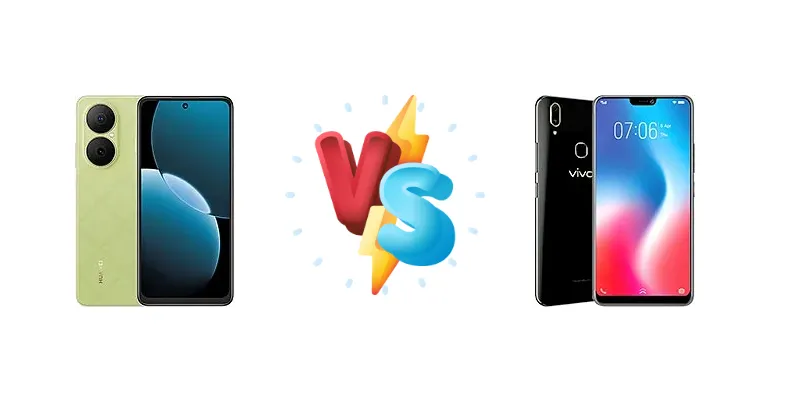
The Huawei Enjoy 80 and vivo V9 6GB represent distinct approaches to the budget smartphone market. The Enjoy 80 prioritizes charging speed with its 40W wired charging, while the V9 6GB relies on the Qualcomm Snapdragon 660, a chipset known for its balanced performance and efficiency. This comparison dissects these key differences to determine which device best suits your needs.
🏆 Quick Verdict
For the average user prioritizing quick top-ups and convenience, the Huawei Enjoy 80 is the better choice thanks to its significantly faster 40W charging. However, users who value a proven chipset and established performance for consistent daily tasks will find the vivo V9 6GB a more reliable option.
| Network |
|---|
| 2G bands | GSM 850 / 900 / 1800 / 1900 | GSM 850 / 900 / 1800 / 1900 |
| 3G bands | HSDPA 850 / 900 / 2100 | HSDPA 850 / 900 / 2100 |
| 4G bands | LTE | 1, 3, 5, 8, 38, 40, 41 |
| Speed | HSPA, LTE | HSPA 42.2/5.76 Mbps, LTE (3CA) Cat12 600/150 Mbps |
| Technology | GSM / HSPA / LTE | GSM / HSPA / LTE |
| Launch |
|---|
| Announced | 2025, April 22 | 2018, June. Released 2018, July |
| Status | Available. Released 2025, April 26 | Discontinued |
| Body |
|---|
| Build | - | Glass front, plastic back, plastic frame |
| Dimensions | 166 x 76.6 x 8.3 mm (6.54 x 3.02 x 0.33 in) | 154.8 x 75 x 7.9 mm (6.09 x 2.95 x 0.31 in) |
| SIM | Nano-SIM + Nano-SIM | Nano-SIM + Nano-SIM |
| Weight | 203 g or 206 g (7.16 oz) | 150 g (5.29 oz) |
| Display |
|---|
| Protection | Aluminosilicate glass | - |
| Resolution | 720 x 1604 pixels, 20:9 ratio (~264 ppi density) | 1080 x 2280 pixels, 19:9 ratio (~400 ppi density) |
| Size | 6.67 inches, 107.2 cm2 (~84.3% screen-to-body ratio) | 6.3 inches, 99.1 cm2 (~85.3% screen-to-body ratio) |
| Type | IPS LCD, 90Hz, 1000 nits (peak) | IPS LCD |
| Platform |
|---|
| CPU | - | Octa-core (4x2.2 GHz Kryo 260 Gold & 4x1.8 GHz Kryo 260 Silver) |
| Chipset | - | Qualcomm SDM660 Snapdragon 660 (14 nm) |
| GPU | - | Adreno 512 |
| OS | HarmonyOS 4.0 | Android 8.1 (Oreo), Funtouch 4 |
| Memory |
|---|
| Card slot | No | microSDXC (dedicated slot) |
| Internal | 128GB 8GB RAM, 256GB 8GB RAM, 512GB 8GB RAM | 64GB 6GB RAM |
| | - | eMMC 5.1 |
| Main Camera |
|---|
| Dual | - | 13 MP, f/2.2, PDAF
Auxiliary lens |
| Features | LED flash, HDR, panorama | Dual-LED flash, HDR, panorama |
| Single | 50 MP, f/1.8, (wide), PDAF | - |
| Video | 1080p@30fps | 4K@30fps, 1080p@30fps |
| Selfie camera |
|---|
| Single | 8 MP, f/2.0, (wide) | 12 MP, f/2.0, (wide), 1/2.8", 1.28µm |
| Video | 1080p@30fps | 1080p@30fps |
| Sound |
|---|
| 3.5mm jack | - | Yes |
| 35mm jack | No | Yes |
| Loudspeaker | Yes | Yes |
| Comms |
|---|
| Bluetooth | 5.1, A2DP, LE | 4.2, A2DP, LE |
| Infrared port | Yes | - |
| NFC | No | No |
| Positioning | GPS, GLONASS, GALILEO, BDS, QZSS | GPS, GLONASS, BDS |
| Radio | No | FM radio, recording |
| USB | USB Type-C 2.0, OTG | microUSB 2.0, OTG |
| WLAN | Wi-Fi 802.11 a/b/g/n/ac, dual-band | Wi-Fi 802.11 a/b/g/n/ac, dual-band, Wi-Fi Direct |
| Features |
|---|
| Sensors | Fingerprint (side-mounted), accelerometer, proximity, compass | Fingerprint (rear-mounted), accelerometer, gyro, proximity, compass |
| Battery |
|---|
| Charging | 40W wired
5W reverse wired | - |
| Type | Si/C Li-Ion 6620 mAh | Li-Ion 3260 mAh, non-removable |
| Misc |
|---|
| Colors | Black, White, Blue, Green | Black, Red |
| Models | JUY-AL00 | 1851 |
| Price | About 140 EUR | About 300 EUR |
Huawei Enjoy 80
- 40W Fast Charging for quick power-ups
- 5W Reverse Wired Charging for accessory top-ups
- Potentially newer software features (depending on Android version)
- Unspecified chipset raises performance concerns
- Lack of detailed specifications hinders comprehensive analysis
vivo V9 6GB
- Proven Snapdragon 660 chipset for reliable performance
- Octa-core CPU for smooth multitasking
- Qualcomm ISP for potentially better image processing
- Slower charging speeds compared to the Enjoy 80
- Lacks reverse wireless charging functionality
Display Comparison
Display specifications are absent from the provided data, making a direct comparison impossible. However, given the market segment, both devices likely feature LCD panels with 720p or 1080p resolutions. The Enjoy 80, being a newer device, *may* benefit from slightly improved color accuracy or brightness, but this is speculative. The absence of high refresh rate technology is expected in this price range for both models.
Camera Comparison
Without sensor details for the Huawei Enjoy 80, a direct camera comparison is limited. The vivo V9 6GB likely features a more mature camera system leveraging Qualcomm’s image signal processing capabilities. While the presence of a 2MP macro camera on either device is largely a marketing gimmick, the overall image quality will depend on the primary sensor and software optimization. The Snapdragon 660’s ISP provides a solid foundation for image processing, potentially resulting in more consistent and detailed photos compared to the Enjoy 80, assuming similar primary sensor resolutions.
Performance
The vivo V9 6GB’s Qualcomm Snapdragon 660 (14nm) is the clear performance leader. Its octa-core CPU, split into 4x2.2 GHz Kryo 260 Gold and 4x1.8 GHz Kryo 260 Silver cores, provides a more robust processing experience than the unspecified chipset in the Enjoy 80. The 14nm process node, while not the most advanced, is well-optimized, offering a balance between performance and power efficiency. This translates to smoother multitasking and a more responsive user interface on the V9 6GB, particularly noticeable when running demanding applications. The Enjoy 80’s chipset, lacking specific details, likely targets basic functionality and may struggle with heavier workloads.
Battery Life
The Huawei Enjoy 80’s 40W wired charging is its standout feature. This allows for significantly faster charging times compared to the vivo V9 6GB, which likely supports standard charging speeds (around 10-15W). While battery capacity isn’t specified for either device, the Enjoy 80’s rapid charging mitigates the impact of a potentially smaller battery. The Enjoy 80 also offers 5W reverse wired charging, a convenient feature for topping up accessories like earbuds, which the V9 6GB lacks.
Buying Guide
Buy the Huawei Enjoy 80 if you frequently find yourself needing to quickly recharge your phone and value the convenience of fast charging. This phone is ideal for users who are always on the go. Buy the vivo V9 6GB if you prioritize a stable, well-documented chipset like the Snapdragon 660 for consistent performance in everyday tasks and light gaming, and aren't as concerned about the absolute fastest charging speeds.
Frequently Asked Questions
❓ Is the Snapdragon 660 still a capable chipset in 2024 for everyday tasks?
Yes, the Snapdragon 660 remains a perfectly adequate chipset for everyday tasks like browsing, social media, and messaging. While it won't excel at demanding games, it provides a smooth and responsive experience for typical smartphone usage. Its efficiency also contributes to good battery life.
❓ How long does it realistically take to charge the Huawei Enjoy 80 from 0% to 100% with the 40W charger?
With 40W charging, the Huawei Enjoy 80 should be able to charge from 0% to 100% in approximately 60-75 minutes, depending on battery capacity and usage during charging. This is significantly faster than the vivo V9 6GB, which would likely take over 2 hours with its standard charging.
❓ Does the vivo V9 6GB support any form of fast charging?
The vivo V9 6GB likely supports a form of fast charging, but it's considerably slower than the 40W charging on the Huawei Enjoy 80. Expect charging speeds around 10-15W, resulting in longer charging times.
❓ What kind of gaming performance can I expect from the vivo V9 6GB?
The Snapdragon 660 in the vivo V9 6GB can handle most mobile games at medium settings. Demanding titles like PUBG Mobile may require lower graphics settings to maintain a stable frame rate. It's not a gaming powerhouse, but it's capable of providing an enjoyable gaming experience for casual gamers.