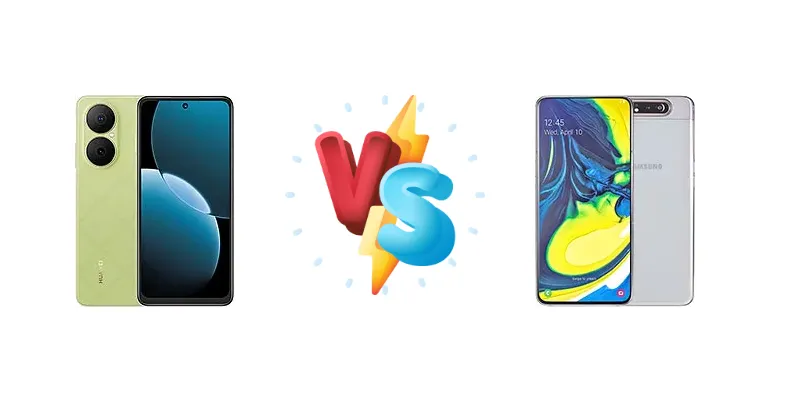
The Huawei Enjoy 80 and Samsung Galaxy A80 represent different approaches to the mid-range smartphone market. The Enjoy 80 prioritizes incredibly fast charging, while the Galaxy A80 focuses on all-day battery life and a solid, if not groundbreaking, performance profile. This comparison dissects their key differences to determine which device delivers the best value.
🏆 Quick Verdict
For users prioritizing rapid replenishment, the Huawei Enjoy 80’s 40W charging is a clear winner. However, the Samsung Galaxy A80 edges out the competition with its proven 90-hour endurance rating, making it the better choice for those who value longevity over quick top-ups.
| Network |
|---|
| 2G bands | GSM 850 / 900 / 1800 / 1900 | GSM 850 / 900 / 1800 / 1900 |
| 3G bands | HSDPA 850 / 900 / 2100 | HSDPA 850 / 900 / 1700(AWS) / 1900 / 2100 |
| 4G bands | LTE | 1, 2, 3, 4, 5, 7, 8, 12, 13, 17, 20, 26, 28, 38, 40, 41, 66 |
| Speed | HSPA, LTE | HSPA 42.2/5.76 Mbps, LTE (3CA) Cat11 600/75 Mbps |
| Technology | GSM / HSPA / LTE | GSM / HSPA / LTE |
| Launch |
|---|
| Announced | 2025, April 22 | 2019, April 10. Released 2019, May |
| Status | Available. Released 2025, April 26 | Discontinued |
| Body |
|---|
| Build | - | Glass front (Gorilla Glass 3), glass back (Gorilla Glass 6), aluminum frame |
| Dimensions | 166 x 76.6 x 8.3 mm (6.54 x 3.02 x 0.33 in) | 165.2 x 76.5 x 9.3 mm (6.50 x 3.01 x 0.37 in) |
| SIM | Nano-SIM + Nano-SIM | · Nano-SIM· Nano-SIM + Nano-SIM |
| Weight | 203 g or 206 g (7.16 oz) | 220 g (7.76 oz) |
| Display |
|---|
| Protection | Aluminosilicate glass | Corning Gorilla Glass 3 |
| Resolution | 720 x 1604 pixels, 20:9 ratio (~264 ppi density) | 1080 x 2400 pixels, 20:9 ratio (~393 ppi density) |
| Size | 6.67 inches, 107.2 cm2 (~84.3% screen-to-body ratio) | 6.7 inches, 108.4 cm2 (~85.8% screen-to-body ratio) |
| Type | IPS LCD, 90Hz, 1000 nits (peak) | Super AMOLED |
| | - | Always-on display |
| Platform |
|---|
| CPU | - | Octa-core (2x2.2 GHz Kryo 470 Gold & 6x1.8 GHz Kryo 470 Silver) |
| Chipset | - | Qualcomm SDM730 Snapdragon 730 (8 nm) |
| GPU | - | Adreno 618 |
| OS | HarmonyOS 4.0 | Android 9.0 (Pie), upgradable to Android 11, One UI 3.1 |
| Memory |
|---|
| Card slot | No | No |
| Internal | 128GB 8GB RAM, 256GB 8GB RAM, 512GB 8GB RAM | 128GB 8GB RAM |
| | - | UFS 2.1 |
| Main Camera |
|---|
| Dual | - | 48 MP, f/2.0, 26mm (wide), 1/2.0", 0.8µm, PDAF
8 MP, f/2.2, 12mm (ultrawide), 1/4.0", 1.12µm
TOF 3D, f/1.2, (depth) |
| Features | LED flash, HDR, panorama | LED flash, panorama, HDR |
| Single | 50 MP, f/1.8, (wide), PDAF | - |
| Video | 1080p@30fps | 4K@30fps, 1080p@30/60fps (gyro-EIS), 720p@480fps |
| Selfie camera |
|---|
| Features | - | LED flash, HDR |
| Single | 8 MP, f/2.0, (wide) | - |
| Triple | - | Motorized pop-up rotating main camera module |
| Video | 1080p@30fps | 4K@30fps, 1080p@30/60fps (gyro-EIS) |
| Sound |
|---|
| 3.5mm jack | - | No |
| 35mm jack | No | No |
| Loudspeaker | Yes | Yes |
| Comms |
|---|
| Bluetooth | 5.1, A2DP, LE | 5.0, A2DP, LE |
| Infrared port | Yes | - |
| NFC | No | Yes |
| Positioning | GPS, GLONASS, GALILEO, BDS, QZSS | GPS, GLONASS, GALILEO, BDS |
| Radio | No | FM radio |
| USB | USB Type-C 2.0, OTG | USB Type-C 2.0 |
| WLAN | Wi-Fi 802.11 a/b/g/n/ac, dual-band | Wi-Fi 802.11 a/b/g/n/ac, dual-band, Wi-Fi Direct |
| Features |
|---|
| Sensors | Fingerprint (side-mounted), accelerometer, proximity, compass | Fingerprint (under display, optical), accelerometer, gyro, proximity, compass |
| | - | ANT+
Bixby natural language commands and dictation |
| Battery |
|---|
| Charging | 40W wired
5W reverse wired | 25W wired |
| Type | Si/C Li-Ion 6620 mAh | Li-Po 3700 mAh, non-removable |
| Misc |
|---|
| Colors | Black, White, Blue, Green | Angel Gold, Ghost White, Phantom Black |
| Models | JUY-AL00 | SM-A805F, SM-A8050, SM-A805X, SM-A805N |
| Price | About 140 EUR | About 380 EUR |
| SAR | - | 0.30 W/kg (head) 0.71 W/kg (body) |
| SAR EU | - | 0.22 W/kg (head) 1.43 W/kg (body) |
| Tests |
|---|
| Battery life | - |
Endurance rating 90h
|
| Camera | - |
Photo / Video |
| Display | - |
Contrast ratio: Infinite (nominal) |
| Loudspeaker | - |
Voice 69dB / Noise 71dB / Ring 79dB
|
| Performance | - |
AnTuTu: 207502 (v7)
GeekBench: 6934 (v4.4)
GFXBench: 14fps (ES 3.1 onscreen) |
Huawei Enjoy 80
- 40W wired charging offers incredibly fast replenishment.
- 5W reverse wired charging for accessories.
- Potentially lower price point (based on Enjoy series positioning).
- Limited information on display quality.
- Unspecified chipset and camera specifications.
Samsung Galaxy A80
- 90-hour endurance rating provides exceptional battery life.
- 607 nits display brightness for excellent outdoor visibility.
- Snapdragon 730 offers a balanced and efficient performance.
- Slower 25W charging compared to the Enjoy 80.
- May be more expensive than the Enjoy 80.
Display Comparison
The Samsung Galaxy A80 boasts a significantly brighter display, peaking at 607 nits, which translates to superior visibility in direct sunlight. While the Enjoy 80’s display specifications are unavailable, Samsung’s panel offers an 'Infinite' contrast ratio, suggesting a deep black level and vibrant colors. This contrast is particularly beneficial for media consumption. The A80’s brightness advantage is crucial for users who spend considerable time outdoors or in brightly lit environments.
Camera Comparison
Both devices offer photo and video capabilities, but detailed camera specifications are limited. Without sensor size or aperture information for the Enjoy 80, it’s difficult to make a direct comparison. The Galaxy A80 likely benefits from Samsung’s image processing algorithms, known for producing vibrant and detailed images. The absence of specific details on the Enjoy 80’s camera system makes it difficult to assess its capabilities beyond basic smartphone photography.
Performance
The Samsung Galaxy A80 is powered by the Qualcomm Snapdragon 730 (8nm), featuring an octa-core CPU configuration with Kryo 470 Gold and Silver cores. This chipset provides a balanced performance profile suitable for everyday tasks and moderate gaming. The Enjoy 80’s chipset is unspecified, but given its positioning, it likely targets similar performance levels. However, the Snapdragon 730’s 8nm process offers a degree of thermal efficiency, potentially leading to less throttling during sustained workloads compared to a potentially less efficient chipset in the Enjoy 80. The A80’s architecture is optimized for consistent performance.
Battery Life
The Samsung Galaxy A80’s standout feature is its 90-hour endurance rating, indicating exceptional battery life. While the Huawei Enjoy 80 offers a faster 40W wired charging solution, the A80’s longevity minimizes the need for frequent charging. The Enjoy 80’s 5W reverse wired charging is a niche feature, useful for topping up accessories, but doesn’t compensate for the A80’s overall battery performance. The A80’s endurance suggests a larger battery capacity, effectively offsetting the Enjoy 80’s faster charging speed for most users.
Buying Guide
Buy the Huawei Enjoy 80 if you frequently find yourself needing to quickly top up your battery throughout the day and value the convenience of extremely fast charging. Buy the Samsung Galaxy A80 if you prioritize all-day battery life, a consistently smooth experience thanks to the Snapdragon 730, and a brighter display for outdoor visibility. The A80 is ideal for users who dislike the anxiety of constantly monitoring battery percentage.
Frequently Asked Questions
❓ How long does it realistically take to fully charge the Huawei Enjoy 80 with the 40W charger?
While a precise time isn't available, 40W charging typically allows a full charge from 0% to 100% in under an hour, potentially around 45-60 minutes. This is significantly faster than the Galaxy A80's 25W charging, which would likely take closer to 1.5-2 hours.
❓ Is the Snapdragon 730 in the Galaxy A80 powerful enough for demanding games like PUBG or Call of Duty?
The Snapdragon 730 is capable of running PUBG and Call of Duty, but you may need to adjust graphics settings to medium or high for a consistently smooth experience. It's not a flagship-level chipset, so don't expect maximum settings at consistently high frame rates, but it provides a playable experience.
❓ What does the 90-hour endurance rating of the Galaxy A80 actually mean in terms of real-world usage?
The 90-hour endurance rating, as tested by GSM Arena, represents a mix of active usage including calls, web browsing, video playback, and standby time. In typical daily use, this translates to comfortably lasting a full day, even with moderate to heavy usage, and potentially stretching into a second day with lighter use.