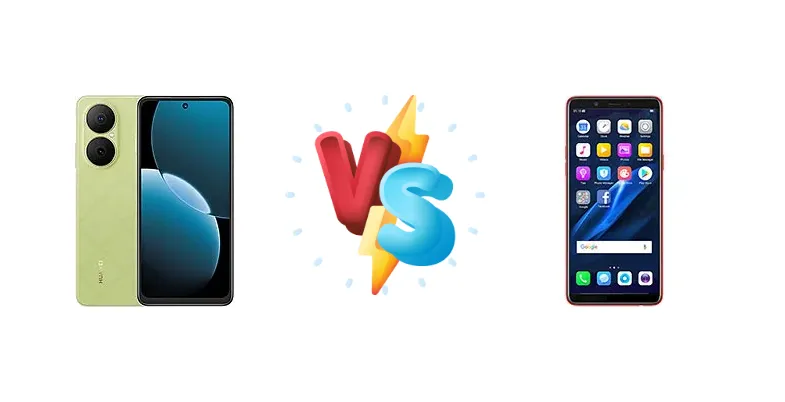
The Huawei Enjoy 80 and Oppo F7 Youth represent compelling options in the crowded entry-level smartphone market. While both aim to deliver a solid experience without breaking the bank, they take distinctly different approaches. The Enjoy 80 prioritizes rapid charging, while the F7 Youth focuses on a more established, if slightly older, chipset. This comparison will dissect these differences to determine which device best suits your needs.
🏆 Quick Verdict
For users prioritizing quick top-ups and occasional reverse charging, the Huawei Enjoy 80 is the clear winner. Its 40W charging significantly outperforms the Oppo F7 Youth’s likely slower charging (spec not provided). However, the F7 Youth’s Helio P60 offers a known and reasonably efficient processing experience.
| Network |
|---|
| 2G bands | GSM 850 / 900 / 1800 / 1900 | GSM 850 / 900 / 1800 / 1900 |
| 3G bands | HSDPA 850 / 900 / 2100 | HSDPA 800 / 850 / 900 / 1700(AWS) / 1900 / 2100 - Taiwan |
| 4G bands | LTE | 1, 2, 3, 4, 5, 7, 8, 18, 19, 20, 26, 28, 38, 39, 40, 41 - Taiwan |
| Speed | HSPA, LTE | HSPA 42.2/5.76 Mbps, LTE (2CA) Cat13 600/100 Mbps |
| Technology | GSM / HSPA / LTE | GSM / HSPA / LTE |
| | - | 1, 3, 5, 7, 8, 38, 40, 41 - Asia Pacific |
| Launch |
|---|
| Announced | 2025, April 22 | 2018, May. Released 2018, June |
| Status | Available. Released 2025, April 26 | Discontinued |
| Body |
|---|
| Dimensions | 166 x 76.6 x 8.3 mm (6.54 x 3.02 x 0.33 in) | 156.5 x 75.2 x 7.8 mm (6.16 x 2.96 x 0.31 in) |
| SIM | Nano-SIM + Nano-SIM | Nano-SIM + Nano-SIM |
| Weight | 203 g or 206 g (7.16 oz) | 155 g (5.47 oz) |
| Display |
|---|
| Protection | Aluminosilicate glass | - |
| Resolution | 720 x 1604 pixels, 20:9 ratio (~264 ppi density) | 1080 x 2160 pixels, 18:9 ratio (~402 ppi density) |
| Size | 6.67 inches, 107.2 cm2 (~84.3% screen-to-body ratio) | 6.0 inches, 92.9 cm2 (~78.9% screen-to-body ratio) |
| Type | IPS LCD, 90Hz, 1000 nits (peak) | IPS LCD |
| Platform |
|---|
| CPU | - | Octa-core (4x2.0 GHz Cortex-A73 & 4x2.0 GHz Cortex-A53) |
| Chipset | - | Mediatek MT6771 Helio P60 (12 nm) |
| GPU | - | Mali-G72 MP3 |
| OS | HarmonyOS 4.0 | Android 8.1 (Oreo), ColorOS 5.2 |
| Memory |
|---|
| Card slot | No | microSDXC (dedicated slot) |
| Internal | 128GB 8GB RAM, 256GB 8GB RAM, 512GB 8GB RAM | 64GB 4GB RAM |
| | - | eMMC 5.1 |
| Main Camera |
|---|
| Features | LED flash, HDR, panorama | LED flash, HDR, panorama |
| Single | 50 MP, f/1.8, (wide), PDAF | 13 MP, f/2.2, PDAF |
| Video | 1080p@30fps | 1080p@30fps |
| Selfie camera |
|---|
| Single | 8 MP, f/2.0, (wide) | 8 MP, f/2.2 |
| Video | 1080p@30fps | - |
| Sound |
|---|
| 3.5mm jack | - | Yes |
| 35mm jack | No | Yes |
| Loudspeaker | Yes | Yes |
| Comms |
|---|
| Bluetooth | 5.1, A2DP, LE | 4.2, A2DP, LE |
| Infrared port | Yes | - |
| NFC | No | No |
| Positioning | GPS, GLONASS, GALILEO, BDS, QZSS | GPS |
| Radio | No | FM radio |
| USB | USB Type-C 2.0, OTG | microUSB 2.0, OTG |
| WLAN | Wi-Fi 802.11 a/b/g/n/ac, dual-band | Wi-Fi 802.11 b/g/n, Wi-Fi Direct |
| Features |
|---|
| Sensors | Fingerprint (side-mounted), accelerometer, proximity, compass | Accelerometer, proximity, compass |
| Battery |
|---|
| Charging | 40W wired
5W reverse wired | - |
| Type | Si/C Li-Ion 6620 mAh | Li-Ion 3410 mAh, non-removable |
| Misc |
|---|
| Colors | Black, White, Blue, Green | Solar Red, Diamond Black |
| Models | JUY-AL00 | - |
| Price | About 140 EUR | About 250 EUR |
Huawei Enjoy 80
- 40W Fast Charging for quick power-ups
- 5W Reverse Wired Charging for accessory top-ups
- Potentially better thermal management due to charging-focused design
- Chipset details are unknown, potentially impacting performance
- Display specifications are missing, potentially indicating a basic panel
Oppo F7 Youth
- Mediatek Helio P60 offers a known and reliable performance profile
- Octa-core CPU provides balanced performance for multitasking
- 12nm process node offers good power efficiency
- Charging speed is unspecified and likely slower than the Enjoy 80
- Lacks reverse charging capabilities
Display Comparison
Display specifications are absent for both devices, making a direct comparison impossible. However, given their market positioning, it’s reasonable to assume both utilize LCD panels. The absence of information regarding refresh rates suggests standard 60Hz panels. Color accuracy and peak brightness will likely be similar, leaning towards adequate rather than exceptional, given the price bracket. Bezels are also likely to be noticeable on both devices.
Camera Comparison
Camera details are missing for both devices. Assuming typical configurations for this price range, both likely feature a primary camera alongside depth or macro sensors. The quality of the image processing will be a key differentiator. Oppo’s image processing is generally known for producing vibrant, social media-ready images, while Huawei often aims for more natural color reproduction. Without sensor size or aperture information, it’s difficult to assess low-light performance. The inclusion of a 2MP macro camera on either device is unlikely to significantly enhance the photography experience.
Performance
The Oppo F7 Youth’s Mediatek Helio P60 (12nm) chipset is the performance centerpiece. Its octa-core configuration, split between four 2.0 GHz Cortex-A73 and four 2.0 GHz Cortex-A53 cores, provides a balanced approach to performance. The Cortex-A73 cores handle demanding tasks, while the A53 cores manage background processes efficiently. The Huawei Enjoy 80 lacks chipset information, making a direct performance comparison difficult. However, given its focus on charging, it’s likely equipped with a more power-efficient, but potentially less powerful, chipset to manage thermal output during fast charging. The Helio P60’s 12nm process node offers a good balance between performance and power efficiency, potentially leading to longer sustained performance compared to a less efficient chipset in the Enjoy 80.
Battery Life
The Huawei Enjoy 80’s 40W wired charging is its standout feature. This allows for significantly faster charging times compared to the Oppo F7 Youth, which lacks specified charging speed. While battery capacity isn’t provided for either device, the Enjoy 80’s rapid charging mitigates the impact of a potentially smaller battery. Furthermore, the Enjoy 80 includes 5W reverse wired charging, enabling it to charge accessories like earbuds or smartwatches – a feature absent on the F7 Youth. This makes the Enjoy 80 a more versatile power solution.
Buying Guide
Buy the Huawei Enjoy 80 if you frequently find yourself needing to quickly replenish your battery and appreciate the convenience of reverse wired charging for accessories. Buy the Oppo F7 Youth if you value a proven chipset architecture – the Helio P60 – and prioritize sustained performance over the absolute fastest charging speeds. The F7 Youth is a better choice for users who engage in moderate multitasking and light gaming.
Frequently Asked Questions
❓ Is the Helio P60 in the Oppo F7 Youth still capable of running modern apps and games?
The Helio P60 is a capable chipset for everyday tasks and light to moderate gaming. While it won't deliver flagship-level performance, it can handle most popular apps and games at reasonable settings. Expect some frame drops in graphically demanding titles, but it remains a viable option for casual gamers.
❓ How long does it take to fully charge the Huawei Enjoy 80 with the 40W charger?
While a precise 0-100% charging time isn't available, 40W charging typically allows for a full charge in under an hour, potentially around 45-60 minutes. This is a significant advantage over standard charging speeds and provides a quick power boost when needed.
❓ Does the Huawei Enjoy 80's reverse charging work with all devices?
The Huawei Enjoy 80's 5W reverse wired charging is compatible with most devices that charge via USB-C or Micro-USB, using the appropriate adapter. However, charging speeds will be limited to 5W, so it's best suited for smaller accessories like earbuds or smartwatches, rather than fully charging a smartphone.