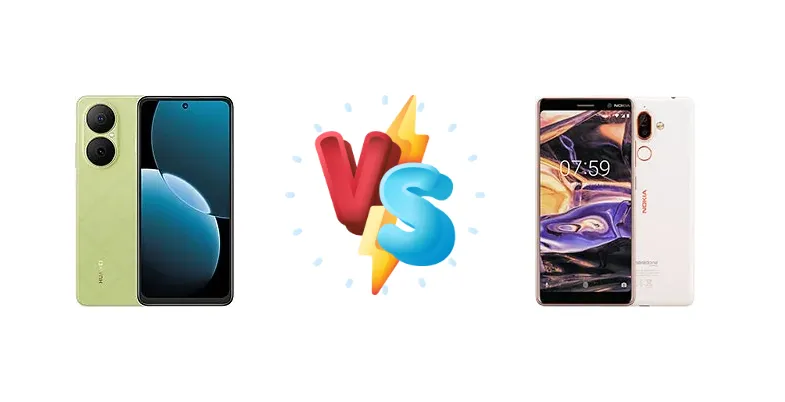
The Huawei Enjoy 80 and Nokia 7 Plus represent different approaches to the mid-range smartphone market. The Enjoy 80 prioritizes rapid charging, while the Nokia 7 Plus focuses on sustained battery life and a balanced feature set. This comparison dissects their key specifications to determine which device best suits your needs.
🏆 Quick Verdict
For users prioritizing quick top-ups, the Huawei Enjoy 80’s 40W charging is a clear advantage. However, the Nokia 7 Plus, with its 87-hour endurance rating, is the better choice for those who value all-day battery life and a more refined, albeit older, chipset.
| Network |
|---|
| 2G bands | GSM 850 / 900 / 1800 / 1900 | GSM 850 / 900 / 1800 / 1900 |
| 3G bands | HSDPA 850 / 900 / 2100 | HSDPA 850 / 900 / 1900 / 2100 |
| 4G bands | LTE | 1, 3, 5, 7, 8, 20, 28, 38, 40, 41 - Global |
| Speed | HSPA, LTE | HSPA 42.2/5.76 Mbps, LTE (2CA) Cat6 300/50 Mbps |
| Technology | GSM / HSPA / LTE | GSM / CDMA / HSPA / EVDO / LTE |
| | - | 1, 3, 4, 5, 7, 8, 20, 28, 34, 38, 39, 40, 41 - China |
| Launch |
|---|
| Announced | 2025, April 22 | 2018, February 25. Released 2018, April 30 |
| Status | Available. Released 2025, April 26 | Discontinued |
| Body |
|---|
| Build | - | Glass front (Gorilla Glass 3), aluminum back, aluminum frame (6000 series) |
| Dimensions | 166 x 76.6 x 8.3 mm (6.54 x 3.02 x 0.33 in) | 158.4 x 75.6 x 8 mm (6.24 x 2.98 x 0.31 in) |
| SIM | Nano-SIM + Nano-SIM | Nano-SIM + Nano-SIM |
| Weight | 203 g or 206 g (7.16 oz) | 183 g (6.46 oz) |
| Display |
|---|
| Protection | Aluminosilicate glass | Corning Gorilla Glass 3 |
| Resolution | 720 x 1604 pixels, 20:9 ratio (~264 ppi density) | 1080 x 2160 pixels, 18:9 ratio (~403 ppi density) |
| Size | 6.67 inches, 107.2 cm2 (~84.3% screen-to-body ratio) | 6.0 inches, 92.4 cm2 (~77.2% screen-to-body ratio) |
| Type | IPS LCD, 90Hz, 1000 nits (peak) | IPS LCD |
| Platform |
|---|
| CPU | - | Octa-core (4x2.2 GHz Kryo 260 Gold & 4x1.8 GHz Kryo 260 Silver) |
| Chipset | - | Qualcomm SDM660 Snapdragon 660 (14 nm) |
| GPU | - | Adreno 512 |
| OS | HarmonyOS 4.0 | Android 8.1 (Oreo), upgradable to Android 10, Android One |
| Memory |
|---|
| Card slot | No | microSDXC (uses shared SIM slot) |
| Internal | 128GB 8GB RAM, 256GB 8GB RAM, 512GB 8GB RAM | 64GB 4GB RAM, 64GB 6GB RAM |
| | - | eMMC 5.1 |
| Main Camera |
|---|
| Dual | - | 12 MP, f/1.8, 25mm (wide), 1/2.55", 1.4µm, dual pixel PDAF
13 MP, f/2.6, (telephoto), 1/3.4", 1.0µm, AF, 2x optical zoom |
| Features | LED flash, HDR, panorama | Zeiss optics, dual-LED dual-tone flash, panorama, HDR |
| Single | 50 MP, f/1.8, (wide), PDAF | - |
| Video | 1080p@30fps | 4K@30fps, 1080p@30fps (gyro-EIS) |
| Selfie camera |
|---|
| Features | - | Zeiss optics |
| Single | 8 MP, f/2.0, (wide) | 16 MP, f/2.0, 1/3.06", 1.0µm |
| Video | 1080p@30fps | 1080p@30fps |
| Sound |
|---|
| 3.5mm jack | - | Yes |
| 35mm jack | No | Yes |
| Loudspeaker | Yes | Yes |
| Comms |
|---|
| Bluetooth | 5.1, A2DP, LE | 5.0, A2DP, LE |
| Infrared port | Yes | - |
| NFC | No | Yes |
| Positioning | GPS, GLONASS, GALILEO, BDS, QZSS | GPS, GLONASS, BDS |
| Radio | No | No |
| USB | USB Type-C 2.0, OTG | USB Type-C 2.0, OTG |
| WLAN | Wi-Fi 802.11 a/b/g/n/ac, dual-band | Wi-Fi 802.11 a/b/g/n/ac, dual-band, Wi-Fi Direct |
| Features |
|---|
| Sensors | Fingerprint (side-mounted), accelerometer, proximity, compass | Fingerprint (rear-mounted), accelerometer, gyro, proximity, compass |
| Battery |
|---|
| Charging | 40W wired
5W reverse wired | 18W wired |
| Music play | - | Up to 126 h |
| Stand-by | - | Up to 723 h (3G) |
| Talk time | - | Up to 19 h (3G) |
| Type | Si/C Li-Ion 6620 mAh | Li-Ion 3800 mAh, non-removable |
| Misc |
|---|
| Colors | Black, White, Blue, Green | Black/Copper, White/Copper |
| Models | JUY-AL00 | TA-1041, TA-1062, TA-1046 |
| Price | About 140 EUR | About 490 EUR |
| SAR EU | - | 0.36 W/kg (head) 1.78 W/kg (body) |
| Tests |
|---|
| Audio quality | - |
Noise -38.8dB / Crosstalk -95.9dB |
| Battery life | - |
Endurance rating 87h
|
| Camera | - |
Photo / Video |
| Display | - |
Contrast ratio: 1701:1 (nominal), 3.479 (sunlight) |
| Loudspeaker | - |
Voice 67dB / Noise 71dB / Ring 79dB
|
| Performance | - |
AnTuTu: 140820 (v7)
GeekBench: 5893 (v4.4)
GFXBench: 8.6fps (ES 3.1 onscreen) |
Huawei Enjoy 80
- 40W fast charging for quick top-ups
- 5W reverse wired charging for accessories
- Potentially more affordable price point
- Chipset performance likely lower than Snapdragon 660
- Battery life likely shorter than Nokia 7 Plus
Nokia 7 plus
- Excellent 87-hour battery endurance
- Qualcomm Snapdragon 660 provides a smooth experience
- High display contrast ratio for good visibility
- Slower 18W charging
- Older chipset may not support the latest software features
Display Comparison
Both devices share a similar nominal contrast ratio of 1701:1, but crucially, both also achieve a sunlight contrast ratio of 3.479:1. This indicates excellent visibility outdoors, a significant benefit for users who spend time outside. However, the context data lacks specifics on panel technology (IPS, AMOLED) or resolution, making a detailed comparison of color accuracy and sharpness impossible. We can infer, given the market positioning, that both likely utilize IPS LCD panels.
Camera Comparison
Both phones feature photo and video capabilities, but the provided data lacks specifics on sensor size, aperture, or image processing algorithms. Without this information, a meaningful camera comparison is impossible. It’s reasonable to assume the Nokia 7 Plus, given its overall focus on a well-rounded experience, may offer more consistent image quality and potentially better low-light performance. The lack of detail suggests neither phone is a standout performer in the camera department.
Performance
The Nokia 7 Plus is powered by the Qualcomm Snapdragon 660, a 14nm chipset featuring an octa-core CPU configuration (4x2.2 GHz Kryo 260 Gold & 4x1.8 GHz Kryo 260 Silver). This provides a balanced performance profile suitable for everyday tasks and moderate gaming. The Enjoy 80’s chipset is not specified, but given its positioning, it likely utilizes a less powerful, more energy-efficient processor. The Snapdragon 660’s architecture, while older, is well-optimized, offering a smoother experience than many newer, less refined chipsets in this price bracket.
Battery Life
The Nokia 7 Plus boasts an impressive endurance rating of 87 hours, indicating exceptional battery life. This is a significant advantage for users who prioritize longevity. The Huawei Enjoy 80 compensates with 40W wired charging, allowing for significantly faster top-ups compared to the Nokia 7 Plus’s 18W charging. While the Enjoy 80’s battery capacity is unknown, the faster charging mitigates the impact of a potentially smaller battery. A user who can spare 30 minutes will gain significantly more charge on the Enjoy 80 than on the Nokia 7 Plus.
Buying Guide
Buy the Huawei Enjoy 80 if you frequently find yourself needing to quickly recharge your phone throughout the day and value the convenience of fast charging. Buy the Nokia 7 Plus if you prioritize long-lasting battery life, a consistently smooth experience thanks to the Snapdragon 660, and a display with excellent contrast, even in direct sunlight. The Nokia 7 Plus is ideal for users who don't want to worry about daily charging.
Frequently Asked Questions
❓ How much faster is the Huawei Enjoy 80's 40W charging compared to the Nokia 7 Plus's 18W charging?
While exact charging times depend on battery capacity, 40W charging is more than double the speed of 18W charging. This translates to significantly less time plugged into the wall, allowing you to quickly replenish the battery when needed. Expect a much faster 0-50% charge on the Enjoy 80.
❓ Is the Snapdragon 660 in the Nokia 7 Plus still a capable processor in 2024?
Yes, the Snapdragon 660 remains a surprisingly capable processor for everyday tasks like browsing, social media, and streaming. While it won't match the performance of flagship chipsets, its optimized architecture and efficient power consumption provide a smooth and reliable experience for most users.
❓ Does the Nokia 7 Plus still receive software updates?
Software update support for the Nokia 7 Plus is limited due to its age. While it originally launched with Android 8.1, it has received updates to Android 9 and 10. Further updates are unlikely, meaning it may lack the latest security patches and features.