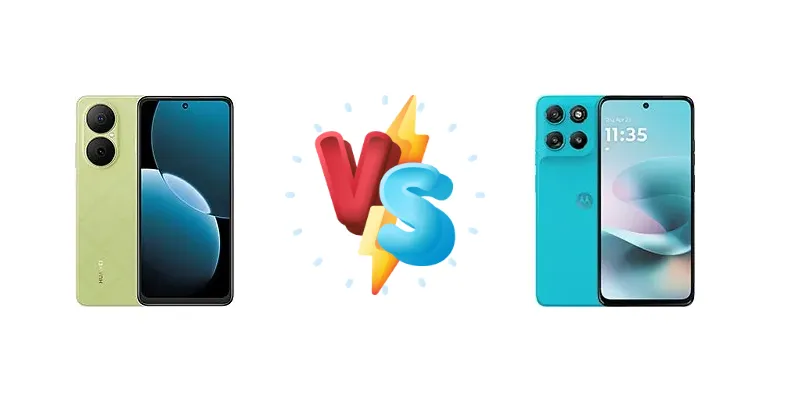
The Huawei Enjoy 80 and Motorola Moto G67 Power represent compelling options in the increasingly competitive budget and mid-range smartphone market. While both aim to deliver a solid user experience, they take distinctly different approaches: Huawei prioritizes rapid charging, while Motorola focuses on efficient processing with the Snapdragon 7s Gen 2. This comparison dissects these choices to determine which device best suits your needs.
🏆 Quick Verdict
For the average user prioritizing sustained performance and future-proofing, the Motorola Moto G67 Power emerges as the stronger choice. The Snapdragon 7s Gen 2’s 4nm process offers superior efficiency and processing power compared to the Enjoy 80, despite the latter’s faster 40W charging. However, users who frequently need extremely quick top-ups may find the Enjoy 80’s charging speed more appealing.
| Network |
|---|
| 2G bands | GSM 850 / 900 / 1800 / 1900 | GSM 850 / 900 / 1800 / 1900 |
| 3G bands | HSDPA 850 / 900 / 2100 | HSDPA 850 / 900 / 1900 / 2100 |
| 4G bands | LTE | 1, 2, 3, 5, 8, 28, 38, 40, 41, 42 |
| 5G bands | - | 1, 2, 3, 5, 8, 28, 38, 40, 41, 77, 78 SA/NSA/Sub6 |
| Speed | HSPA, LTE | HSPA, LTE, 5G |
| Technology | GSM / HSPA / LTE | GSM / HSPA / LTE / 5G |
| Launch |
|---|
| Announced | 2025, April 22 | 2025, November 05 |
| Status | Available. Released 2025, April 26 | Available. Released 2025, November 12 |
| Body |
|---|
| Build | - | Glass front (Gorilla Glass 7i), plastic frame, silicone polymer (eco leather) back |
| Dimensions | 166 x 76.6 x 8.3 mm (6.54 x 3.02 x 0.33 in) | 166.2 x 76.5 x 8.6 mm (6.54 x 3.01 x 0.34 in) |
| SIM | Nano-SIM + Nano-SIM | Nano-SIM + Nano-SIM |
| Weight | 203 g or 206 g (7.16 oz) | 210 g (7.41 oz) |
| Display |
|---|
| Protection | Aluminosilicate glass | Corning Gorilla Glass 7i |
| Resolution | 720 x 1604 pixels, 20:9 ratio (~264 ppi density) | 1080 x 2400 pixels, 20:9 ratio (~391 ppi density) |
| Size | 6.67 inches, 107.2 cm2 (~84.3% screen-to-body ratio) | 6.7 inches, 109.5 cm2 (~86.1% screen-to-body ratio) |
| Type | IPS LCD, 90Hz, 1000 nits (peak) | IPS LCD, 120Hz, HDR10+, 1050 nits (peak) |
| Platform |
|---|
| CPU | - | Octa-core (4x2.40 GHz Cortex-A78 & 4x1.95 GHz Cortex-A55) |
| Chipset | - | Qualcomm SM7435-AB Snapdragon 7s Gen 2 (4 nm) |
| GPU | - | Adreno 710 |
| OS | HarmonyOS 4.0 | Android 15, planned upgrade to Android 16 |
| Memory |
|---|
| Card slot | No | No |
| Internal | 128GB 8GB RAM, 256GB 8GB RAM, 512GB 8GB RAM | 128GB 8GB RAM, 256GB 8GB RAM |
| Main Camera |
|---|
| Dual | - | 50 MP, f/1.8 (wide), 1/1.95", 0.8µm, PDAF
8 MP, f/2.2, 118˚ (ultrawide), 1/4.0", 1.12µm |
| Features | LED flash, HDR, panorama | Dual-LED flash, HDR, panorama |
| Single | 50 MP, f/1.8, (wide), PDAF | - |
| Video | 1080p@30fps | 4K@30fps, 1080p@30fps |
| Selfie camera |
|---|
| Features | - | HDR |
| Single | 8 MP, f/2.0, (wide) | 32 MP, f/2.2, (wide), 0.7µm |
| Video | 1080p@30fps | 4K@30fps, 1080p@30/60fps |
| Sound |
|---|
| 35mm jack | No | Yes |
| Loudspeaker | Yes | Yes, with stereo speakers (with Dolby Atmos) |
| Comms |
|---|
| Bluetooth | 5.1, A2DP, LE | 5.1, A2DP, LE |
| Infrared port | Yes | - |
| NFC | No | Yes (market/region dependent) |
| Positioning | GPS, GLONASS, GALILEO, BDS, QZSS | GPS, GALILEO, GLONASS, BDS, QZSS |
| Radio | No | Unspecified |
| USB | USB Type-C 2.0, OTG | USB Type-C 2.0, OTG |
| WLAN | Wi-Fi 802.11 a/b/g/n/ac, dual-band | Wi-Fi 802.11 a/b/g/n/ac, dual-band |
| Features |
|---|
| Sensors | Fingerprint (side-mounted), accelerometer, proximity, compass | Fingerprint (side-mounted), accelerometer, gyro, proximity, compass |
| Battery |
|---|
| Charging | 40W wired
5W reverse wired | 30W wired |
| Type | Si/C Li-Ion 6620 mAh | Si/C Li-Ion 7000 mAh |
| Misc |
|---|
| Colors | Black, White, Blue, Green | Pantone: Cilantro, Parachute Purple, Blue Curacao |
| Models | JUY-AL00 | - |
| Price | About 140 EUR | ₹ 15,734 |
Huawei Enjoy 80
- 40W wired charging offers exceptionally fast top-up times.
- 5W reverse wired charging allows for emergency charging of other devices.
- Potentially lower price point (depending on market).
- Lack of chipset information raises concerns about long-term performance.
- Potentially less efficient processor leading to shorter battery life.
Motorola Moto G67 Power
- Snapdragon 7s Gen 2 (4nm) provides excellent performance and efficiency.
- Octa-core CPU delivers a balanced experience for gaming and multitasking.
- Likely to receive longer software support due to the newer chipset.
- Slower 30W charging compared to the Huawei Enjoy 80.
- May be slightly more expensive than the Huawei Enjoy 80.
Display Comparison
Display specifications are absent from the provided data, making a direct comparison impossible. However, given the market positioning of both devices, it’s reasonable to assume both utilize LCD panels. The absence of details like refresh rate or resolution suggests neither phone is targeting display quality as a key selling point. Users seeking vibrant colors and high refresh rates should consider alternatives.
Camera Comparison
Without camera specifications for the Huawei Enjoy 80, a detailed comparison is limited. The Moto G67 Power’s camera performance will likely hinge on its main sensor and image processing algorithms. While the absence of details prevents a definitive assessment, Motorola’s image processing tends towards natural color reproduction, while Huawei often employs more aggressive sharpening and saturation. Users prioritizing accurate colors and dynamic range may prefer the Motorola, while those seeking instantly shareable, vibrant photos might lean towards Huawei (assuming a comparable sensor).
Performance
The Motorola Moto G67 Power’s Qualcomm Snapdragon 7s Gen 2 (4nm) represents a significant advantage over the Huawei Enjoy 80, which lacks chipset information. The 4nm fabrication process of the Snapdragon 7s Gen 2 translates to improved thermal efficiency and power consumption, meaning less throttling during demanding tasks like gaming and video editing. The octa-core configuration, with 4x2.40 GHz Cortex-A78 and 4x1.95 GHz Cortex-A55 cores, provides a balanced approach to performance, offering strong single-core speeds for responsiveness and multi-core capabilities for multitasking. The Enjoy 80, lacking this detailed chipset information, likely relies on a less efficient and potentially older architecture.
Battery Life
The Huawei Enjoy 80 boasts 40W wired charging, significantly faster than the Motorola Moto G67 Power’s 30W charging. This translates to quicker top-up times, potentially reducing downtime. However, charging speed isn’t everything. The Snapdragon 7s Gen 2’s 4nm process in the Moto G67 Power contributes to superior power efficiency, potentially offsetting the Enjoy 80’s faster charging with longer overall battery life. While the Enjoy 80 can rapidly add percentage points, the G67 Power may simply require less frequent charging.
Buying Guide
Buy the Huawei Enjoy 80 if you need the absolute fastest charging speeds and frequently find yourself needing to quickly replenish your battery throughout the day. Buy the Motorola Moto G67 Power if you prioritize long-term performance, efficient power consumption for extended battery life, and a more modern chipset architecture that will likely receive software updates for a longer period.
Frequently Asked Questions
❓ Will the Snapdragon 7s Gen 2 in the Moto G67 Power handle demanding games like PUBG Mobile smoothly?
Yes, the Snapdragon 7s Gen 2 is a capable chipset for gaming. Its Cortex-A78 cores provide strong single-core performance, crucial for many mobile games, and the Adreno GPU is well-suited for running PUBG Mobile at medium to high settings. The 4nm process also helps mitigate thermal throttling during extended gaming sessions.
❓ How long will it realistically take to fully charge the Huawei Enjoy 80 with the 40W charger?
While a precise figure requires testing, a 40W charger should be able to fully charge the Huawei Enjoy 80 from 0% to 100% in approximately 60-75 minutes, assuming a compatible charger and no background app activity. This is significantly faster than the Moto G67 Power’s 30W charging.
❓ Does the Motorola Moto G67 Power support 5G connectivity?
The provided specifications do not explicitly state 5G support. However, the Snapdragon 7s Gen 2 chipset *is* capable of supporting 5G, so it's likely the Moto G67 Power does, but this should be verified with the retailer or Motorola's official specifications.