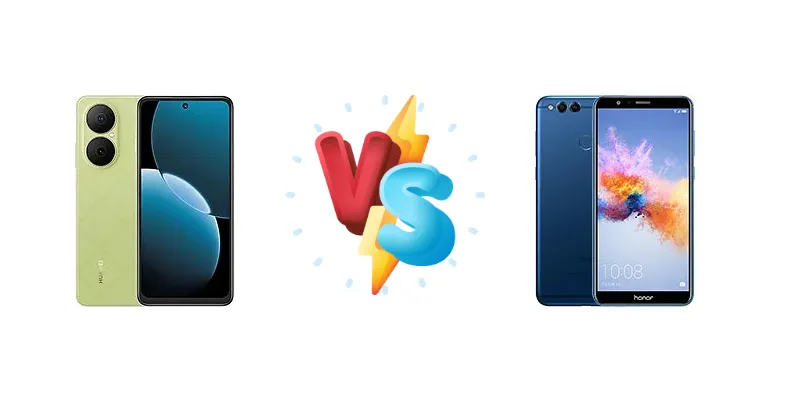
The Huawei Enjoy 80 and Honor 7X represent different priorities in the budget smartphone space. The Enjoy 80 focuses on rapid replenishment with its 40W charging, while the Honor 7X aims for longevity with a reported 77-hour endurance rating. This comparison dissects these core differences, alongside their other specifications, to determine which device best suits your needs.
🏆 Quick Verdict
For users prioritizing minimizing downtime, the Huawei Enjoy 80 is the clear winner thanks to its 40W charging. However, if consistent, multi-day battery life is paramount, the Honor 7X’s 77-hour endurance rating makes it the more practical choice, despite its slower charging capabilities.
| Network |
|---|
| 2G bands | GSM 850 / 900 / 1800 / 1900 | GSM 850 / 900 / 1800 / 1900 - SIM 1 & SIM 2 |
| 3G bands | HSDPA 850 / 900 / 2100 | HSDPA 850 / 900 / 1900 / 2100 |
| 4G bands | LTE | 1, 3, 5, 7, 8, 20, 40 |
| Speed | HSPA, LTE | HSPA 42.2/5.76 Mbps, LTE Cat4 150/50 Mbps |
| Technology | GSM / HSPA / LTE | GSM / HSPA / LTE |
| Launch |
|---|
| Announced | 2025, April 22 | 2017, December. Released 2017, December |
| Status | Available. Released 2025, April 26 | Discontinued |
| Body |
|---|
| Build | - | Glass front, aluminum back, aluminum frame |
| Dimensions | 166 x 76.6 x 8.3 mm (6.54 x 3.02 x 0.33 in) | 156.5 x 75.3 x 7.6 mm (6.16 x 2.96 x 0.30 in) |
| SIM | Nano-SIM + Nano-SIM | Nano-SIM + Nano-SIM |
| Weight | 203 g or 206 g (7.16 oz) | 165 g (5.82 oz) |
| Display |
|---|
| Protection | Aluminosilicate glass | - |
| Resolution | 720 x 1604 pixels, 20:9 ratio (~264 ppi density) | 1080 x 2160 pixels, 18:9 ratio (~407 ppi density) |
| Size | 6.67 inches, 107.2 cm2 (~84.3% screen-to-body ratio) | 5.93 inches, 90.7 cm2 (~77.0% screen-to-body ratio) |
| Type | IPS LCD, 90Hz, 1000 nits (peak) | IPS LCD |
| Platform |
|---|
| CPU | - | Octa-core (4x2.36 GHz Cortex-A53 & 4x1.7 GHz Cortex-A53) |
| Chipset | - | Kirin 659 (16 nm) |
| GPU | - | Mali-T830 MP2 |
| OS | HarmonyOS 4.0 | Android 7.0 (Nougat), upgradable to Android 8.0 (Oreo), EMUI 5.1 |
| Memory |
|---|
| Card slot | No | microSDXC (uses shared SIM slot) |
| Internal | 128GB 8GB RAM, 256GB 8GB RAM, 512GB 8GB RAM | 32GB 3GB RAM, 32GB 4GB RAM, 64GB 4GB RAM, 128GB 4GB RAM |
| | - | eMMC 5.1 |
| Main Camera |
|---|
| Dual | - | 16 MP, f/2.2, 26mm (wide), 1/2.9", 1.25µm, PDAF
Auxiliary lens |
| Features | LED flash, HDR, panorama | LED flash, HDR, panorama |
| Single | 50 MP, f/1.8, (wide), PDAF | - |
| Video | 1080p@30fps | 1080p@30fps |
| Selfie camera |
|---|
| Single | 8 MP, f/2.0, (wide) | 8 MP, f/2.0, 27mm (wide) |
| Video | 1080p@30fps | 1080p@30fps |
| Sound |
|---|
| 3.5mm jack | - | Yes |
| 35mm jack | No | Yes |
| Loudspeaker | Yes | Yes |
| Comms |
|---|
| Bluetooth | 5.1, A2DP, LE | 4.1, A2DP, EDR, LE |
| Infrared port | Yes | - |
| NFC | No | No |
| Positioning | GPS, GLONASS, GALILEO, BDS, QZSS | GPS, GLONASS |
| Radio | No | FM radio |
| USB | USB Type-C 2.0, OTG | microUSB 2.0 |
| WLAN | Wi-Fi 802.11 a/b/g/n/ac, dual-band | Wi-Fi 802.11 b/g/n, Wi-Fi Direct |
| Features |
|---|
| Sensors | Fingerprint (side-mounted), accelerometer, proximity, compass | Fingerprint (rear-mounted), accelerometer, proximity, compass |
| Battery |
|---|
| Charging | 40W wired
5W reverse wired | - |
| Stand-by | - | Up to 647 h (3G) |
| Talk time | - | Up to 21 h (3G) |
| Type | Si/C Li-Ion 6620 mAh | Li-Ion 3340 mAh, non-removable |
| Misc |
|---|
| Colors | Black, White, Blue, Green | Black, Blue, Gold, Red, Gray |
| Models | JUY-AL00 | BND-AL10, BND-TL10, BND-L21, BND-L22, BND-L24, BND-L31, BND-L2, BND-L34, BND-AL00 |
| Price | About 140 EUR | About 180 EUR |
| Tests |
|---|
| Audio quality | - |
Noise -89.5dB / Crosstalk -86.6dB |
| Battery life | - | Endurance rating 77h |
| Camera | - |
Photo / Video |
| Display | - |
Contrast ratio: 1941 (nominal), 2.734 (sunlight) |
| Loudspeaker | - |
Voice 66dB / Noise 71dB / Ring 85dB |
| Performance | - |
AnTuTu: 67636 (v7)
GeekBench: 3535 (v4.4)
GFXBench: 2.8fps (ES 3.1 onscreen) |
Huawei Enjoy 80
- 40W fast charging significantly reduces charging time.
- 5W reverse wired charging adds versatility.
- Likely a more modern design aesthetic (based on brand trends).
- Battery capacity is unknown, potentially limiting overall endurance.
- Performance details are lacking, making it difficult to assess its capabilities.
Honor 7X
- Exceptional 77-hour battery endurance for multi-day use.
- High display contrast ratio (2.734) for excellent sunlight visibility.
- Kirin 659 provides adequate performance for everyday tasks.
- Slower charging speeds compared to the Enjoy 80.
- Older chipset may struggle with demanding applications.
Display Comparison
The Honor 7X boasts a display with a contrast ratio of 1941 (nominal) and a significantly improved 2.734 under direct sunlight, suggesting superior outdoor visibility. While the Enjoy 80’s display specifications are absent, the Honor 7X’s contrast ratio indicates a panel optimized for readability in challenging lighting conditions. This is a key advantage for users who spend considerable time outdoors or in brightly lit environments.
Camera Comparison
Both devices feature photo and video capabilities, but detailed camera specifications are limited. Without sensor size or aperture information, a direct comparison is difficult. The absence of details suggests neither phone is positioned as a camera-centric device. The focus is likely on providing functional, rather than exceptional, imaging capabilities. It's safe to assume both will perform adequately in good lighting conditions, but struggle in low-light scenarios.
Performance
The Honor 7X is powered by the Kirin 659 (16nm), an octa-core processor featuring a combination of Cortex-A53 cores clocked at 2.36 GHz and 1.7 GHz. This chipset, while not a powerhouse, provides adequate performance for everyday tasks and light multitasking. The Enjoy 80’s chipset is not specified, but given its positioning, it likely targets a similar performance tier. The 16nm process node of the Kirin 659 suggests moderate power efficiency, but it will likely exhibit thermal throttling under sustained heavy loads.
Battery Life
The Honor 7X’s standout feature is its impressive 77-hour endurance rating, indicating exceptional battery life for its class. The Huawei Enjoy 80 counters with 40W wired charging, a significantly faster charging speed than typically found in this price range. This allows for rapid replenishment, potentially mitigating the impact of a smaller battery capacity (which is not specified). The Enjoy 80 also offers 5W reverse wired charging, enabling it to charge other devices, a feature absent in the Honor 7X.
Buying Guide
Buy the Huawei Enjoy 80 if you frequently find yourself needing to top up your phone throughout the day and value the convenience of extremely fast charging. Buy the Honor 7X if you prioritize battery life above all else, often go extended periods without access to a charger, and appreciate a phone that can reliably last through multiple days of moderate use. The Honor 7X is also a better fit for users who value display contrast in bright sunlight.
Frequently Asked Questions
❓ How long does it take to fully charge the Huawei Enjoy 80 with the 40W charger?
While a precise figure isn't available, 40W charging suggests a full charge from 0-100% could be achieved in approximately 60-90 minutes, significantly faster than the Honor 7X. However, this depends on the battery capacity, which remains unspecified.
❓ Is the Honor 7X's 77-hour endurance rating realistic with typical usage?
The 77-hour rating is based on Honor's testing methodology, which likely involves a mix of standby and light usage. Real-world endurance will vary depending on screen brightness, app usage, and network conditions. However, it suggests the phone can comfortably last through two full days of moderate use.
❓ Can the Huawei Enjoy 80 charge other devices wirelessly?
No, the Huawei Enjoy 80 supports 5W *wired* reverse charging, meaning you can use it to charge other devices via a USB cable, but it does not support wireless charging.
❓ Will the Kirin 659 in the Honor 7X struggle with modern mobile games?
The Kirin 659 can handle less demanding mobile games, but may experience frame rate drops or require reduced graphics settings in more graphically intensive titles. It's not designed for high-end gaming.