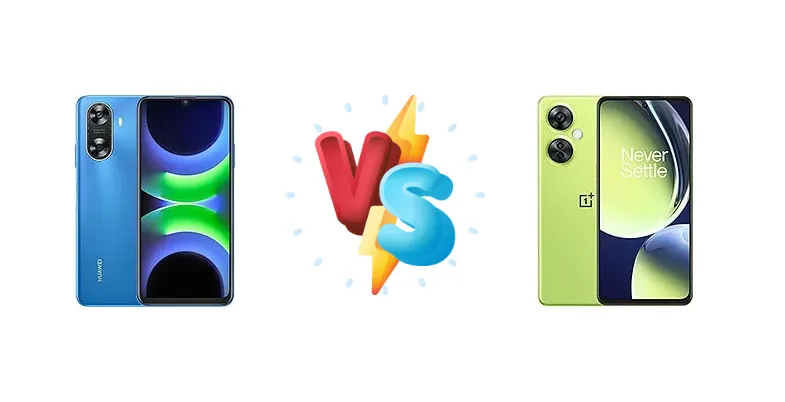
The sub-$250 smartphone market is fiercely competitive. The Huawei Enjoy 70z and OnePlus Nord CE 3 Lite both aim to deliver 5G connectivity and essential features at an accessible price point. However, they take drastically different approaches to achieving this, with Huawei relying on its in-house Kirin chipset and OnePlus leveraging Qualcomm's Snapdragon series. This comparison dissects the key differences to help you choose the right device.
🏆 Quick Verdict
For most users, the OnePlus Nord CE 3 Lite emerges as the stronger choice. Its Snapdragon 695, built on a more efficient 6nm process, offers a noticeable performance advantage and significantly faster 67W charging. While the Enjoy 70z is a capable device, it's held back by its older Kirin 710A and slower charging speeds.
| Network |
|---|
| 2G bands | GSM 850 / 900 / 1800 / 1900 | GSM 850 / 900 / 1800 / 1900 |
| 3G bands | HSDPA 850 / 900 / 2100 | HSDPA 800 / 850 / 900 / 1700(AWS) / 1900 / 2100 - International |
| 4G bands | LTE | 1, 2, 3, 4, 5, 7, 8, 12, 13, 17, 18, 19, 20, 26, 28, 32, 38, 39, 40, 41, 66 - International |
| 5G bands | - | 1, 3, 5, 7, 8, 20, 28, 38, 40, 41, 66, 77, 78 SA/NSA - International |
| Speed | HSPA, LTE | HSPA, LTE, 5G |
| Technology | GSM / HSPA / LTE | GSM / HSPA / LTE / 5G |
| | - | 1, 3, 5, 8, 28, 40, 41, 77, 78 SA/NSA - India |
| Launch |
|---|
| Announced | 2024, February 22 | 2023, April 04 |
| Status | Available. Released 2024, February 22 | Available. Released 2023, April 11 |
| Body |
|---|
| Build | - | Glass front, plastic frame, plastic back |
| Dimensions | 168.3 x 77.7 x 9 mm (6.63 x 3.06 x 0.35 in) | 165.5 x 76 x 8.3 mm (6.52 x 2.99 x 0.33 in) |
| SIM | Nano-SIM + Nano-SIM | Nano-SIM + Nano-SIM |
| Weight | 199 g (7.02 oz) | 195 g (6.88 oz) |
| Display |
|---|
| Protection | - | Corning Gorilla Glass |
| Resolution | 720 x 1600 pixels, 20:9 ratio (~260 ppi density) | 1080 x 2400 pixels, 20:9 ratio (~391 ppi density) |
| Size | 6.75 inches, 110.0 cm2 (~84.1% screen-to-body ratio) | 6.72 inches, 109.6 cm2 (~87.1% screen-to-body ratio) |
| Type | IPS LCD | IPS LCD, 120Hz, 550 nits (typ), 680 nits (peak) |
| Platform |
|---|
| CPU | Octa-core (4x2.0 GHz Cortex-A73 & 4x1.7 GHz Cortex-A53) | Octa-core (2x2.2 GHz Kryo 660 Gold & 6x1.7 GHz Kryo 660 Silver) |
| Chipset | Kirin 710A (14 nm) | Qualcomm SM6375 Snapdragon 695 5G (6 nm) |
| GPU | Mali-G51 MP4 | Adreno 619 |
| OS | HarmonyOS 4.0 | Android 13, OxygenOS 13.1 |
| Memory |
|---|
| Card slot | microSDXC | microSDXC (uses shared SIM slot) |
| Internal | 128GB 8GB RAM, 256GB 8GB RAM | 128GB 8GB RAM, 256GB 8GB RAM |
| | - | UFS 2.2 |
| Main Camera |
|---|
| Dual | 13 MP, f/1.8, (wide), AF
Auxiliary lens | - |
| Features | LED flash, HDR, panorama | LED flash, HDR, panorama |
| Triple | - | 108 MP, f/1.8, (wide), 1/1.67", 0.64µm, PDAF
2 MP (macro)
Auxiliary lens |
| Video | 1080p@30fps | 1080p@30fps |
| Selfie camera |
|---|
| Features | - | HDR, panorama |
| Single | 8 MP, f/2.0 | 16 MP, f/2.4, (wide), 1.0µm |
| Video | 1080p@30fps | 1080p@30fps |
| Sound |
|---|
| 3.5mm jack | - | Yes |
| 35mm jack | Yes | Yes |
| Loudspeaker | Yes | Yes, with stereo speakers |
| Comms |
|---|
| Bluetooth | 5.1, A2DP, LE | 5.1, A2DP, LE, aptX HD |
| NFC | No | Yes (market/region dependent) |
| Positioning | GPS, GLONASS, GALILEO, BDS, QZSS | GPS, GALILEO, GLONASS, BDS, QZSS |
| Radio | No | No |
| USB | USB Type-C 2.0 | USB Type-C 2.0, OTG |
| WLAN | Wi-Fi 802.11 b/g/n, Wi-Fi Direct | Wi-Fi 802.11 a/b/g/n/ac, dual-band |
| Features |
|---|
| Sensors | Fingerprint (side-mounted), accelerometer, proximity, compass | Fingerprint (side-mounted), accelerometer, gyro, proximity, compass |
| Battery |
|---|
| Charging | 22.5W wired | 67W wired, 80% in 30 min |
| Type | Li-Po 6000 mAh | Li-Po 5000 mAh |
| Misc |
|---|
| Colors | Black, Blue, White | Pastel Lime, Chromatic Gray |
| Models | MGA-AL40 | CPH2467, CPH2465 |
| Price | About 140 EUR | £ 169.98 / € 209.99 |
| SAR | - | 1.17 W/kg (head) 0.70 W/kg (body) |
| Tests |
|---|
| Performance | - |
AnTuTu: 412006 (v9)
GeekBench: 2052 (v5)
GFXBench: 17fps (ES 3.1 onscreen) |
Huawei Enjoy 70z
- Potentially streamlined software experience (depending on region)
- May offer a more affordable price point
- Reliable brand reputation
- Older Kirin 710A chipset limits performance
- Significantly slower 22.5W charging
- Less efficient 14nm process
OnePlus Nord CE 3 Lite
- Faster Snapdragon 695 chipset for improved performance
- Ultra-fast 67W charging (80% in 30 minutes)
- More efficient 6nm process for better battery life
- OxygenOS can be resource intensive
- May be slightly more expensive than the Enjoy 70z
Display Comparison
Neither device boasts a standout display. While specific panel details (like peak brightness or color gamut coverage) are unavailable, the focus here is on the underlying processors impacting the user experience *while* using the display. The Enjoy 70z's older chipset will likely struggle to maintain high refresh rates (if supported) during demanding tasks, leading to potential stuttering. The Nord CE 3 Lite’s Snapdragon 695, while not a flagship performer, offers a more consistent experience.
Camera Comparison
Without detailed camera specs beyond the core chipsets, a direct comparison is limited. However, the Snapdragon 695 typically supports more advanced image signal processors (ISPs) than the Kirin 710A, potentially leading to better image processing, especially in low-light conditions. The Enjoy 70z may rely more heavily on software algorithms to compensate for hardware limitations. The absence of OIS information for both devices suggests a reliance on software stabilization, which is less effective than optical stabilization.
Performance
The core difference lies in the chipsets. The OnePlus Nord CE 3 Lite’s Qualcomm Snapdragon 695 (6nm) is a clear upgrade over the Huawei Enjoy 70z’s Kirin 710A (14nm). The 6nm process node translates to improved power efficiency and thermal management, meaning the Snapdragon 695 can sustain peak performance for longer periods without throttling. The CPU architecture also favors the OnePlus device; its Kryo 660 Gold cores (2x2.2 GHz) offer a performance boost over the Kirin’s Cortex-A73 cores (4x2.0 GHz). This difference will be most noticeable in demanding applications like games and video editing.
Battery Life
While battery capacity isn't specified, the charging speeds tell a compelling story. The OnePlus Nord CE 3 Lite’s 67W wired charging is a game-changer, capable of reaching 80% charge in just 30 minutes. This is a significant advantage for users who need a quick power boost. The Huawei Enjoy 70z’s 22.5W charging is considerably slower, requiring a much longer time to fully charge the battery. This difference in charging speed directly impacts usability and convenience.
Buying Guide
Buy the Huawei Enjoy 70z if you prioritize a potentially more streamlined software experience (depending on region and HMS availability) and are comfortable with a slower charging speed. Buy the OnePlus Nord CE 3 Lite if you value faster performance for gaming and multitasking, and demand significantly quicker charging times – crucial for users on the go. The Nord CE 3 Lite is the better all-rounder for the average smartphone user.
Frequently Asked Questions
❓ Is the Snapdragon 695 in the OnePlus Nord CE 3 Lite powerful enough for demanding games like PUBG Mobile?
The Snapdragon 695 can handle PUBG Mobile at medium settings with a stable frame rate. While it won't deliver the highest graphical fidelity, it provides a playable experience. The Kirin 710A in the Enjoy 70z will likely struggle with consistent performance at higher settings, potentially leading to frame drops and lag.
❓ How does Huawei's HMS (Huawei Mobile Services) affect the software experience on the Enjoy 70z compared to the OnePlus Nord CE 3 Lite's OxygenOS?
Huawei's HMS is a replacement for Google Mobile Services, and the experience can vary depending on your region. While HMS has improved, it may lack some of the app compatibility and seamless integration found in OxygenOS. OxygenOS, based on Android, offers a wider range of readily available apps and services.
❓ Will the Huawei Enjoy 70z overheat during prolonged use, such as video recording or gaming?
The Kirin 710A, built on a 14nm process, is more prone to thermal throttling than the Snapdragon 695 (6nm). Prolonged use of demanding applications on the Enjoy 70z may result in noticeable performance slowdowns as the device attempts to manage heat.